
Phone App Remote Battery Disconnect
4.3Editor score
Smartphone app control
Real-time battery monitoring
Broad system voltage support
Low standby consumption
Compare the best anti theft kill switch remote battery disconnect options for voltage protection, current capacity, installation, and daily security.
An anti theft kill switch remote battery disconnect adds a controllable barrier between your vehicle battery and its electrical system. The best models provide dependable remote operation, safe voltage thresholds, useful status displays, and enough current capacity for the engines they support.
This guide compares ten remote battery disconnect switches on the factors that matter most: electrical rating, supported voltage, standby consumption, anti-theft operation, installation requirements, battery-terminal compatibility, and access to manual controls. It also highlights each product's distinct advantages and limitations.
The selections show how the category ranges from straightforward one-button kits to app-controlled and dual-remote systems. Ratings and specifications reflect the supplied listings, while availability and pricing can change, so confirm the latest details before making a final purchase decision.
4.3Editor score
4.8Editor score

4.1Editor score
The comparison below highlights the principal differences among ten remote battery disconnect switches, including supported electrical systems, continuous-current ratings, voltage monitoring, standby draw, and control methods. It is intended to make electrical matching and installation requirements easier to assess before purchase.


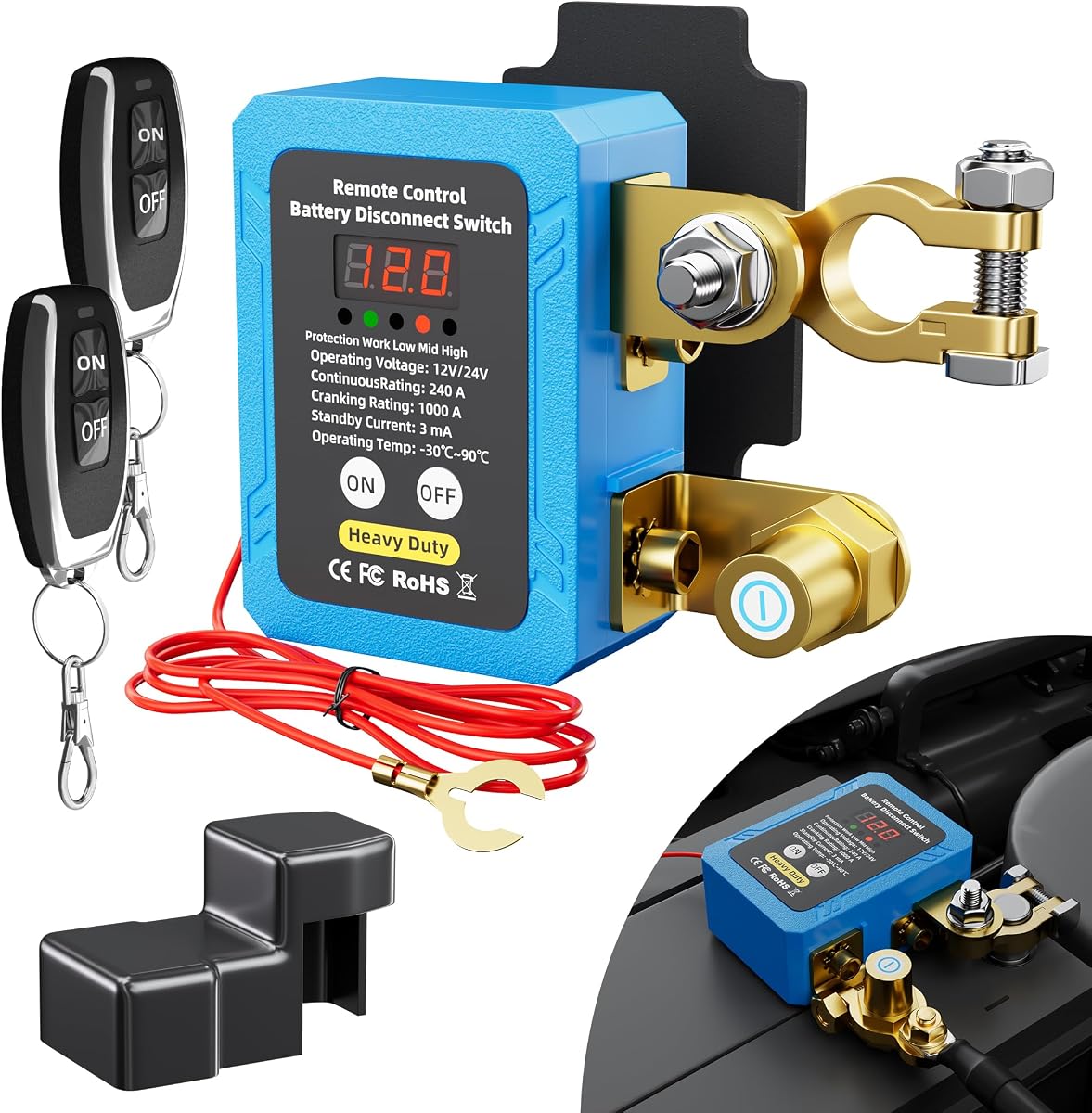
This 240A remote battery disconnect combines one of the strongest ratings in the category with an unusually clear feature set. Its 4.8 rating is the highest among the ten products, and the most immediately attractive element is the LED voltage display, which gives users an at-a-glance indication of battery status without opening the hood.
We may earn a commission when you buy through this link, at no additional cost to you.
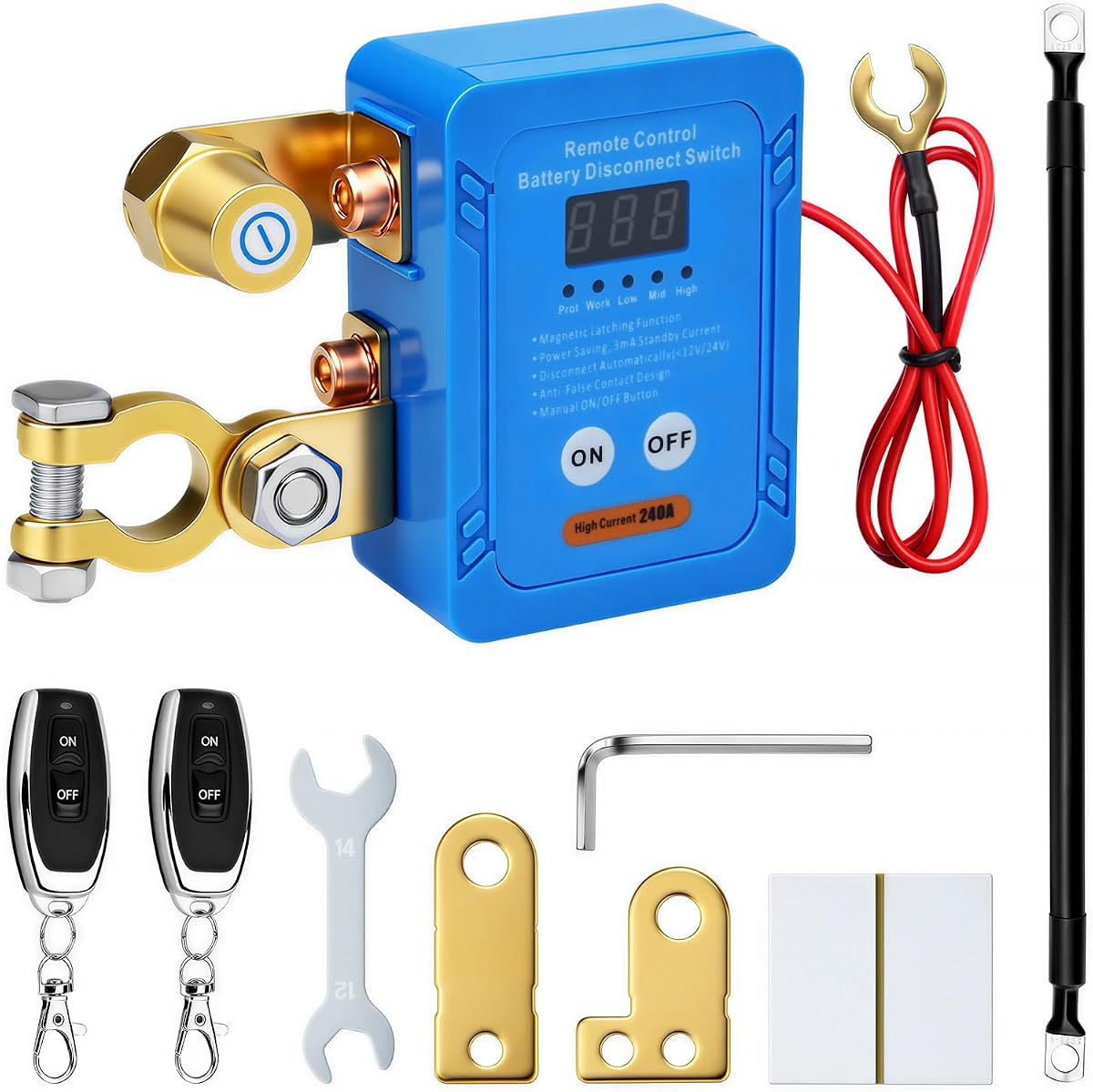
The switch supports both 12V and 24V systems and includes two remote controls. Its 240A continuous rating is suited to a broad selection of cars, trucks, recreational vehicles, boats, ATVs, and off-road vehicles, while the listed 500A one-second surge rating accommodates typical engine-starting inrush. The included 10AWG wiring, terminal clamps, mounting brackets, wrenches, and side-terminal adapters create a more complete package than many competing kits.
There are sensible qualifications. The manufacturer does not recommend it for heavy-duty construction equipment or engines whose starting current exceeds 600A. Although the weather-resistant housing and reinforced terminals suit outdoor use, a properly secured installation remains essential. The wide compatibility language should also be treated as guidance rather than a substitute for checking battery type, post size, starter requirements, and wiring constraints.
This is the strongest all-around recommendation for drivers who want remote disconnection, visible voltage monitoring, and a generous accessory kit in one package. It is particularly attractive for RV, boat, truck, and multi-vehicle owners who need more flexibility than a basic one-button switch. The higher rating and comprehensive hardware justify its place as the Editor's Choice.
The integrated LED display reports battery voltage with a stated accuracy of plus or minus 0.5V. That makes it easier to identify a discharged battery before attempting a start and to verify the system state after using the remote.
Side-terminal adapter brackets and heavy-duty copper clamps broaden the kit's practical usefulness. The included hardware also reduces the likelihood that a basic installation will require additional terminal adapters or mounting pieces.
We may earn a commission when you buy through this link, at no additional cost to you.
This remote battery disconnect offers a focused, uncomplicated way to cut a vehicle's battery power without reaching under the hood. Its 4.1 rating places it in the middle of the field, but the combination of a 250A rated current, 450A momentary current, pure copper wiring, and remote operation makes it a practical budget-focused option.
We may earn a commission when you buy through this link, at no additional cost to you.
The installation concept is refreshingly direct. A battery clip attaches to the negative pole, the red wire connects to the positive pole, and the upgraded layout is described as reducing the number of cables. The switch is listed for cars, trucks, RVs, travel trailers, campers, motorcycles, and other engine applications using 12V batteries.
The listing does not advertise a voltage display or detailed automatic cutoff behavior, so buyers should not assume those functions. It also warns against disconnecting the positive terminal because doing so may damage the battery or vehicle circuitry. Any installation still requires care with routing, terminal security, and the possibility that disconnecting power will reset or disable some vehicle electronics.
Choose this product when the priority is a simple remote kill function, useful current ratings, and uncomplicated installation rather than app control or detailed monitoring. It is a sensible entry point for routine anti-theft and storage use, provided the vehicle's electrical system and battery arrangement are checked before installation.
The described negative-terminal arrangement and reduced cable count make this design approachable for owners who understand basic 12V wiring. Clear routing and secure connections remain essential even when the installation process appears straightforward.
A 250A rated current and 450A momentary rating provide a useful capacity baseline for many cars, trucks, and smaller recreational vehicles. Owners should still compare those figures with their vehicle's starter and accessory requirements.
We may earn a commission when you buy through this link, at no additional cost to you.
This smart-voltage disconnect blends remote security with automatic battery protection. Its 4.2 rating and 250A continuous-current rating make it a balanced option for owners who want more electrical awareness than a basic switch without moving into app-based control.
We may earn a commission when you buy through this link, at no additional cost to you.
The switch monitors voltage and automatically cuts power after a delay when the reading falls below 11.8V. It also disables remote operation when voltage exceeds 13.6V, reducing the chance of an accidental shutdown while the vehicle is charging or operating. A magnetic latching relay helps keep standby consumption to a listed 5mA.
Remote range is given as 30–70 meters, which is less predictable than a fixed range but useful in a range of settings. The unit supports remote and manual operation and includes adjustable shims for standard and undersized battery posts. One limitation is that the product is explicitly designed around 12V systems, so it is less broadly compatible than the dual-voltage models in this list.
This is a good recommendation for a car, truck, RV, boat, or motorcycle that spends time parked while still needing a dependable remote cutoff. It is especially useful for owners who value automatic over-discharge protection and appreciate having a manual fallback when the remote cannot be used.
Automatic power interruption below 11.8V addresses a common long-term parking problem. The delayed response gives the user an opportunity to react before the battery is deeply depleted.
Wireless operation is convenient for routine security, while the manual override provides a practical fallback for maintenance or emergency situations. This dual-control arrangement makes the product easier to manage in different circumstances.
We may earn a commission when you buy through this link, at no additional cost to you.
This 250A smart remote switch distinguishes itself with a listed standby draw of only 0.7mA. That is particularly relevant for a device intended to solve parasitic drain, since the switch itself must consume very little power while the vehicle remains parked.
We may earn a commission when you buy through this link, at no additional cost to you.
Its smart mode supports 12V and 24V environments, with normal operation described across 11.4–14V and 23–27V. Remote control becomes unavailable at very low voltage, while manual operation remains available in the 6.5–11V range. Five green LEDs confirm switching actions, and an extendable spring-shaped antenna is intended to improve remote distance.
Fit is the principal caveat. The listing specifies tapered battery posts measuring 15–17mm and warns that all screws must be tightened securely. It also states that the switch should not be used on industrial equipment. As with any battery disconnect, the vehicle should be checked for electronics that may behave differently after power is removed.
This model suits owners seeking low standby consumption across a wide range of 12V or 24V applications, including cars, RVs, trailers, trucks, ATVs, and marine boats. It is particularly compelling when battery preservation is the main concern and a visible confirmation of each remote action is helpful.
A 0.7mA standby specification helps the switch remain useful during extended storage. The lower draw reduces the burden the installed device places on the battery compared with many conventional electronic accessories.
Bright green status indicators provide immediate confirmation after a remote command. That visibility reduces uncertainty when disconnecting a vehicle in a dim parking area or from a greater distance.
We may earn a commission when you buy through this link, at no additional cost to you.
This 140A switch prioritizes visibility and broad electrical compatibility. It carries a 4.3 rating, includes an LED voltage display, and is listed for 8V–30V batteries with capacities from 50Ah to 100Ah. That wide range makes it useful for an assortment of 12V and 24V mobile applications.
We may earn a commission when you buy through this link, at no additional cost to you.
The smart protection logic is more detailed than a basic on-off system. The listing says the switch automatically disconnects after 300 seconds when voltage is below 11.8V or between 17V and 24V. During charging ranges of 13.6–17V and 27.2–30V, the remote is unresponsive and operation moves to the manual buttons, helping prevent accidental shutdowns.
Its 140A rated current is lower than the 240A–250A offered by several competitors, so heavy starter loads may require closer scrutiny. It is also explicitly not compatible with lithium or valve-regulated batteries. Transfer shims and slotted tabs help accommodate flat or side-mounted arrangements where vertical clearance is limited.
This is a strong option for cars, boats, RVs, trailers, trucks, tractors, ATVs, UTVs, motorcycles, and similar equipment that fall within the stated capacity and battery-type limits. Buyers who value the voltage display and flexible mounting over maximum current capacity will find its feature set well balanced.
Support from 8V through 30V provides flexibility across many common mobile electrical systems. Capacity limits and battery chemistry exclusions still need to be checked against the vehicle being equipped.
Slotted connection tabs allow vertical height adjustment, while transfer shims support side mounting. These details are helpful in crowded engine bays where a flat installation is not practical.
We may earn a commission when you buy through this link, at no additional cost to you.
This remote switch is among the strongest performers in the roundup, with a 4.6 rating and a feature set aimed at owners who need both serious current capacity and low standby consumption. Its latching relay is rated for 240A continuous current and 1200A starting current.
We may earn a commission when you buy through this link, at no additional cost to you.
The LED voltage display adds practical visibility, while the listed 0.001A standby current makes the unit well suited to long-term parking. Smart protection automatically cuts power after 300 seconds below 11.8V. When voltage rises above 13.6V, remote control locks and manual operation becomes the only option, reducing the risk of an accidental cutoff while driving.
Negative-terminal installation is supported with transfer shims and a terminal shim cap for flat and side mounting. The listed compatibility covers cars, RVs, boats, trucks, ATVs, UTVs, and motorcycles, although the product is described primarily as a universal 12V solution. Its 1200A starting specification is impressive, but vehicle-specific current requirements should still determine suitability.
This is an excellent choice for a high-output 12V vehicle that needs remote security, low parked-state consumption, and a visible battery-state indicator. It also suits classic-car owners seeking protection from self-discharge and forgotten electrical loads, provided the installation is completed correctly.
The magnetic latching design holds its state without continuous heavy consumption. A listed 0.001A standby draw is especially attractive when a vehicle will remain disconnected or parked for extended periods.
The listed 1200A starting-current capability gives the switch ample headroom for many gasoline engines. Users should still consider alternator output, cable quality, and the manufacturer's recommended connection method.
We may earn a commission when you buy through this link, at no additional cost to you.
This app-controlled switch brings the most sophisticated interface to the category. Its 4.3 rating reflects a capable alternative for owners who prefer managing battery power through a phone rather than relying only on a dedicated key-fob remote.
We may earn a commission when you buy through this link, at no additional cost to you.
The listed control range is 65 feet, or 20 meters, which is suitable for operating the switch around a home, garage, or parking area rather than from across a large lot. Real-time battery-status monitoring is a major convenience, and the 12V, 24V, and 36V support broadens compatibility. Electrical capacity is listed at 240A continuous and 1200A peak starting current.
The product is designed specifically for vehicles with engines under 4.0 liters, so it should not be assumed suitable for every large engine. Smartphone compatibility requires Android 8.0 or later or iOS 12.0 or later. Its automatic disconnection below 11.8V, or within the listed truck range, helps preserve enough charge for a later start.
This is the premium recommendation for drivers who prioritize app control and battery monitoring. The five-minute DIY claim and corrosion-resistant construction support convenient installation, but the smart-phone ecosystem and engine-size limitation make it less universally applicable than a conventional key-fob model.
Real-time status information removes the need to open the hood merely to check a voltage display. The interface may be especially helpful for owners managing multiple vehicles or checking a battery before traveling.
Compatibility with 12V, 24V, and 36V systems distinguishes this model from many 12V-focused competitors. Engine size and current requirements remain separate considerations that should be verified before installation.
We may earn a commission when you buy through this link, at no additional cost to you.
This top-post remote switch offers a clear 250A continuous-current rating, two pre-paired remotes, and a direct negative-terminal installation approach. Its 4.3 rating suggests a generally favorable balance of protection and ease of setup.
We may earn a commission when you buy through this link, at no additional cost to you.
The kit is described as using fewer wires than earlier designs, with included diagrams intended to simplify installation in tight battery spaces. High-purity copper components and corrosion-resistant materials support electrical performance, while the stated 30-meter remote range is adequate for typical parking and driveway use.
Compatibility is centered on 12V vehicles, including cars, trucks, RVs, trailers, motorcycles, boats, and ATVs. It is expressly unsuitable for 24V systems, and the battery-post requirement is limited to standard tapered posts measuring 15–17mm. The listed 450A peak load should also be compared with the starter's requirements rather than treated as a universal guarantee.
This switch is a good fit for owners of 12V vehicles with conventional top posts who want substantial current capacity and a less complicated wiring arrangement. The inclusion of two remotes, diagrams, and a one-year warranty also makes it a reassuring choice for first-time remote-disconnect installers.
Connecting at the negative terminal follows the installation approach emphasized throughout the category. Fewer cables can make routing easier, but all connections still need to be clean, tight, and protected from abrasion.
Two pre-paired fobs allow the owner and another driver to control the switch. They are particularly convenient for households sharing a vehicle or for keeping one remote accessible while the other serves as a backup.
We may earn a commission when you buy through this link, at no additional cost to you.
This RVBOATPAT switch combines a 240A continuous-current rating with an LED voltage display and automatic protection. Its 4.0 rating is the lowest among the selected products, but the underlying specifications remain relevant for cars, trucks, boats, RVs, and other mobile 12V applications.
We may earn a commission when you buy through this link, at no additional cost to you.
The magnetic latching relay is described as drawing only 3mA in standby mode. When voltage falls below 11.8V, the switch cuts power after 120 seconds to conserve remaining charge. Above 13.2V, remote operation is disabled and control moves to the switch's physical button, helping avoid accidental shutdown during driving or cranking.
Compared with most competitors in the list, the product description is concise and does not include details about supplied remotes, mounting hardware, or dimensional adjustments. Prospective buyers should verify the package contents and confirm terminal compatibility before ordering. The system is also presented as a 12V product rather than a universal dual-voltage design.
This is a suitable choice for a 12V vehicle or boat that needs remote anti-theft control, automatic low-voltage protection, and a visible voltage readout. Its strong continuous-current specification and low standby draw are positives, although the lower customer rating and fewer installation details warrant careful product-page and vehicle checks.
The 120-second response below 11.8V gives the owner a brief opportunity to restore or operate the vehicle before power is removed. It is designed to reduce the risk of a deeply discharged battery during prolonged parking.
Disabling the remote above 13.2V prevents a control command from being accepted during periods associated with charging or driving. Physical button control remains available for deliberate operation.
We may earn a commission when you buy through this link, at no additional cost to you.
This smart remote battery disconnect pairs automatic low-voltage protection with both wireless and manual control. Its 4.3 rating places it comfortably among the stronger entries, and the magnetic switch's listed standby consumption of 0.003A makes it a sensible choice for long-term parking.
We may earn a commission when you buy through this link, at no additional cost to you.
The stated logic cuts power after 120 seconds when voltage falls below 11.8V. When voltage exceeds 13.2V, remote control is disabled to reduce the possibility of an accidental cutoff while the vehicle is being driven. The manual option provides an additional way to disconnect the battery during emergencies or electrical work.
The supplied listing does not provide a detailed continuous-current or surge-current rating, which is an important specification to compare against the vehicle. It also does not clearly describe the full mounting hardware or terminal-size range. Users should confirm those details and understand how the switch affects settings or electronic systems that require constant battery power.
This product is best for a standard 12V vehicle owner seeking an automatic battery-preservation function, a remote anti-theft control, and a manual fallback. Its compact feature set and low standby draw are compelling, but buyers who need a high starter-current specification should choose a model with clearly stated current figures.
A listed standby current of 0.003A helps minimize the drain created by the protection device itself. This is especially valuable when the switch remains installed during extended storage or infrequent use.
The physical control option remains useful when working around the vehicle's electrical system. It also provides a backup if the remote is lost or its battery needs replacement.
We may earn a commission when you buy through this link, at no additional cost to you.
Choosing a remote battery disconnect involves matching the switch to the vehicle, understanding how power is disconnected, and balancing remote features against installation complexity. The following factors are the most important to evaluate before ordering.
Begin by identifying the vehicle's nominal battery voltage and electrical architecture. Many products in this category are designed specifically for 12V systems, while others support combinations such as 12V and 24V or even 8V through 30V. The supported range should match the battery, alternator, control modules, and intended equipment. A nominal 24V truck, for example, should not be fitted with a model labeled only for 12V use.
Also consider the battery chemistry and capacity. One listing explicitly excludes lithium and valve-regulated batteries, while others state capacity ranges or general vehicle applications. Treat those descriptions as boundaries, not guarantees. Confirm the battery type, voltage, capacity, and terminal arrangement before installation.
Continuous-current and starting-current figures answer different questions. Continuous rating indicates the load the switch is designed to carry for sustained operation, while peak or cranking rating describes how it should handle brief engine-start surge. Compare both values with the alternator output, accessory load, and starter requirements of the vehicle rather than choosing on the largest printed number alone.
For a high-output engine or a work truck, a clearly documented 240A–250A continuous rating may be preferable. For smaller vehicles, a lower rating may be sufficient, but the manufacturer must still support the expected load. If a listing does not state current capacity clearly, treat that missing information as a reason to seek more documentation before installation.
Smart switches use voltage thresholds to prevent deep discharge and accidental operation. Common behavior includes automatic disconnection below a specified voltage, remote lockout while charging or driving, and manual-only control during high-voltage conditions. These thresholds differ among products, so compare the listed values rather than assuming every 12V model behaves identically.
The delay before automatic cutoff is also important. A delayed response gives the driver time to react, but it should not be relied upon as the only protection against excessive discharge. Understand whether a low-voltage event disables the remote, cuts power entirely, or changes the available controls.
A switch intended to prevent battery drain should not consume a meaningful share of the battery itself. Listed standby figures range from approximately 0.001A to 0.003A in several models, while others specify higher values. Lower consumption can be valuable during weeks of storage, but the overall installation also matters because wiring, clocks, alarms, and vehicle electronics can still draw power.
Compare standby draw against the battery's capacity and intended parking duration. Even a low-draw device may not preserve a battery if the vehicle's own electronics remain active. For extended storage, a maintenance charger or proper battery-care procedure may still be appropriate.
Most products use a compact key-fob remote, while the premium app-controlled option uses a smartphone within a stated range of 65 feet. A dedicated remote is simple, consistent, and does not depend on a charged phone or wireless network. App control adds status visibility and centralized toggling, but it introduces software and device-compatibility considerations.
Manual controls remain important regardless of remote method. Look for a physical ON/OFF control that can be used for maintenance, emergencies, or troubleshooting. Some smart models deliberately disable remote functions while charging or driving, leaving manual operation as the safe choice during those periods.
Battery terminals are not universal. Many products target tapered top posts around 15–17mm, while others include side-terminal adapters, transfer shims, or slotted tabs for height adjustment. Measure both the post diameter and the available space around the battery before ordering. Side-mounted batteries and recessed terminals can make a technically capable switch difficult or unsafe to fit.
The unit must also be mounted securely and protected from heat, moisture, moving parts, and sharp edges. Proper cable routing is as important as the electrical connection. A remote switch that vibrates loose or exposes a conductor to abrasion can create a greater problem than the drain it was intended to prevent.
A complete kit can simplify installation and reduce extra trips to the parts store. The most complete listing includes two remotes, 10AWG wiring, mounting brackets, wrenches, terminal clamps, and side-terminal adapters. Other products may include wiring diagrams and basic fasteners without providing every tool or connector.
Compare the package contents against the vehicle rather than assuming all remote switches arrive with the same hardware. It is also worth checking whether the battery terminal must be removed, whether cable lengths are sufficient, and whether additional fusing or connection hardware is recommended. Proper electrical practice remains necessary regardless of what is included.
Disconnecting a battery can reset infotainment systems, clock displays, radio presets, window calibration, security modules, and other electronics that rely on constant power. Some modern vehicles may also use coded, software-controlled, or battery-monitoring systems that react differently when voltage is removed. Before installing the switch, determine whether the vehicle expects a memory-maintenance connection or a specific disconnection procedure.
The purpose of the switch is to isolate the main battery, so optional constant-power feeds or memory wires may require careful planning. Do not improvise a second power path without understanding how the vehicle's alarm, tracker, or charging system behaves. Secure the remote and retain a key nearby when working around the system.
Before installation, identify the battery type, nominal voltage, terminal dimensions, and the vehicle's expected starting current. Compare those details with the switch specifications and disconnect the negative battery terminal according to the vehicle manufacturer's service instructions. Protect the cable from contacting the positive terminal, and keep metal tools away from both posts.
Mount the switch in a dry, accessible, and secure location. Connect the wiring according to the supplied diagram, tighten every screw, protect bare conductors with insulation, and use the included shims or adapters where appropriate. Check polarity and terminal fit before reconnecting power. Once installed, test remote and manual operation while the vehicle is stationary, then verify that the voltage display and status indicators show the expected state.
For routine use, engage the remote before leaving the vehicle in a high-risk location or for an extended parked period. Do not use the remote while driving unless the manufacturer explicitly permits it. Recheck connections periodically, especially after rough roads or service work, and keep the remote battery and contact surfaces clean. Replace the remote battery when commands become unreliable, and have the switch inspected if voltage readings, wireless range, or switching behavior change.
It can discourage theft by making the main battery difficult to use and by allowing power to be removed quickly. It is not a substitute for a modern immobilizer, alarm, tracking system, or sound parking practices. A determined thief may still find other ways to bypass a standalone battery disconnect. The switch is most effective as one layer of a broader security plan.
A properly selected low-draw model should consume very little standby power, with several products listing approximately 0.001A to 0.003A. Nevertheless, the vehicle's own electronics, wiring faults, forgotten lights, and accessories can still drain the battery. For long-term storage, combine the switch with battery-maintenance procedures appropriate for the battery chemistry.
Most products in this roundup use a negative-terminal connection because it reduces the risk of arcing if the circuit is switched under load. One budget listing describes connections to both the negative clip and a red positive wire, so the instructions for that specific product should be followed carefully. In every case, use the manufacturer's diagram rather than inferring the wiring from appearance.
It can reset clocks, radio settings, window calibration, security systems, and other memory-dependent functions. Some modern vehicles may also require a constant-memory connection or a special battery-disconnection procedure. Check the vehicle owner's manual and consider which accessories must remain powered before choosing where to install the switch.
The switch should comfortably handle the vehicle's alternator output, accessory loads, and engine-starting surge. A 240A–250A continuous rating covers many common cars and trucks, while peak or cranking ratings describe the brief surge during startup. If the listing does not provide clear current figures, seek additional information or choose a product with better-documented specifications.
Some products, particularly the flame-retardant and weather-resistant models, are designed for outdoor installations. Others provide no explicit environmental rating. Even with a weather-resistant enclosure, the switch should be mounted where it cannot be submerged, exposed to direct high heat, struck by moving parts, or damaged by road debris.
Most smart switches disable remote commands at high voltage to prevent an accidental power cutoff while the vehicle is being driven or charged. In that state, the physical switch button usually remains available for deliberate operation. This safety behavior is generally preferable to allowing a stray remote command to interrupt the engine's electrical supply.
A single switch normally controls one battery and one vehicle because it is installed in a specific electrical circuit. Some products include two remotes for convenience or backup access, but those remotes are generally paired to the same unit. Managing multiple vehicles requires separate switches or a compatible multi-vehicle control system, with each installation matched to its own electrical requirements.
The LED Display Flame-Retardant Remote Battery Disconnect is the most complete overall option, combining a 240A rating, 12V and 24V support, dual remotes, a clear voltage display, and extensive mounting hardware. The Phone App Controlled Disconnect is the premium choice for smartphone users, while the 450A Peak Remote Disconnect offers the most straightforward budget-oriented feature set.
Prioritize correct electrical matching before any convenience feature. Confirm voltage, battery chemistry, terminal dimensions, continuous and starting-current requirements, and the effect disconnection will have on vehicle electronics. After that, low standby draw, automatic over-discharge protection, manual controls, and remote range can help separate otherwise similar products.
Customer ratings and specifications can change as listings are updated, and pricing also changes over time. Before purchasing, review the current product page, installation manual, included hardware, warranty terms, and compatibility notes. Those final checks help ensure that the selected anti theft kill switch remote battery disconnect fits both the vehicle and the owner's security routine.
