
10 in 1 Water Quality Tester
3.8Editor score
Ten-in-one water testing
Resistivity up to 20 MΩ
Automatic temperature compensation
This guide compares 10 resistivity meters for DI water, highlighting accuracy, features, probes, calibration, portability, and data handling.
Resistivity meters for DI water help determine how effectively deionized water has removed dissolved ions, making them useful for laboratories, industrial cleaning, electronics manufacturing, aquariums, and water-treatment verification. A worthwhile meter should provide clear readings, dependable calibration options, and probes appropriate for ultrapure water rather than merely displaying a generic conductivity figure.
This guide compares ten products based on their published measurement capabilities, supported parameters, calibration features, portability, data handling, and intended applications. The list includes dedicated professional instruments, portable multiparameter kits, and simpler home meters, while clearly identifying products that measure related water-quality properties but are not direct resistivity instruments.
Each review explains the standout strengths, limitations, and likely buyer for all ten products. The top recommendations cover a budget multi-function option, a smart professional meter, and a premium handheld instrument, while the remaining entries help illustrate the range of available equipment. Product availability and pricing can change, so readers should verify current details before purchasing.
3.8Editor score

4.6Editor score

4.9Editor score
The comparison below covers all ten listed products, emphasizing actual resistivity support, supplementary measurements, portability, and useful data features. Two entries are included because they represent adjacent water-measurement tools rather than dedicated resistivity meters.

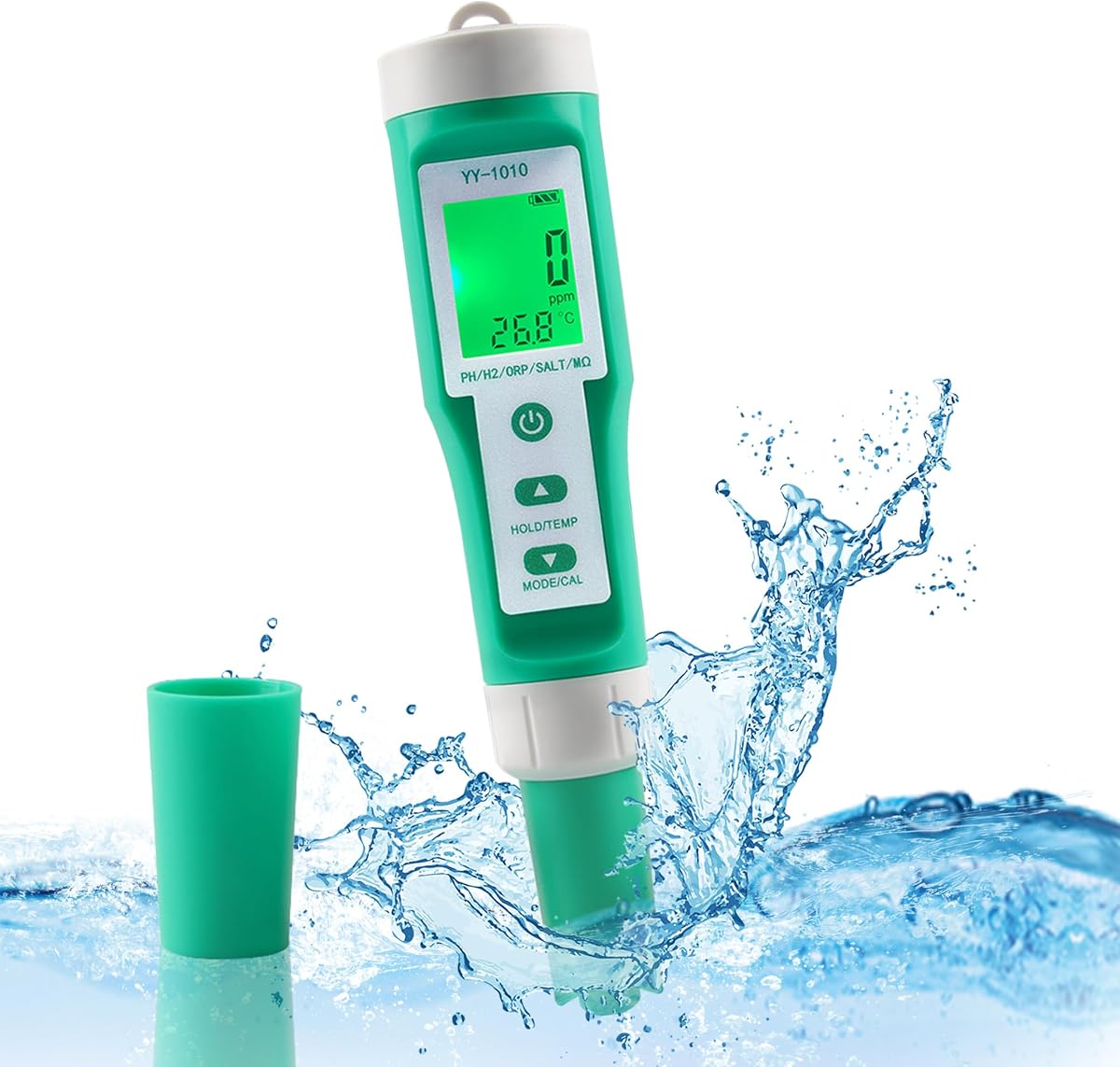


This compact tester has a 3.8 rating and stands out as an affordable way to monitor resistivity along with pH, TDS, EC, salinity, specific gravity, ORP, hydrogen, fertility, and temperature. Its stated resistivity range extends from 5 Ω to 20 MΩ, making it useful for basic checks of deionized water and a range of other aqueous solutions.
We may earn a commission when you buy through this link, at no additional cost to you.
The device combines a high-sensitivity electrode with automatic temperature compensation across the stated 0–60°C range. A green backlit LCD, one-key mode switching, and a hold function make it approachable for users who need several readings from one instrument. Three calibration powder packs are included, although batteries must be supplied separately.
The main drawback is that this is a broad-purpose consumer tester rather than a dedicated laboratory ultrapure-water instrument. Its 3.8 rating suggests mixed experiences, and the published information does not provide detailed uncertainty specifications for every mode. Buyers who need traceable calibration records or specialized low-conductivity cell design should consider a professional alternative.
This is a sensible budget choice for occasional DI-water checks, household systems, aquariums, and other general water-quality tasks. Its combination of resistivity, TDS, EC, and temperature readings is particularly useful when you want context around a purity reading without purchasing several separate devices.
Resistivity becomes easier to interpret when viewed alongside conductivity, TDS, and temperature. This tester provides those supporting readings in the same enclosure, helping users identify changes in the water system.
The backlit display, automatic sleep, compact dimensions, and hold function suit quick checks around a home or small workshop. The included calibration powders also help users perform basic maintenance.
We may earn a commission when you buy through this link, at no additional cost to you.
The PCO60-Z earns a 4.6 rating and is the strongest all-around recommendation for users who want professional measurement features without giving up standalone operation. It measures pH, conductivity, TDS, salinity, resistivity, and ORP, with a double-junction pH and conductivity combination sensor and a separate ORP sensor.
We may earn a commission when you buy through this link, at no additional cost to you.
Bluetooth connectivity links the meter to the ZenTest app on a smartphone, tablet, or MacBook. From there, users can control measurements, conduct calibration, manage data, and log results in a cloud-based system. The stated connection range is 30 feet, and the instrument can also function as a conventional standalone tester when a smart device is unavailable.
This flexibility is valuable for laboratories, field technicians, and water-treatment professionals who may move between bench work, service calls, and documentation tasks. The trade-off is that the app and cloud system add complexity compared with a simple handheld display, and users who only need an occasional reading may not use those capabilities.
Choose the PCO60-Z when repeatable monitoring, digital records, and mobile workflows matter as much as the numerical reading. It is a particularly compelling option for organizations testing multiple DI-water points because cloud-based records can simplify comparison and sharing.
The meter supports connected and unconnected workflows, giving users the freedom to take immediate readings in the field while retaining app-based logging when documentation is required.
A double-junction pH and conductivity sensor is paired with a separate ORP sensor, giving the instrument a more specialized configuration than generic all-in-one consumer testers.
We may earn a commission when you buy through this link, at no additional cost to you.
With a 4.9 rating, the Ultrameter II 6PIIFCE is the leading premium recommendation in this guide. It combines pH, ORP, conductivity, TDS, resistivity, FCE, and temperature in a single handheld instrument, reducing the need to move between separate meters during water-quality assessments.
We may earn a commission when you buy through this link, at no additional cost to you.
Its advanced four-electrode conductivity technology and microprocessor-controlled operation are central to its appeal for treatment, industrial, laboratory, and field work. Automatic temperature compensation, automatic range selection, user-adjustable TDS conversion, and true one-handed controls support fast, repeatable use in different environments.
Battery life is listed at more than 100 hours or 5,000 tests, and non-volatile memory preserves calibration settings during battery replacement. These are meaningful advantages for a professional instrument, although the premium nature of the product means it may be excessive for occasional household checks.
The Ultrameter II is best suited to organizations that value dependable workflow, broad parameter coverage, and minimal setup. For repeated DI-water monitoring in demanding settings, its combination of field portability and retained settings is particularly attractive.
Automatic range selection and temperature compensation reduce the number of manual decisions required at each site. The one-handed format helps technicians acquire readings while managing sample containers or documentation.
Non-volatile memory retains calibration settings even when batteries are replaced, reducing the chance of repeating setup procedures between service visits.
We may earn a commission when you buy through this link, at no additional cost to you.
The Myron L 6PIIFCE carries a 4.4 rating and is a strong choice for users who need more than a direct purity result. It measures conductivity, resistivity, TDS, pH, ORP or free chlorine, and temperature, making it useful for water-treatment analysis and broader quality-control programs.
We may earn a commission when you buy through this link, at no additional cost to you.
Automatic ranging simplifies use across varying water conditions, while adjustable temperature compensation and conductivity-to-TDS ratio settings allow the readings to be adapted to the application. The built-in LSI and hardness calculator adds interpretive value, and date and time stamps help organize records.
Like other high-end multiparameter meters, this model may be more than a casual buyer needs. Those seeking the simplest possible DI-water check could find the menu and number of parameters unnecessarily elaborate. Its value becomes clearer when one instrument must support several recurring water-quality tasks.
Choose the 6PIIFCE for laboratory, industrial, or treatment work where conductivity, resistivity, pH, and sanitizing measurements are all relevant. It is especially compelling for users who appreciate built-in calculations and time-based documentation.
The calculator turns several measurements into useful treatment context, helping users evaluate saturation and hardness without performing every conversion manually.
Adjustable temperature compensation and TDS conversion provide flexibility across different sample types, while automatic ranging simplifies day-to-day operation.
We may earn a commission when you buy through this link, at no additional cost to you.
This 10-in-1 tester has a 3.4 rating and is most appropriate for users who want resistivity alongside hydrogen concentration and many common water-quality parameters. Its stated resistivity range is 50 Ω to 20 MΩ, covering both relatively conductive samples and highly resistive DI water.
We may earn a commission when you buy through this link, at no additional cost to you.
The instrument also measures pH, hydrogen, fertility, TDS, EC, ORP, specific gravity, salinity, and temperature. Hydrogen readings can be shown in ppb or ppm, and the display includes a green backlight, stable-reading hold function, data retention, and a low-battery indicator.
Its lower rating indicates that user experiences may be inconsistent. Some listing claims, including health-related statements about hydrogen water, are not central to evaluating a resistivity meter and should not be treated as proof of product efficacy. Buyers focused on laboratory-grade traceability need more detailed technical documentation.
This model makes sense for general home or hobby use involving drinking water, hydroponics, pools, and aquariums, particularly when hydrogen readings are also desired. For verified DI-water analysis alone, the more specialized Apera and Myron options offer a stronger fit.
The combination is unusual among general-purpose testers and may be attractive for users evaluating hydrogen-water systems while also monitoring the electrical quality of the water.
The backlit screen, dual-unit hydrogen modes, hold control, and data retention make the meter convenient for quick comparisons and recording values.
We may earn a commission when you buy through this link, at no additional cost to you.
The SX731 has a 4.8 rating and is a compelling portable kit for technicians who need several water-quality parameters in the field. It is described as supporting pH, ORP, dissolved oxygen, conductivity, TDS, salinity, resistivity, and temperature, although the supplied kit information specifically identifies three included probes for pH, conductivity, and ORP.
We may earn a commission when you buy through this link, at no additional cost to you.
Automatic electrode recognition is a particularly useful feature because the meter switches to the appropriate parameter mode according to the connected probe. Automatic calibration, automatic temperature compensation, self-diagnosis, automatic power-off, and storage for 300 data sets make it practical for repeated field work.
The phrase lab-grade describes the product's positioning, but buyers should still verify the exact probe specifications required for their application. The kit is more substantial than a consumer multi-function pen and may present unnecessary complexity if only resistivity is needed.
Choose the SX731 for mobile water-quality work where pH, conductivity, and ORP must be measured with a single portable platform. Its high rating, automatic probe recognition, and data storage make it especially suitable for service teams that want fewer manual setup steps.
The meter identifies connected electrodes and changes modes automatically, reducing menu navigation and helping lower the chance of using an inappropriate setup.
Storage for 300 recalled data sets gives field users meaningful recording capacity without requiring a separate logger for every routine inspection.
We may earn a commission when you buy through this link, at no additional cost to you.
The SX723 is a portable multiparameter kit centered on pH, mV, conductivity, TDS, salinity, resistivity, and temperature. It includes three lead-free ATC probes, with pH and conductivity identified in the supplied information, and its automatic electrode recognition simplifies operation.
We may earn a commission when you buy through this link, at no additional cost to you.
The meter also offers automatic calibration, automatic temperature compensation, self-diagnosis, data logging, automatic power-off, and storage for 300 sets. Those features closely match the workflow of the SX731 while offering a focused measurement set for users who do not need every parameter available in the larger kit.
A rating of 0 in the comparison reflects that no user rating was supplied for this product; it does not represent a measured quality score. Without customer feedback or a published specification sheet in the provided data, buyers should confirm compatibility with their DI-water sampling procedure and required accessories.
The SX723 is best for portable testing where resistivity must be combined with pH, conductivity, and related readings. It is a balanced option for field and bench users who value automatic setup and data recall without carrying an instrument with every possible parameter.
The meter covers resistivity and its close conductivity-related measurements while also supporting pH, mV, and temperature, making it suitable for routine water-quality interpretation.
Automatic calibration, compensation, electrode recognition, and power-off reduce repetitive manual tasks during repeated measurements.
We may earn a commission when you buy through this link, at no additional cost to you.
The Pinpoint meter has a 4.2 rating and is designed primarily around conductivity and water hardness. It is not a dedicated resistivity meter, so it does not satisfy every need of a buyer searching specifically for direct ultrapure-water resistivity readings. It is included because conductivity can reveal whether DI-water quality is changing.
We may earn a commission when you buy through this link, at no additional cost to you.
The kit includes the meter, a permanent probe, and calibration fluid. Its large LCD can be read from a distance, while the portable bench format suits home users, laboratories, and water professionals who want a simple spot check without navigating a complex multiparameter interface.
The main limitation is the absence of a stated direct resistivity function. Conductivity and resistivity are inversely related, but a hardness-focused display should not be treated as a substitute for a meter with a calibrated resistance range and temperature compensation appropriate to ultrapure samples.
Choose the Pinpoint when your goal is simple hardness or conductivity monitoring and direct resistivity is secondary. For DI-water qualification or a numeric resistivity specification, select one of the dedicated resistivity-capable instruments higher in this list.
Its focused design removes the need to navigate numerous modes, making the meter practical for users who primarily want a dependable indication of dissolved-ion concentration.
Calibration fluid and a permanent probe are included, helping owners begin routine checks without sourcing separate basic accessories.
We may earn a commission when you buy through this link, at no additional cost to you.
The GY1 has a 4.0 rating, but it measures water activity rather than the electrical resistivity of DI water. Its resistive humidity sensor is used to determine equilibrium moisture status in foods and other materials, so the word resistive describes the sensing principle rather than a resistivity reading for bulk water.
We may earn a commission when you buy through this link, at no additional cost to you.
The instrument displays water activity and sample temperature, supports Bluetooth and USB data transfer, and uses an equilibrium algorithm to indicate when a stable result is available. Results typically require 15–30 minutes depending on the sample, according to the supplied product information.
Its 0.02 aw stated accuracy and intended agricultural, food, and research uses are meaningful within that category. However, none of these features establishes it as an instrument for judging ion removal or DI-water purity. The product is included to clarify the distinction between water activity and water resistivity.
Choose the GY1 for food moisture, dried produce, grain, or research applications. It should not be selected for DI-water resistivity testing, where a conductivity-compatible meter with a direct resistance mode is the appropriate tool.
Water activity describes how readily water is bound or available within a material. It is not interchangeable with electrical resistivity, which is used here to assess dissolved ions in water.
The smart algorithm tracks stability over time, helping users recognize when the sample has reached equilibrium rather than interrupting the measurement too early.
We may earn a commission when you buy through this link, at no additional cost to you.
The RESTMO flow meter has a 4.5 rating and measures water flow and consumption rather than resistivity. It is useful as a companion tool for understanding how much water passes through a hose or line, but it cannot determine dissolved-ion levels, conductivity, or the electrical resistance of DI water.
We may earn a commission when you buy through this link, at no additional cost to you.
The meter offers flow, last-consumption, weekly-average, and total modes. A one-touch control changes modes, and a long press switches between gallons and liters. Its LCD automatically sleeps after one minute without operation or flow, which helps conserve battery life during intermittent use.
Pure brass inlet and outlet threads add durability, while the heavy-duty ABS housing carries an IPX6 waterproof rating for outdoor exposure. The measurement tolerance is stated at less than 5%. It cannot provide the numerical evidence needed to verify whether a DI-water system is achieving the required purity.
Choose the RESTMO for garden irrigation, hose usage, flow-rate checks, or consumption tracking. If verifying DI-water quality is the goal, use a dedicated resistivity-capable meter from the top of this guide and treat the flow meter only as an optional operational companion.
Real-time flow, recent consumption, weekly average, and accumulated total provide different views of system use from a single installed device.
Brass fittings, rugged ABS construction, and IPX6 water resistance make the meter suitable for outdoor hose applications, provided the battery compartment is handled with dry hands.
We may earn a commission when you buy through this link, at no additional cost to you.
The right meter depends on the purity range, required accuracy, sampling environment, and need for documentation. Review the technical factors below before choosing a general-purpose tester or a professional multiparameter instrument.
A conductivity meter is not automatically a resistivity meter. Resistivity is the reciprocal of conductivity, but a product must be designed to calculate and display resistance or resistivity correctly, including appropriate unit selection and temperature treatment. Products such as the Pinpoint hardness meter and GY1 water activity analyzer do not satisfy a direct resistivity requirement, while the Apera and Myron instruments explicitly include resistivity modes.
Choose a meter that states a usable resistivity range and supports the quality level expected from your DI-water system.
DI water is highly resistive, so a meter must cover the upper end of the desired purity scale rather than concentrating only on ordinary drinking or pool water. The 10-in-1 models list ranges reaching 20 MΩ, while professional products provide dedicated low-conductivity measurement configurations. Consider both the upper resistance limit and the low-end resolution needed to detect contamination.
Match the specified range to your system specification rather than choosing solely on the largest printed number.
Conductivity and resistivity change with temperature, so consistent comparison requires compensation. Every recommended dedicated meter offers automatic temperature compensation, allowing readings to remain more meaningful when sample temperature varies. Adjustable compensation can be useful when comparing results under different protocols, but the correct setting should follow the standard used by your facility.
Prioritize automatic compensation and verify that it is active for the measurement mode you use.
The probe is the part that directly contacts the sample, so its design influences low-level conductivity performance, response time, and maintenance. The Myron L Ultrameter II uses four-electrode conductivity technology, while the PCO60-Z uses a double-junction pH and conductivity combination sensor. Apera kits include dedicated pH and conductivity probes with automatic recognition.
Choose a sensor arrangement suited to the sample and verify the supplied electrode specifications before purchasing.
Low-conductivity readings can be sensitive to calibration technique and electrode condition. Professional meters offer automatic calibration and self-diagnosis, while the budget 10-in-1 tester includes three calibration powder packs. A meter with retained calibration settings can also reduce setup time, which is one advantage of the Ultrameter II's non-volatile memory.
Favor products that support a repeatable calibration process and include clear instructions for the standards and solutions required.
Field technicians often value automatic probe recognition, one-handed operation, battery life, and data recall. Laboratory users may prioritize dedicated modes, calculators, timestamped results, and repeatability. A portable kit can serve both environments, but its included probes and menus should align with the measurements you actually use rather than expanding into unnecessary features.
Select the form factor that matches where most readings will be taken and how results will be recorded.
A single display is adequate for immediate spot checks, but recurring monitoring benefits from stored or exported records. The SX731 and SX723 can store and recall 300 data sets, the PCO60-Z offers cloud-based logging through its app, and the Myron L 6PIIFCE includes date and time stamps. These features help compare water-system performance over time.
Choose a meter with data management that matches the documentation required by your workflow.
The purchase should be evaluated as a complete measurement system rather than a display alone. Probe condition, calibration supplies, batteries, connectivity, data export, and available accessories all affect ongoing use. Consumer units may require batteries that are not included, while professional meters may require more careful storage and replacement procedures.
Check all included components and ongoing maintenance requirements before making a final selection.
Begin by reading the instrument's manual and identifying the correct conductivity or resistivity mode, calibration procedure, temperature-compensation setting, and intended sample volume. Rinse the probe with high-quality DI or deionized water as directed, then condition it according to the manufacturer's instructions. Handle probes by their sensing and connector ends rather than gripping the delicate electrode surfaces.
Calibrate with standards appropriate to the expected sample and measurement range. Confirm the entered temperature-compensation value, immerse the probe to the required depth, remove trapped bubbles, and wait for a stable reading. Rinse between samples to prevent carryover. For ultrapure water, even small contamination from a poorly rinsed container or an unclean probe can materially affect the result.
After use, rinse the probe and store it as directed, commonly in its protective cap or holder. Clean deposits promptly, avoid prolonged immersion in unsuitable solutions, and replace aging probe components according to the manufacturer's schedule. Save or export readings when monitoring quality trends, and periodically verify performance with a fresh standard rather than assuming the display remains accurate indefinitely.
The expected value depends on the DI-water system, storage conditions, temperature, and contamination level. Ultrapure water is generally far more resistive than ordinary tap or drinking water, but there is no single universal acceptance number for every application. Compare readings with the specification established for the equipment, process, or laboratory using the meter's manufacturer guidance.
A TDS meter can provide a useful estimate because TDS is generally derived from conductivity, and conductivity is inversely related to resistivity. However, it does not display a direct resistivity result and may use a fixed conversion factor. If your process requires a resistivity value in a defined unit, use a meter that explicitly supports and correctly calculates that measurement.
Electrical conductivity in water changes as temperature changes, and the relationship is substantial enough to affect comparisons. Automatic temperature compensation adjusts the displayed result to a reference temperature. Keep the meter and sample conditions consistent, confirm the compensation setting, and follow the protocol used for all readings you intend to compare.
Yes, a new or recently serviced meter should be checked with an appropriate calibration standard before it is used for consequential measurements. Use the standard closest to the expected sample conductivity, follow the required procedure, and document the result if quality control is part of your workflow. Calibration solutions can expire or degrade, so inspect their condition and storage history.
The listed products are primarily handheld or portable meters, and most are intended for spot measurements rather than permanent loop installation. A fixed inline conductivity or resistivity transmitter would be more appropriate for continuous monitoring and control. Portable models are useful for verifying the loop at multiple points or investigating changes discovered by an installed system.
Differences can result from calibration standards, temperature compensation, probe condition, sample contamination, rinsing, stabilization time, and differences in the measurement range. Test both instruments with a known standard under the same procedure before suspecting the DI-water system. If readings continue to differ, review the manufacturer instructions and seek application support.
A four-electrode configuration can be advantageous because it reduces the influence of electrode polarization at low conductivity. That can improve suitability for very resistive samples compared with a simpler two-electrode arrangement. The complete meter design, cell constant, calibration method, and sample handling still determine overall suitability.
No. A direct display and a reliable probe are generally enough for periodic spot checks. Bluetooth, cloud storage, and automatic logging become valuable when measurements must be shared, audited, trended, or associated with particular sample points and times.
The 10 in 1 Water Quality Tester is the most practical budget-oriented option, combining a stated 20 MΩ resistivity range with numerous familiar water-quality measurements. The Apera PCO60-Z is the strongest connected choice for users who value mobile control, cloud records, and flexible standalone operation, while the Myron L Ultrameter II 6PIIFCE leads the premium field category with its advanced conductivity technology and retained calibration settings.
Prioritize the instrument that directly measures resistivity over the required range, performs reliable temperature compensation, and includes a sensor configuration suited to low-conductivity samples. Add portability, automatic setup, and data logging only as needed. Conductivity-focused, water-activity, and flow-measurement products can complement a DI-water system, but they should not replace a proper resistivity meter.
Before purchasing, verify the current manufacturer specifications, included accessories, probe requirements, calibration supplies, and application support. Product features, ratings, availability, and pricing can change, so checking the current listing ensures that the chosen meter still matches your DI-water quality protocol and operating environment.