
GE 33600 RG6 Coaxial Cable
4.6Editor score
Straightforward 50-foot installation
Tool-free screw-on connectors
Compact, ready-to-use design
Our guide compares the best coaxial cable for antenna options for TV reception, weather resistance, shielding, connectors, and easy installation at home.
Coaxial cable for an antenna must preserve a weak television signal while resisting interference, moisture, and the wear associated with long installation routes. A good cable also needs secure F-type connectors, appropriate shielding, enough length for the layout, and compatibility with the television, tuner, amplifier, or other equipment in the system.
We compared all ten products by examining their stated impedance, conductor design, shielding, frequency support, connector construction, weather resistance, included accessories, and intended antenna applications. The list covers indoor and outdoor RG6 runs, long-distance options, a compact installation, and an RG8X cable designed for 50-ohm radio systems.
Each review identifies the circumstances in which its cable is most useful, along with the trade-offs readers should consider before buying. Product ratings and availability can change, and current prices vary by length, color, seller, and promotional offer, so readers should verify the latest listing details before ordering.
4.6Editor score

4.7Editor score

4.7Editor score
The comparison below highlights cable type, length, impedance, shielding, and weather-handling features so antenna installers can quickly identify the option that fits a particular television or radio system.



The G-PLUG 50FT RG6 Coaxial Cable Extender combines a 50-foot run with triple shielding, 75-ohm impedance, and preinstalled compression connectors. Its 4.7 rating reflects a well-rounded option for connecting outdoor television antennas, satellite receivers, cable modems, routers, and other coax-equipped devices to a wider range of home entertainment components.
We may earn a commission when you buy through this link, at no additional cost to you.
The triple-shielded construction is the cable's most important feature for antenna installations. Shielding helps reject electromagnetic and radio-frequency interference that can enter through nearby electronics, power wiring, or other cables. Rubber-sealed F-type connectors and a durable PVC jacket add protection when the run passes through outdoor areas exposed to rain, humidity, and changing temperatures.
One practical advantage is the included female-to-female F81 coupler. It gives installers an option to combine cable sections when a single 50-foot run is not enough. That flexibility is useful for routing around walls or reaching a distant antenna position, although every additional joint should be secured carefully because a loose or poorly sealed connection can impair performance.
This is the strongest general recommendation for most antenna projects because it balances shielding, weather resistance, useful length, and installation accessories. Choose it for an outdoor television antenna, a satellite installation, or a mixed coax setup. Verify that the antenna and receiver use compatible F-type connections before purchasing.
Triple shielding helps preserve antenna signals in environments where electrical noise is present. That makes the cable suitable for runs passing near household wiring, networking equipment, or other sources of electromagnetic interference.
The weather-resistant jacket and rubber-sealed connectors make this a practical choice for exterior sections. Secure exposed cable with appropriate clips or ties while avoiding kinks, sharp bends, and crushing pressure.
We may earn a commission when you buy through this link, at no additional cost to you.
The energeaster 50FT RG6 Coaxial Cable uses foil, braid, and foil layers to create triple-layer shielding around a 75-ohm signal path. It earns a 4.7 rating and is presented for a broad mix of antenna, television, satellite, broadband, and home entertainment connections, including support for 4K HDR video, Dolby Digital audio, and high-speed internet.
We may earn a commission when you buy through this link, at no additional cost to you.
Its compression-style F connectors use rubber O-rings to help keep moisture, dust, and corrosion away from the connection points. The connector joint is also designed to resist vibration, which can be useful where movement might otherwise loosen a connection. A female-to-female coupler is included and pre-attached for installations that need to extend the run.
The cable is not limited to conventional rooftop television antennas. Its stated compatibility includes caravan television setups, antennas, cable boxes, DVRs, satellite systems, broadband equipment, and other coax-based devices. That makes it a versatile option, although users should still verify impedance and connector type for specialized equipment.
This is a good selection for someone who values shielding and connection security over a minimal accessory bundle. The 50-foot length offers a useful balance between installation flexibility and cable management. It is especially appropriate for exterior runs or antenna installations in areas where moisture and interference could threaten performance.
The combination of foil and braided shielding offers broad protection against electromagnetic and radio-frequency interference. That helps an antenna signal reach a tuner or television with less unwanted noise.
The included coupler permits longer runs when properly connected. Keep added sections straight, supported, and securely seated so the connection does not become a source of signal degradation.
We may earn a commission when you buy through this link, at no additional cost to you.
The Nixsto RG6 Coaxial Cable stands out for its extensive selection of lengths, from short 1.5-foot options to 100-foot runs, with multiple intermediate sizes available. Its 4.7 rating makes it a practical choice for digital television antennas, set-top boxes, modems, satellite receivers, splitters, radios, and streaming equipment.
We may earn a commission when you buy through this link, at no additional cost to you.
The cable uses a 75-ohm copper-plated conductor and gold-plated F-type contacts with built-in O-ring seals. A round, water-resistant black PVC jacket protects the internal construction, while the stated signal support extends to 4K HDR video, Dolby Digital audio, and high-speed internet connections.
One advantage is the option to match the cable closely to the installation rather than leaving excess length coiled behind a television. Short runs can simplify connections in entertainment centers, while longer versions suit an outdoor antenna or equipment located in another room. A brass female-to-female extender is included to support expansion.
This cable is a strong fit for buyers who want one product family to cover several installation lengths. The main point to confirm is the selected variant shown on the listing. Its range, discreet color, and included extender make it especially convenient for mixed indoor and outdoor antenna projects.
A precise length reduces unnecessary excess and makes routing easier around furniture, walls, and entertainment centers. It also helps installers avoid creating tight coils that can add strain to a connector.
O-ring seals and a water-resistant jacket support use around antennas, basements, satellite dishes, and coastal environments. Exterior cable should still be routed and secured to limit movement and abrasion.
We may earn a commission when you buy through this link, at no additional cost to you.
This 50ft RG6 Coaxial Cable is built around a triple-shielded 18 AWG conductor and 75-ohm impedance, with stated transmission support up to 3 GHz. Its 4.7 rating and extensive installation accessories make it the most fully equipped option in this guide for television antennas, CATV, satellite systems, modems, routers, and DVRs.
We may earn a commission when you buy through this link, at no additional cost to you.
The supplied kit goes beyond the cable itself. It includes an F81 female coupler, a right-angle F adapter, cable clips, and cable ties. Those items make it easier to extend a run, navigate confined spaces, and secure the cable along a wall or around entertainment equipment.
Weather protection is another distinguishing feature. Waterproof boot connectors, internal waterproofing, a UV-resistant wall-rated PVC jacket, and corrosion-resistant threaded fittings are designed for indoor and outdoor installations. The cable is also described as ISO 9001 manufactured, CE and RoHS compliant, and tested to SCTE standards.
This premium pick is ideal for installers who want a complete, organized installation rather than a basic cable-and-connector package. Some users may not need the right-angle adapter or routing accessories, but they add flexibility at little inconvenience. For a permanent rooftop antenna, basement run, or mixed indoor-outdoor setup, this is a particularly complete choice.
The coupler, right-angle adapter, clips, and ties cover common routing needs. This bundle is particularly useful when an antenna installation includes both long exterior runs and short connections behind a television or cabinet.
A UV-resistant wall-rated jacket and corrosion-resistant fittings suit installations that will remain in service for long periods. Use suitable supports and avoid placing connectors where they may collect standing water.
We may earn a commission when you buy through this link, at no additional cost to you.
The 10FT RG6 Coaxial Cable offers a compact solution for nearby antennas, televisions, modems, satellite dishes, and other coax-equipped equipment. It has a 4.7 rating, uses an 18 AWG conductor with 75-ohm impedance, and is specified for frequencies from 2.3 MHz to 3.0 GHz.
We may earn a commission when you buy through this link, at no additional cost to you.
Shielding combines 60% braided aluminum with 100% aluminum foil. This construction helps reduce electromagnetic and radio-frequency interference that could otherwise affect nearby high-frequency equipment. The stated capabilities include 4K Ultra HD and Full HD video, high-speed internet, online gaming, and real-time streaming.
A major advantage is the short, manageable length. It is useful for connecting a television close to an antenna amplifier, a small indoor antenna positioned near a set, or a satellite component mounted within the same room. The moisture-resistant outer coating is also designed for indoor walls and outdoor antenna extension sections.
This pick makes the most sense when the antenna and receiver are already close together. For a rooftop or distant outdoor antenna, it may require a coupler and a longer RG6 extension. For a room-level installation or short replacement lead, however, it offers useful shielding in a convenient form.
Ten feet is enough for many indoor antenna arrangements and keeps connections manageable. A compact lead is also easier to conceal behind furniture or near a mounted television.
Foil and braided aluminum layers support stable transmission near common household electronics. The cable remains best suited to short runs, where excess length and added junctions are unnecessary.
We may earn a commission when you buy through this link, at no additional cost to you.
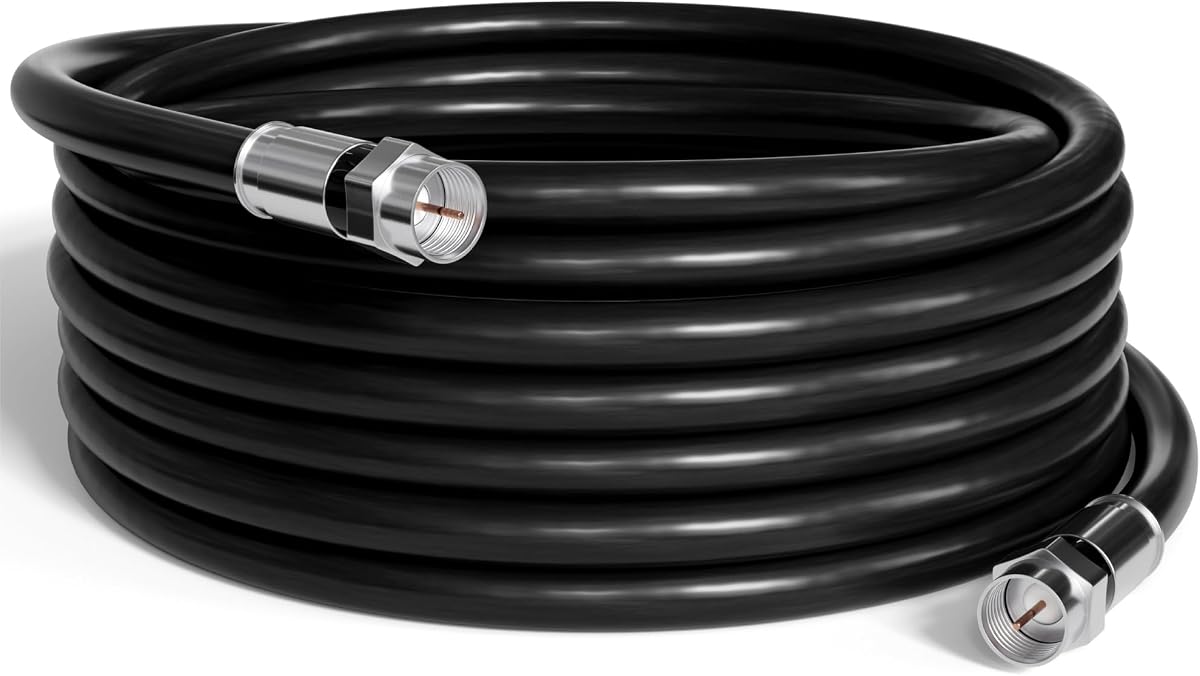
The GE 33600 RG6 Coaxial Cable is a straightforward 50-foot cable with screw-on connectors and no required tools. Its 4.6 rating makes it a practical budget-oriented option for readers who want a familiar installation process without a large collection of adapters and routing accessories.
We may earn a commission when you buy through this link, at no additional cost to you.
The main appeal is convenience. The cable arrives ready to use, so a basic antenna connection can be completed by hand. Screw-on F-type fittings are widely used in home coax installations, although buyers should confirm that the antenna and receiver have compatible threaded connections.
The supplied product information is concise, so it does not provide the same level of detail about shielding layers, frequency range, or connector sealing as some of the other choices. For that reason, buyers with demanding outdoor exposure or complex interference conditions may prefer a model with more specific weatherproof and shielding specifications.
This is a sensible budget pick for a straightforward television antenna connection, a short-distance indoor arrangement, or a replacement run in a conventional home installation. It offers the essential 50 feet of RG6 cable and simple connectors without introducing unnecessary accessories. Buyers should focus on connector compatibility and proper hand tightening.
Screw-on F-type connectors simplify installation for people without compression tools. Tighten them firmly by hand while avoiding excessive force that could damage the fitting or equipment port.
The 50-foot cable provides enough reach for many room-to-room and exterior antenna arrangements. Its basic design is best for straightforward systems rather than installations requiring multiple specialized adapters.
We may earn a commission when you buy through this link, at no additional cost to you.
The GE RG6 Coaxial Cable distinguishes itself with quad shielding, gold-plated compression connectors, and support for digital transfer speeds up to 3 GHz. Its 4.7 rating suits connections among televisions, antennas, cable modems, satellite equipment, and other coax-compatible devices.
We may earn a commission when you buy through this link, at no additional cost to you.
Quad shielding provides an especially high level of protection against interference and signal leakage. The solid core conductor and gold-plated fittings are intended to support reliable communication while resisting corrosion. Compression connectors create a secure screw-on connection that can be installed without specialized tools.
The flame-retardant cable is also approved for long-term in-wall uses such as home security, surveillance, internet, and home theater installations. That makes it more versatile than a basic outdoor patch cable when the run needs to pass through a wall or protected cavity. It is still important to follow local building and electrical requirements.
Choose this cable for a permanently routed antenna system where interference control and durable connectors are priorities. Quad shielding may provide more protection than a basic system needs, but that makes the cable well suited to installations near electronics, network equipment, or complex coax networks. It is not intended as a substitute for a 50-ohm PL259 radio cable.
Multiple shielding layers help block unwanted electromagnetic and radio-frequency interference. This is particularly useful for permanent antenna runs routed through areas with many nearby electronic sources.
The flame-retardant jacket supports appropriate in-wall installations. Check local rules and use only cable approved for the intended environment, taking care to protect it from sharp edges and construction damage.
We may earn a commission when you buy through this link, at no additional cost to you.
The RG8X Coaxial Cable is a specialty 50-foot cable for CB radio, ham radio, antenna analyzers, tuners, dummy loads, SWR meters, transceivers, and other 50-ohm radio-frequency equipment. Its 4.6 rating reflects a focused design for high-powered radio applications rather than conventional 75-ohm television antennas.
We may earn a commission when you buy through this link, at no additional cost to you.
The cable uses a thicker 17 AWG pure copper center conductor with double shielding. Fully molded nickel-plated brass UHF connectors feature gold-plated center pins and are rated for frequencies up to 300 MHz. The construction is described as stronger and more durable than an average CB antenna cable.
A strong, flexible PVC jacket allows indoor or outdoor use, and the connectors provide a secure fit for compatible radio equipment. This makes the cable a sensible companion for a CB installation in a vehicle, a base station antenna, or a nearby amateur radio setup. It can also support temporary use with appropriate test equipment.
This is the right choice when the antenna in question belongs to a 50-ohm radio system. It should not be treated as a direct substitute for RG6 television coax because the impedance and connector type differ. For television antennas, use an RG6 cable with F-type connectors; for CB or ham radio, this RG8X model is the more technically appropriate option.
The 17 AWG pure copper center conductor gives this cable more capacity for radio-frequency installations than a typical thin television lead. That makes it appropriate for CB and ham radio antenna connections.
Molded PL259 connectors provide a robust mechanical fit and gold-plated center pins support dependable electrical contact. Use appropriate adapters when connecting the cable to equipment fitted with different connectors.
We may earn a commission when you buy through this link, at no additional cost to you.
THE CIMPLE CO's 100-foot RG6 cable is designed for long-distance runs connecting television antennas, free-to-air and over-the-air antennas, wireless antennas, modems, satellite receivers, radios, CATV equipment, and other coax systems. Its 4.7 rating and 75-ohm design make it a recognizable choice for larger installations.
We may earn a commission when you buy through this link, at no additional cost to you.
The cable uses an 18 AWG solid center conductor with aluminum braiding and additional shielding. It is swept to 3.0 GHz, supports frequencies down to 2.3 MHz, and is compatible with both digital and analog signals. That specification set covers many modern television antenna and broadband applications.
Double O-ring compression connectors and a PVC outer jacket help the cable work indoors or outdoors. Precision-machined weathertight fittings are intended to create a tight connection that resists weather damage, making the 100-foot length useful for reaching an elevated outdoor antenna or a distant equipment location.
The 100-foot run is the defining advantage when one cable must cover a substantial distance. Its size requires more thoughtful cable management than a 10-foot or 50-foot option, and unnecessary excess should be arranged without creating tight loops. For a long outdoor or building-crossing antenna run, it offers useful reach with strong technical specifications.
A 100-foot length can reduce the need for added couplers, which helps minimize connection points. The solid conductor and shielding support low-loss transfer across the extended run.
Double O-ring compression connectors and a weather-resistant jacket support exterior use. Position connectors where they are less likely to remain wet, and inspect seals after severe weather.
We may earn a commission when you buy through this link, at no additional cost to you.
THE CIMPLE CO 50-foot outdoor RG6 cable is built for television antennas, satellite dishes, cable modems, radios, CATV, and indoor or outdoor coax systems. Its 4.7 rating, 75-ohm impedance, and 3.0 GHz sweep rating make it well suited to contemporary broadcast television and satellite installations.
We may earn a commission when you buy through this link, at no additional cost to you.
The cable contains an 18 AWG solid center conductor with aluminum braiding and added shielding. This construction is designed for low-loss signal transfer over long-distance runs. It supports frequencies from 2.3 MHz through 3.0 GHz and works with both digital and analog signals.
Outdoor protection is the distinguishing feature. Weather-stabilized, UV-coated connectors, a PVC jacket, and double O-ring compression connections with weather-booted ends help the installation withstand exposure. The exact fit and weather resistance of every connection are still important, so connectors should be firmly seated and not left where standing water can collect.
Choose this cable for a 50-foot exterior run between an antenna or satellite dish and the associated equipment. It is also suitable for indoor portions of a mixed installation. Compared with a basic patch cable, its emphasis on shielding and environmental protection makes it a more deliberate choice for permanent rooftop and eave-mounted antenna systems.
UV coatings, weather boots, and double O-rings help protect exposed connections. These features are especially relevant for rooftop antennas and satellite installations that face sunlight and moisture.
The solid 18 AWG conductor, dual shielding, and swept frequency range support dependable transmission. Avoid crushing the cable and protect it from sharp edges to preserve these electrical and physical benefits.
We may earn a commission when you buy through this link, at no additional cost to you.
The right antenna cable depends on the signal type, impedance, connection hardware, installation environment, and route length. These factors matter more than a long feature list because an incompatible connector or poorly matched cable can make a capable antenna perform poorly.
Most television antennas, free-to-air antennas, modems, and satellite equipment use 75-ohm RG6. CB and ham radio installations commonly use 50-ohm coax such as RG8X with PL259 connectors. These systems are not interchangeable simply because both carry radio-frequency signals; impedance, connector type, construction, and intended frequency range must all align with the equipment.
Match the cable to the antenna system rather than choosing by length alone. A 75-ohm F-type cable is appropriate for most modern household television antenna installations, while the 50-ohm RG8X option in this guide is a specialized choice for radio and RF testing equipment.
Measure from the antenna or dish to the television, tuner, amplifier, modem, or distribution point. Include vertical rise, turns around corners, service loops, and the distance to the connector. Longer runs need a cable designed for low loss, and indoor sections may not require the same environmental protection as exposed exterior sections.
Choose the shortest practical length and avoid unnecessary slack. If a route exceeds a convenient single-cable length, use a properly seated coupler or a correctly rated extension, secure the added connection, and keep it accessible for inspection.
Impedance describes how the cable is designed to carry the signal. RG6 television cable is generally 75 ohms and should be matched to compatible television and broadband equipment. The RG8X option is 50 ohms and is intended for radio-frequency systems. Using a mismatched cable can lead to reflections, interference, or reduced transfer quality.
Also compare the stated frequency range. Many of these cables support television, satellite, and broadband signals up to 3 GHz, which is appropriate for contemporary antenna equipment. Specialized radio applications may instead emphasize lower frequencies, connector voltage rating, and power-handling capacity.
Shielding helps reject electromagnetic and radio-frequency interference that can enter the antenna lead. Triple shielding, quad shielding, and dual shielding all offer more protection than an unshielded or minimally shielded lead, although the number of layers is only one part of overall installation quality. A damaged, poorly terminated, or sharply bent cable can undermine the benefit.
For installations near routers, motors, power lines, or dense electronic equipment, prioritize robust shielding and sound connectors. Keep the cable separated from obvious interference sources when practical, but avoid placing it directly against sharp metal edges or unstable surfaces.
F-type connectors are standard for most television antennas, while PL259 UHF connectors are intended for the RG8X radio cable in this guide. Check both the antenna output and the television, tuner, amplifier, or modem input before ordering. A cable that otherwise suits the installation cannot be used if its connector does not fit.
Compression fittings often create a secure, weather-resistant connection, while screw-on fittings offer convenient tool-free installation. Whichever style is selected, the connector should seat fully and be tightened according to the manufacturer's instructions without damaging the port.
Outdoor antenna cable should have a suitably weather-resistant jacket and connectors. Features such as rubber boots, O-rings, UV stabilization, and sealed compression fittings help protect the most vulnerable connection points. These features reduce exposure to rain, humidity, sunlight, dust, and corrosion but do not excuse poor routing or damaged seals.
Support the cable at regular intervals, keep it away from sharp edges, and position connectors where water is less likely to sit. Inspect exposed fittings after storms, and do not bury, staple, or pinch the cable in a way that changes its shape or damages the jacket.
Some products include couplers, right-angle adapters, clips, and cable ties. These can save time and make a permanent installation neater, but they should support rather than dictate the design. A right-angle connector is helpful in tight spaces, while clips and ties keep a long run from hanging, swaying, or collecting dirt.
Do not buy a coupler unless the route genuinely needs more length. Every added junction introduces another point where moisture, looseness, or poor seating can affect performance. Premium bundles are most valuable when the included pieces correspond to the planned installation.
The best connector cannot compensate for a cable that is crushed, abraded, twisted, or bent too tightly. Use gentle bends, avoid repeated movement at the connector, and keep coax away from sharp metal and hot surfaces. Secure the middle of the run so its weight is not carried by either connector.
Before installation, check that every part of the system uses compatible fittings and that powered equipment is disconnected while connections are made. After routing, inspect the cable from end to end and confirm that all connectors are secure before testing the antenna system.
Before installation, identify the antenna output, the television or tuner input, and any amplifier, splitter, or modem that will sit between them. Confirm that the cable impedance and connector type match every device. Disconnect powered equipment, then plan the route so the cable can lie straight without sharp bends, tension, or unnecessary loops.
Connect the cable by hand and make sure the connector seats completely on the equipment port. If an extension coupler is required, attach both cable ends securely, inspect the connection, and keep the coupler out of standing water. Route exterior sections along the building or another suitable support, using clips or ties at regular intervals without crushing the jacket.
Test the completed connection, then periodically inspect exposed parts for loose fittings, damaged jackets, corrosion, or water intrusion. Do not create tight service loops, staple the cable through its jacket, or place sharp bends under permanent stress. If reception changes, check the connectors and antenna placement before assuming the cable itself has failed.
A quality 75-ohm RG6 cable is the standard choice for most modern television antennas, including indoor, rooftop, and over-the-air systems. Look for solid connectors, suitable shielding, and a jacket rated for wherever the cable will be installed. The correct connector is usually an F-type fitting.
RG6 can be used outdoors when the cable and connectors are designed for weather exposure. Look for sealed compression fittings, O-rings or rubber boots, and a weather-resistant jacket. Even protected connectors should be supported, kept away from standing water, and checked periodically for damage.
Choose the shortest length that can reach the antenna, television, amplifier, or distribution point without strain. A 50-foot cable covers many residential installations, while 100 feet can suit larger properties or elevated antenna positions. Include extra length for turns, corners, and routing around obstacles when measuring.
A longer cable can introduce more loss and provides another opportunity for a poor connection. Use a cable designed for the relevant impedance and frequency range, minimize added couplers, and keep connectors secure. Very long runs may require professional planning or a distribution amplifier.
Not for a typical television antenna. RG8X is a 50-ohm cable intended for applications such as CB radio, ham radio, antenna tuners, and analyzers, and it uses PL259 connectors. A 75-ohm RG6 cable with compatible F-type connectors is the more appropriate television antenna choice.
A coupler is only needed when the available cable cannot cover the route. The female-to-female couplers included with some products can join compatible RG6 sections, but each added connection should be fully seated and protected from moisture. For cleaner performance, a single correctly sized cable is preferable.
Only use cable approved for in-wall installation, such as a flame-retardant model specifically described for that purpose. Avoid standard outdoor patch cable unless local rules permit it. Protect the cable from nails, sharp edges, and construction damage, and follow applicable building and electrical codes.
Check every connector, coupler, and equipment port before replacing the cable. Look for loose fittings, damaged shielding, water inside a boot, sharp bends, or crushed sections. A short known-good test cable can help isolate the fault, while professional assistance is sensible for rooftop work or permanent in-wall wiring.
The G-PLUG 50FT RG6 Coaxial Cable Extender is the strongest all-around recommendation because it combines triple shielding, weather-resistant compression connectors, 75-ohm impedance, and a useful 50-foot length. The GE 33600 serves as the budget pick for a simple, tool-free installation, while the 50ft RG6 Coaxial Cable stands out as the premium choice for its weather protection and complete accessory set.
For most households, the priority should be compatibility first: choose 75-ohm RG6 with F-type connectors for television antennas, or 50-ohm RG8X with PL259 connectors for radio equipment. After that, match the cable length to the route, select sufficient shielding for the environment, and make sure the connectors are compatible and securely installed.
Ratings, lengths, product options, and prices can change over time, and the same product family may offer several variations. Review the current listing before ordering to confirm the selected length, connector style, shielding, included accessories, and current price. That final check helps prevent a technically sound cable from becoming a poor fit for the installation.