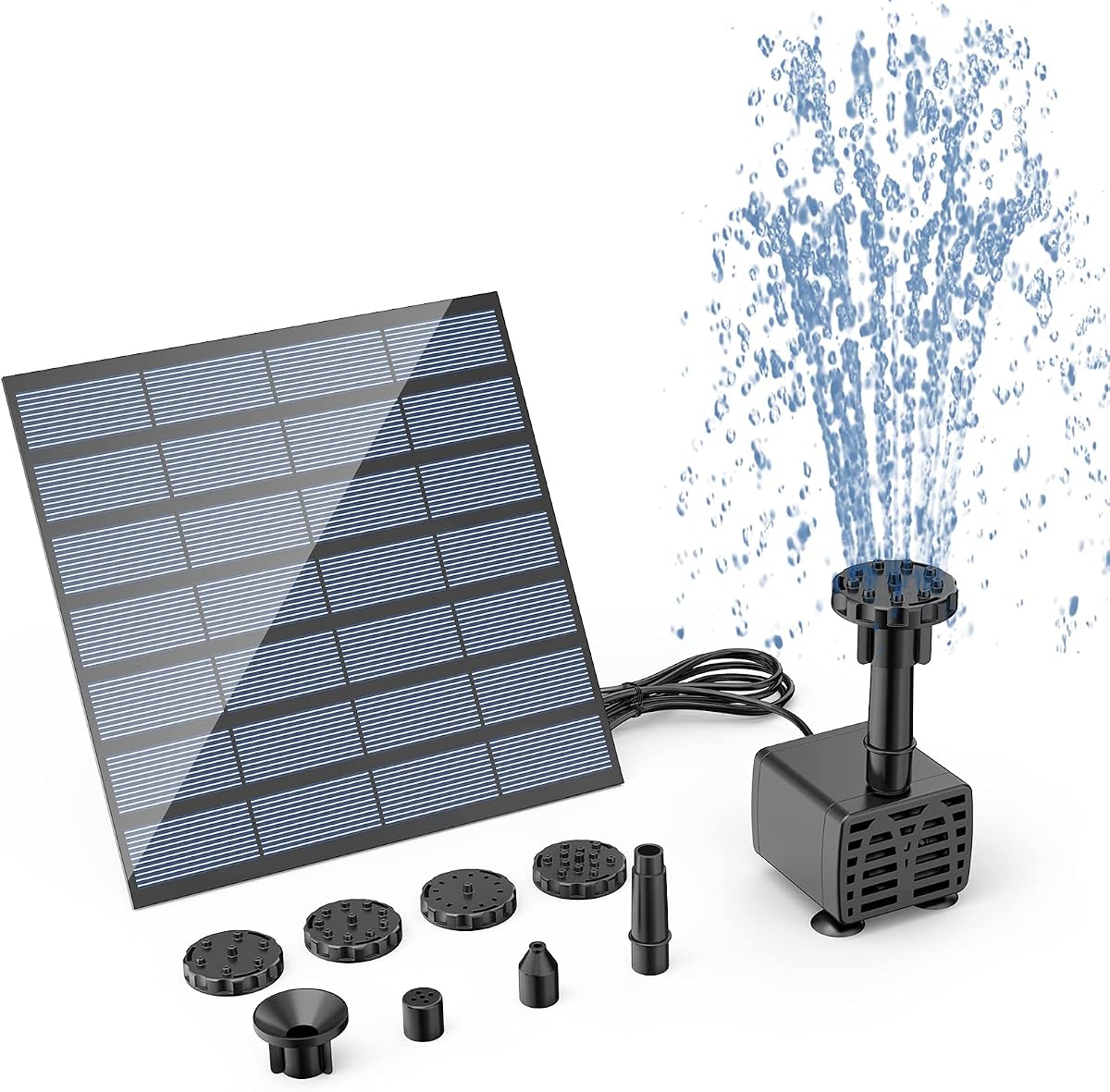
AISITIN DIY Solar Water Pump Kit
3.8Editor score
Compact 1.5W solar pump
Six interchangeable water styles
Seven-and-a-half-foot power cable
This DIY Solar Water Pump Kit guide compares solar power, flow rate, protection, tubing, nozzles, and setup for gardens, ponds, and bird baths.
A DIY Solar Water Pump Kit can turn sunlight into flowing water for a bird bath, garden pond, fountain, waterfall, or small irrigation project. The best kits balance usable flow, reliable solar performance, straightforward installation, and accessories that support different water-feature designs.
We compared all ten options by examining solar-panel output, pump capacity, included nozzles and tubing, placement options, water-shortage safeguards, filtration, cable reach, and intended use. The list includes compact fountain kits, pond filtration systems, a deep-well pump, and an educational model for young builders.
Each review identifies the product's strongest qualities and practical limitations, helping you match the kit to your space and expected water movement. Product ratings, features, and availability can change, so confirm current specifications and listing details before making a final purchase.
3.8Editor score

5.0Editor score

4.1Editor score
The comparison below highlights the defining differences among the ten kits, including solar output, flow capability, included components, protection features, and the environments best suited to each design.


The Solar Powered Fountain Pump is a straightforward option for adding moving water to a bird bath, patio container, garden, or small pond. Its 3.7 rating reflects the trade-off between simple construction and modest solar output, but the included four nozzles and 9.84-foot cord give users several ways to shape the fountain effect.
We may earn a commission when you buy through this link, at no additional cost to you.
The 2W panel is appropriate for decorative displays rather than demanding circulation. Its suction cups help hold the pump securely inside a basin, while the cord allows the panel to sit in a brighter location when the fountain itself is shaded. Four interchangeable nozzles support different spray patterns, and the pump is designed to run quietly, which is helpful near patios and wildlife areas.
The main limitation is power. A 2W panel cannot deliver the flow or lift associated with the 15W, 25W, or 30W systems in this guide. It also lacks a battery, so performance naturally depends on available sunlight. You may need to remove leaves from the panel and clean the pump regularly, particularly in dusty areas or around plants that shed debris.
Choose this kit when a small ornamental fountain is the goal and simple installation matters more than high volume. It is a practical fit for first-time builders, renters, and anyone who wants an uncomplicated introduction to solar-powered water features.
The suction-cup base and short accessory set keep installation approachable. Position the panel in direct sunlight, secure the pump in the basin, and begin with a nozzle that produces a contained spray.
The nearly ten-foot power cord lets the panel follow the best available sunlight instead of forcing the entire fountain into one location. It is especially useful when the basin is partly shaded by a wall or garden structure.
We may earn a commission when you buy through this link, at no additional cost to you.
The 15W Solar Fountain Pump Kit combines a relatively capable solar panel with a generous accessory package. Its 3.8 rating comes with a 3.8 rating alongside a setup designed for quick installation, but the product stands out for the balance between 15W output, six nozzles, tubing, and a five-meter panel cable.
We may earn a commission when you buy through this link, at no additional cost to you.
This kit can support fountains in bird baths, gardens, and ponds while also feeding water through the included 6.56-foot flexible hose. Six interchangeable nozzles allow you to vary spray height and shape, and the tubing opens the door to stream or waterfall-style arrangements. The panel can be placed on its stand or mounted to a wall, making it easier to find an appropriate sun exposure.
It does not include a battery, so the fountain will not continue operating after sunset. As with most direct-solar pumps, reduced sunlight can lower flow and spray height. The built-in filter is helpful, but it still needs occasional cleaning, especially if the intake sits near leaves or algae.
This is a strong choice for builders who want more design flexibility than a basic bird-bath pump but do not need pond-scale flow. It is particularly useful when tubing is important to the planned layout and the installation area receives strong, consistent sunlight.
Six nozzles and flexible tubing make this kit adaptable to contained fountains, small streams, and decorative water routes. The accessories reduce the need to source basic plumbing components separately.
Use the included stand where portability matters, or mount the panel on a wall facing sunlight. The long cable separates panel placement from the submerged pump, which can simplify feature design.
We may earn a commission when you buy through this link, at no additional cost to you.
The AMZtime 15W Solar Fountain Pump earns the Editor's Choice position because it combines a well-balanced feature set with a 5.0 rating. Its 15W monocrystalline glass panel, six interchangeable nozzles, extended cord, and flexible mounting options make it a convincing all-around kit for DIY outdoor fountains.
We may earn a commission when you buy through this link, at no additional cost to you.
The glass-covered monocrystalline panel is designed for consistent operation and durability, while the pump automatically adapts its flow and spray height to sunlight intensity. Six nozzles range from gentle bubblers to more dynamic arching effects, giving the builder room to change the appearance without replacing the pump.
Installation is tool-light. A ground stake supports the panel in soil, while wall mounting is also possible. The extended cord allows the panel to remain in strong sun even when the fountain basin is partly shaded. There is no battery, however, and the product description's claim of zero maintenance should be understood in practical terms: the panel, filter, and pump still need occasional cleaning.
This is the most versatile recommendation for a homeowner creating a decorative fountain in a bird bath, small pond, waterfall, garden bed, or hydroponic arrangement. It is particularly appealing when spray customization and panel durability are more important than overnight operation.
The 15W monocrystalline panel provides enough output for decorative fountains while remaining compact enough for ordinary garden placement. Stronger sunlight naturally produces greater flow and taller sprays.
Six nozzle heads let you move from a restrained bubbling display to a more noticeable water feature. Changing nozzles is an inexpensive way to coordinate the fountain with the shape of its basin.
We may earn a commission when you buy through this link, at no additional cost to you.
The AISITIN DIY Solar Water Pump Kit is a budget-minded introduction to solar water features. Its 3.8 rating is supported by a 1.5W pump, six water styles, and a 7.6-foot connecting wire, making it most appropriate for bird baths, fish-tank circulation, and small decorative ponds.
We may earn a commission when you buy through this link, at no additional cost to you.
The kit is adaptable despite its compact size. Users can select among six nozzle shapes or attach water pipes to develop alternative features, including a small stream or redirected circulation. Automatic activation follows sufficient sunlight exposure, and the wire is long enough to place the panel and pump in moderately different positions.
Its limitations are significant but understandable. A 1.5W pump cannot compete with the flow of the larger 15W, 25W, or 30W models. It has no battery, and the listing specifically notes that cloudy conditions, a dirty panel, or a clogged pump can prevent operation. Any water feature must also use clean water to preserve performance.
This is the pick for beginners, classroom-adjacent projects, and small containers where the goal is a decorative trickle rather than strong circulation. It is also a sensible option when minimizing the size of the solar equipment is important. For larger ponds, choose a more powerful system.
The interchangeable nozzles and compatible pipe connection let you experiment with several water shapes. This makes the kit more useful than a fixed-design fountain pump despite its modest output.
After the panel receives enough sunlight, the pump starts automatically. Position the glass panel toward direct sun and keep it clean to maintain reliable operation.
We may earn a commission when you buy through this link, at no additional cost to you.
The POPOSOAP Battery-Backup Pump stands apart with its 6.5W solar panel and built-in 3000mAh rechargeable battery. Its 4.0 rating reflects a feature set focused on resilience, including continued operation under cloudier conditions, dry-run protection, anti-clogging filtration, and several mounting options.
We may earn a commission when you buy through this link, at no additional cost to you.
The battery backup is the central benefit. It can preserve water movement when clouds reduce incoming solar energy, although the product explicitly does not operate at night and still depends on the panel for recharging. A filter system helps protect the pump from debris, while dry-run protection shuts the motor down if the water level becomes too low.
The accessory package supports varied layouts. Eight spray modes offer multiple fountain shapes, and the five-foot tubing can create a waterfall, bubbler, or stream. The pump may float on foam or mount underwater with suction cups. The panel uses a rotatable ground stake and can also be mounted on a wall.
This kit is a strong match for bird baths and decorative garden features that may receive intermittent sunlight. It is less suitable for nighttime use or any project requiring continuous overnight circulation. Owners should clean the pump regularly and keep the solar panel unobstructed.
The integrated rechargeable battery gives the pump an advantage over direct-only solar kits during temporary cloud cover. It stores daytime energy rather than functioning as a true night-time system.
Dry-run protection and anti-clogging design reduce avoidable pump wear. These safeguards are especially useful in garden environments where leaves, algae, and changing water levels are common concerns.
We may earn a commission when you buy through this link, at no additional cost to you.
The Biling 7.5W Water Pump is designed for users who want a specified flow rate and straightforward fountain or irrigation-style use. Its 3.7 rating is the second-lowest among the list, but the combination of 80 GPH flow, a 7.5W glass-covered panel, and protective pump design remains useful.
We may earn a commission when you buy through this link, at no additional cost to you.
The manufacturer explains that the pump was upgraded after evaluating common failures involving dry operation and blocked blades. As a result, the model includes automatic low-water shutdown and filters designed to stop waste from entering the pumping chamber. The panel produces a stated 10V output to support steadier pump performance.
Installation can follow either of two paths. Connect a sprinkler head to build a fountain for a bird bath or garden pond, or connect the water pipe to create a general outdoor water-project arrangement. The system requires adequate sunlight and does not include a battery, so it is not a night-time solution.
This is a practical option for medium-small outdoor features where a nominal 80 GPH figure helps with capacity planning. It suits users who value dry-run and blockage protection over elaborate nozzle selection. Confirm that your container and intended circulation match the pump's operating requirements before installation.
The stated 80 GPH rating gives buyers a more concrete performance target than many small fountain kits. Actual output will still depend on sunlight, lift, plumbing resistance, and the selected nozzle.
The included accessories support both decorative spraying and piped water movement. This flexibility is useful for patios, bird baths, garden ponds, and small outdoor projects.
We may earn a commission when you buy through this link, at no additional cost to you.
The ECO-WORTHY 449 GPH Pump is the premium general-purpose choice in this guide. Its 4.1 rating is joined by a 25W monocrystalline panel, maximum flow of 449 GPH, a stated 10.17-foot lift, and a 16-foot power cable, giving it more capacity than the compact fountain kits.
We may earn a commission when you buy through this link, at no additional cost to you.
Its performance figures make it relevant to larger fountains, garden ponds, waterfalls, small pools, irrigation, hydroponics, aquaponics, and rainwater applications. The pump body includes an adjustment function for modifying output, while dry-run protection shuts it down if the water supply is exhausted. A filter design helps limit debris-related clogging.
The panel is a monocrystalline unit, which the manufacturer describes as offering better quality and conversion efficiency than polycrystalline alternatives, along with a long expected service life when properly used and stored. The battery is not included, and the pump does not run at night. The product must remain completely submerged, and regular cleaning remains necessary.
Choose this model when you need meaningful flow or vertical lift and have room for a larger panel and pump. Its specifications go well beyond a small ornamental bird-bath fountain. It is a better fit for established garden water systems than for a compact tabletop display.
The 449 GPH maximum flow and 10.17-foot maximum lift create more headroom for substantial fountain displays, pond circulation, and waterfall routing. Actual performance will vary with sunlight and installation conditions.
The 25W monocrystalline panel is designed for efficient conversion and extended outdoor service. A 16-foot cable provides more freedom when the panel needs to be separated from the water feature.
We may earn a commission when you buy through this link, at no additional cost to you.
The ECO-WORTHY Solar Well Pump is not a decorative fountain kit; it is a specialized off-grid pumping system. Its 4.1 rating and substantial specifications distinguish it from the garden kits, including a 100W solar panel, 12V deep-well pump, 230-foot maximum lift, and up to 1.6 GPM flow.
We may earn a commission when you buy through this link, at no additional cost to you.
Its primary application is drawing water where conventional electrical wiring is inconvenient or unavailable. The pump can connect directly to the solar panel or work with a matching 12V battery and controller for a more stable system. That flexibility makes the kit relevant to off-grid living, farm and ranch use, irrigation, and remote water projects.
Deep-well installation requires planning. The stated output is inversely proportional to head, so achieving 1.6 GPH at the maximum 230-foot lift is not the same as achieving it at ground level. The panel is sensitive to shade, and even a small obstruction can affect output, so unobstructed, direct sunlight and routine panel cleaning are essential.
This is the right recommendation for a serious remote water-lifting project, not a bird bath. It requires more technical confidence than a plug-in fountain pump and is best selected after confirming well depth, lift requirements, local conditions, and the need for battery or controller components.
A maximum lift of 230 feet makes the system appropriate for deep wells and elevated water destinations. Plan the installation around realistic head, because flow falls as lift increases.
The pump can use the panel directly or pair it with a 12V battery and controller for steadier operation. This gives builders flexibility between simplicity and energy buffering.
We may earn a commission when you buy through this link, at no additional cost to you.
The 4M Green Science Pump Kit is an educational activity rather than an outdoor water pump. Its 4.1 rating and focus on ages five through twelve make it especially useful for families, homeschoolers, and educators seeking a hands-on introduction to renewable energy.
We may earn a commission when you buy through this link, at no additional cost to you.
The kit includes more than 25 components, including a solar panel, motor, gearbox, battery module, cylinder, piston, and figure parts. Once assembled, the blue figure pumps water from one container to another, giving children a visible demonstration of energy transformation and mechanical action. The model works from sunlight or a standard AAA battery, although the battery is not included.
The educational value extends beyond simply running a pump. Children can observe how the solar cell converts light into electricity, how the battery supplies energy chemically, and how the gearbox converts rapid motor rotation into useful pumping force. The figure-driven mechanism makes cause and effect easier to observe than a conventional utility pump would.
This is a strong choice for a science gift, classroom demonstration, Earth Day activity, or screen-free weekend project. It is not intended to move water through a garden pond, and adult supervision is recommended during assembly. Use a small container and appropriate tabletop workspace rather than adapting it into an outdoor installation.
The working model makes solar conversion visible in real time. Children can compare sunlight and battery operation while seeing how energy ultimately drives the pumping mechanism.
More than 25 components create a substantial build that introduces gears, pistons, motors, and circuits. It offers a more involved experience than a preassembled science demonstration.
We may earn a commission when you buy through this link, at no additional cost to you.
The NFESOLAR Pond Filter Kit has the highest listed customer rating in the guide at 4.5. It is also the most specialized: a 30W solar panel, 210 GPH submersible pump, filter box, three-stage media arrangement, fountain nozzles, and 6.6-foot tubing create a complete pond-support package.
We may earn a commission when you buy through this link, at no additional cost to you.
The filtration system uses filter sponges, bio balls, and ceramic rings to trap debris, improve clarity, and support a healthy aquatic environment. A diverter valve can divide water between a fountain and waterfall, while adjustable flow control lets the user tune output and spray height. The brushless pump is designed for quiet operation and includes dry-run protection.
Installation requires placing the filter box in the pond and exposing the panel to direct sunlight. The long 16.4-foot power cable provides considerable separation between the two components. Although the quick-clean design supports easier maintenance, filter media and the pump still need regular attention in ponds containing fish, plants, and accumulated debris.
Choose this kit for a koi pond, fish pond, turtle pond, or garden water feature where filtration matters as much as fountain appearance. It is less appropriate for a small bird bath because the included capacity and hardware exceed the needs of a simple ornamental basin.
Sponges, bio balls, and ceramic rings create multiple stages for capturing waste and supporting water quality. This makes the kit more relevant to stocked ponds than standard fountain pumps.
The diverter valve and adjustable flow control allow water to serve more than one decorative function. The included tubing can be routed into a waterfall, while nozzles provide a fountain outlet.
We may earn a commission when you buy through this link, at no additional cost to you.
The right solar pump depends on the size of your water feature, the amount of sunlight, desired flow, and whether you need filtration, battery storage, or the ability to move water from a deeper source.
Start with the intended job rather than the number of accessories. A compact bird bath may need only a modest decorative pump, while a pond, waterfall, or irrigation line benefits from a higher-flow unit with greater lift. Compare stated flow rates, maximum lift, and the dimensions of the basin or reservoir. A pump that looks powerful but operates at a high vertical head may deliver less water at the feature than expected.
In short, choose a small pump for small basins and a high-capacity pump for circulation or elevated water displays.
Solar output determines how much energy reaches the pump and how performance responds to weather. The guide includes panels from 1.5W through 100W, but the higher ratings serve very different applications. Decorative fountain kits commonly use smaller panels, while pond systems and deep-well pumping require substantially more energy. Monocrystalline panels and glass surfaces are common among the more capable kits.
In short, match panel output to the pump and accept that strong direct sunlight produces the most reliable results.
Most solar fountain pumps operate only when the panel receives adequate light. A built-in rechargeable battery can preserve operation through temporary cloud cover, but it does not turn a typical daytime fountain into an all-night system. The POPOSOAP model includes a 3000mAh battery, while most other garden kits do not store energy. The 4M educational model offers a separate battery option for indoor or cloudy use.
In short, decide whether temporary cloudy-day continuity matters; otherwise, direct solar operation keeps the system simple.
Lift is the vertical height the pump must move water. Decorative bird-bath pumps need little lift, whereas pond waterfalls, elevated streams, and deep wells demand much more. Also consider friction from long hoses, elbows, and filter boxes. A high stated lift is useful only if the pump and panel can deliver sufficient power under the actual sunlight and plumbing conditions. Flow and output generally decrease as lift increases.
In short, calculate the total vertical rise and select a pump with comfortable performance margin for that destination.
Nozzle variety changes the look of a fountain, while tubing expands the available layouts. Kits with four to eight nozzles cover everything from restrained bubbles to taller sprays. Included hoses can support waterfall routes, streams, or circulation into garden beds. Check whether accessories connect directly to the pump and whether the tubing length fits your planned space. More accessories are useful only when they offer genuine design flexibility.
In short, favor the kit whose nozzles and tubing match the specific water pattern you intend to build.
A garden pump can be damaged by low water, a blocked impeller, leaves, and algae. Dry-run protection automatically shuts the pump off when the water level falls too low. Filters and anti-clogging features help reduce debris intrusion, but they do not eliminate maintenance. The Biling, POPOSOAP, ECO-WORTHY garden pump, and NFESOLAR system all highlight some form of protection.
In short, prioritize automatic shutdown and accessible filtration for any outdoor installation exposed to changing water levels.
The pump often sits in a shaded basin while the panel must occupy a sunny location. Cable length determines how far those components can be separated. Most fountain kits provide enough reach for a nearby garden arrangement, while the ECO-WORTHY and NFESOLAR pond systems offer longer cables. Ground stakes, wall mounting, and rotatable panels add flexibility, but the panel should still face direct sun without shade from trees or structures.
In short, measure the route between panel and pump and prioritize unobstructed sunlight over aesthetic placement.
A small decorative fountain may need only a simple intake screen, but a stocked pond benefits from sponge, biological, and ceramic filtration. The NFESOLAR kit is built around a three-stage filter box, while the 25W ECO-WORTHY model focuses on higher flow and adjustable output. A well pump is designed to draw groundwater and should not be treated as a pond fountain accessory.
In short, add substantial filtration for fish ponds and choose a specialized well pump only for water-lifting projects.
Begin by reading the included instructions and identifying every pump, panel, nozzle, tube, stake, and mounting component. Position the solar panel where it receives direct, unobstructed sunlight, then place the pump fully underwater in clean water. A basin should have enough depth to keep the intake covered at all times, and dry-run protection should never be treated as a substitute for maintaining an adequate water level.
Connect the selected nozzle or tubing, secure the panel with its ground stake or mounting method, and allow the pump to operate in sunlight before making permanent adjustments. If flow is weak, check whether the panel is shaded or dirty, whether the intake is obstructed, whether the pump is submerged, and whether tubing bends are restricting flow. Avoid running the pump continuously against a low water supply because even protected motors can wear prematurely.
For upkeep, clean the pump intake and filter regularly, remove debris from the solar panel, and keep the pump housing free of algae and sediment. Check the battery-backed model for charging performance, inspect cables for damage, and rinse compatible filter media on a schedule suited to the pond. Always disconnect the solar setup before handling submerged components, and consult the manual for model-specific maintenance instructions.
Most operate when the solar panel receives sufficient light, so cloudy weather can reduce flow or stop the pump. The POPOSOAP model includes a 3000mAh rechargeable battery that can support operation after the panel has stored energy, although it is not designed to run at night. Clean the panel and place it in direct sunlight for the most reliable results.
The garden fountain and pond systems in this guide generally do not run continuously at night unless separate stored-energy or battery arrangements are supplied. The POPOSOAP has an integrated battery for temporary cloudy-day operation but explicitly does not operate at night. For uninterrupted overnight use, plan a suitable battery and controller system based on the pump's voltage and energy requirements.
It depends on the model and your desired schedule. Many kits operate directly from the panel and require no separate battery, but they stop when available sunlight becomes insufficient. A separate battery can smooth performance during variable weather if the model supports the appropriate voltage and charging arrangement. Confirm compatibility before connecting additional components.
A compact model such as the 1.5W AISITIN kit or 2W Solar Powered Fountain Pump is generally suited to a small bird bath because the required lift and flow are modest. Larger 6.5W to 30W systems can also work if you want stronger circulation or multiple water effects. Choose based on basin size, desired spray pattern, and available sunlight.
A suitable pond pump can circulate water in a koi pond, but filtration and water quality are essential. The NFESOLAR Pond Filter Kit is specifically designed with a 30W panel, 210 GPH pump, and three-stage media system. The ECO-WORTHY 449 GPH model offers higher flow for larger applications, while the included filter still needs regular cleaning.
Check whether the pump is fully submerged, the water level is adequate, the panel is receiving direct sunlight, and the panel surface is clean. Inspect the intake for leaves, sediment, or a blocked filter, and confirm that the selected nozzle or hose is not restricting flow. A clogged pump or dirty panel can prevent startup even when the unit is correctly assembled.
A fountain pump primarily moves water to create a spray, bubble, or stream. A pond filter kit combines a pump with filtration media and a filter box to remove debris, improve clarity, and support aquatic health. The NFESOLAR kit therefore serves a broader pond-care function than a basic decorative fountain pump.
Some solar pumps can support small irrigation or off-grid water projects, but the required lift and flow determine whether they are suitable. The 7.5W Biling and 25W ECO-WORTHY garden models may handle modest projects, while the 100W deep-well system is intended for more demanding off-grid lifting. Verify distance, elevation, daily water needs, and local conditions before installation.
The AMZtime 15W Solar Fountain Pump is the strongest all-around option, combining a 5.0 rating, a durable 15W glass panel, six nozzles, and flexible mounting. The AISITIN kit is the practical budget selection for small basins and beginner projects, while the ECO-WORTHY 449 GPH model provides the most capacity for demanding garden and pond applications.
Prioritize the factors that directly affect your project: sunlight, required lift, basin or reservoir size, desired water pattern, filtration, and overnight operating needs. A small decorative fountain needs very different capabilities from a stocked pond, waterfall, irrigation line, or deep well. Choose the simplest kit that comfortably meets the required flow, then account for maintenance and seasonal sunlight changes.
Before purchasing, confirm the current product specifications, included components, compatibility information, and availability on the listing. Ratings and product details can change over time, so the manufacturer's current instructions should guide final installation and care decisions.