
Blink Outdoor 4 XR
4.0Editor score
Up to 1000-foot open-air range
Four-camera system included
Two-year claimed battery life
Local microSD storage option
Compare the best Long Range Outdoor WiFi Camera options for range, 4K video, solar power, night vision, smart detection, storage, and easy setup.
Long range outdoor WiFi cameras are built to watch broad properties without relying on a nearby router or tangled extension cables. The strongest models combine dependable wireless transmission, detailed video, useful night vision, intelligent detection, flexible recording, and weather resistance. Range alone matters little if the image becomes unstable, blurry, or difficult to review.
This guide compares ten relevant products, including complete camera systems, add-on cameras, and one outdoor WiFi extender that can improve connectivity for compatible surveillance equipment. We considered wireless distance, image resolution, power options, detection features, storage choices, two-way audio, and the practical limitations of each installation.
Each review explains where a product stands out, what compromises buyers should consider, and which properties or use cases it suits best. The list includes budget options, 4K systems, high-zoom PTZ cameras, solar-powered models, and specialized long-range networking equipment. Product availability and pricing can change, so check current listings before purchasing.
4.0Editor score
4.4Editor score

The comparison below highlights each product's format, range, image capabilities, power arrangement, and most important practical limitation. It includes complete systems, add-on cameras, and an outdoor network extender, so buyers should verify compatibility and hub requirements before choosing.




The BU-H900 ranks first because it combines a 50x optical zoom, 4K recording, 360-degree pan, 90-degree tilt, and exceptionally long infrared coverage in one outdoor PTZ camera. Its 4.0 rating reflects a capable specialist camera that prioritizes reach and detailed observation. For users watching distant roads, forests, shoreline areas, warehouses, or large outdoor spaces, its optics are the list's defining advantage.
We may earn a commission when you buy through this link, at no additional cost to you.
The autofocus lens is especially important because digital magnification alone can degrade detail. Optical zoom brings distant subjects closer before the image is enlarged, helping preserve useful evidence such as vehicle features, clothing, or wildlife behavior. Fast pan and tilt speeds let the camera scan broad premises quickly, while app-based control makes it possible to return to a particular subject or configure a favorite area.
At night, four super-infrared LEDs and four additional infrared LEDs are stated to provide visibility up to 1200 feet. Four bright floodlights add color night vision extending to 130 feet. That combination suits users who need long-range monochrome visibility without making a dark scene look unnaturally bright, although the strongest color results remain concentrated closer to the camera.
AI recognition can distinguish people, vehicles, and pets, and the camera can follow a detected person while keeping them centered. Customizable detection zones, sensitivity, and schedules help reduce irrelevant alerts. It also supports continuous 24/7 recording to a microSD card as large as 128GB, avoiding dependence on cloud storage for the primary recording function, though the card itself must be purchased separately.
The trade-off is installation complexity. This is a large PTZ camera with a 50x lens, so placement, alignment, and network setup require more thought than a compact fixed camera. The aluminum housing and IP66 rating help it cope with harsh outdoor conditions. Overall, it is the strongest choice for buyers whose defining need is seeing distant subjects clearly, especially across expansive properties.
The 50x autofocus lens is more useful than an ordinary wide-angle lens when monitoring ships, wildlife, highways, parking lots, or stadium-scale areas. Optical magnification keeps distant subjects clearer, while the PTZ motors allow rapid repositioning without adding multiple housings.
The camera can record continuously to a compatible microSD card, making it suitable for users who prefer local control. Because no card is included and the model lacks a specified cloud-storage feature, buyers should confirm their recording and retention expectations before installation.
We may earn a commission when you buy through this link, at no additional cost to you.
The CYVIO 4K Solar Wireless Security Camera is a specialized add-on for properties already using a compatible CYVIO NVR. Its 3.6 rating is the lowest among the rated cameras here, but the product addresses a clear need: extending 4K wireless coverage without laying cable across a large yard, farm, warehouse, or parking area.
We may earn a commission when you buy through this link, at no additional cost to you.
The stated long-range capability reaches 700 meters in open areas, giving the camera an unusually long declared reach. A 130-degree lens with a 2.8mm F1.6 aperture covers substantial ground from a single mounting point, while DWDR is included to improve visibility in backlit scenes. This combination favors broad situational awareness rather than the extreme magnification offered by the BU-H900.
Advanced PIR sensing and AI-based human and vehicle detection can trigger recordings and mobile alerts. A spotlight and siren add active deterrence, while built-in full-duplex audio allows real-time conversation through the connected app. These features are useful at gates, driveways, outbuildings, and remote access points where speaking to a visitor or warning someone away may be valuable.
The decisive limitation is system dependency. The supplied information explicitly states that this camera cannot work alone and that a compatible NVR is not included. It must connect to that recorder, and app-based remote control also requires the NVR to be linked. Existing CYVIO owners may find this an economical way to expand coverage, but first-time buyers should choose a complete standalone system instead.
The IP66 enclosure is designed for exposure to rain, wind, sand, ice, and snow. Solar power reduces manual charging, making the unit more practical for locations where a battery swap would be difficult. With 4K, long-range wireless, deterrence features, and broad viewing in one package, it is a strong add-on for the right ecosystem, but its compatibility requirement sharply limits who should buy it.
A stated 700-meter transmission distance makes the camera suitable for large grounds where standard WiFi may become unreliable. Open-air range will be greater than the practical result through dense buildings, vegetation, or other obstructions, so site testing remains important.
This is an add-on camera, not a complete independent security system. Confirm that the existing recorder supports the camera, follow the QR-code-style linking process, and ensure the app is connected to the NVR before expecting remote viewing, alerts, or two-way communication.
We may earn a commission when you buy through this link, at no additional cost to you.
This Swann MaxRanger4K add-on camera combines 4K recording, Wi-Fi HaLow transmission, solar charging, color night vision, and active deterrence in a compact unit designed to extend an existing hub-based system. Its 4.2 rating reflects a well-rounded camera with one of the longest advertised open-air ranges in the category.
We may earn a commission when you buy through this link, at no additional cost to you.
Wi-Fi HaLow operates on the 900MHz spectrum and is designed to travel farther than conventional WiFi. The camera can be placed up to 2000 feet from the hub in open air, with the manufacturer also claiming reliable penetration through walls, trees, and other obstacles. This makes it particularly attractive for farms, large homes, and business properties where cameras need to sit far from the central hub.
The image sensor supports 4K UHD, useful when users need to inspect faces, license plates, clothing details, or other small evidence digitally. At night, a spotlight provides color video up to 100 feet, while infrared can see in darkness up to 130 feet. True Detect sensing can trigger the spotlight, alerts, and a built-in siren, adding deterrence as well as notification.
Integrated solar charging is another major strength. It removes routine battery replacement and avoids running a power cable to a remote camera. A microphone and speaker support two-way communication through the Swann Security app, allowing a user to greet a visitor or issue a warning. The system also advertises no monthly monitoring fee, which helps control the long-term cost of ownership.
This camera is not a standalone purchase. It must join an existing Swann MaxRanger4K Hub through a simple QR-code pairing process. That limitation is acceptable for owners who already operate the correct hub and want to add a distant solar camera. For everyone else, the complete three-camera kit reviewed later provides a more self-contained path into the same long-range technology.
The 900MHz Wi-Fi HaLow approach is especially useful where conventional 2.4GHz or 5GHz signals fade. It can reach farther from the hub and penetrate common obstructions more effectively, although terrain, vegetation, building materials, and camera placement still affect the real result.
Solar charging supports remote placement, while a spotlight, siren, and two-way audio help respond to detected activity. These active features supplement recorded evidence by making a detected person or vehicle aware that the property is being watched and may speak with them immediately.
We may earn a commission when you buy through this link, at no additional cost to you.
The 2026 Upgraded 2K Security Camera is a budget-oriented option for covering a doorway, yard, driveway, or side of a home where a conventional WiFi signal is available. Its 4.3 rating is strong despite the absence of the headline-level 4K resolution and extended hub-based range found elsewhere in the list.
We may earn a commission when you buy through this link, at no additional cost to you.
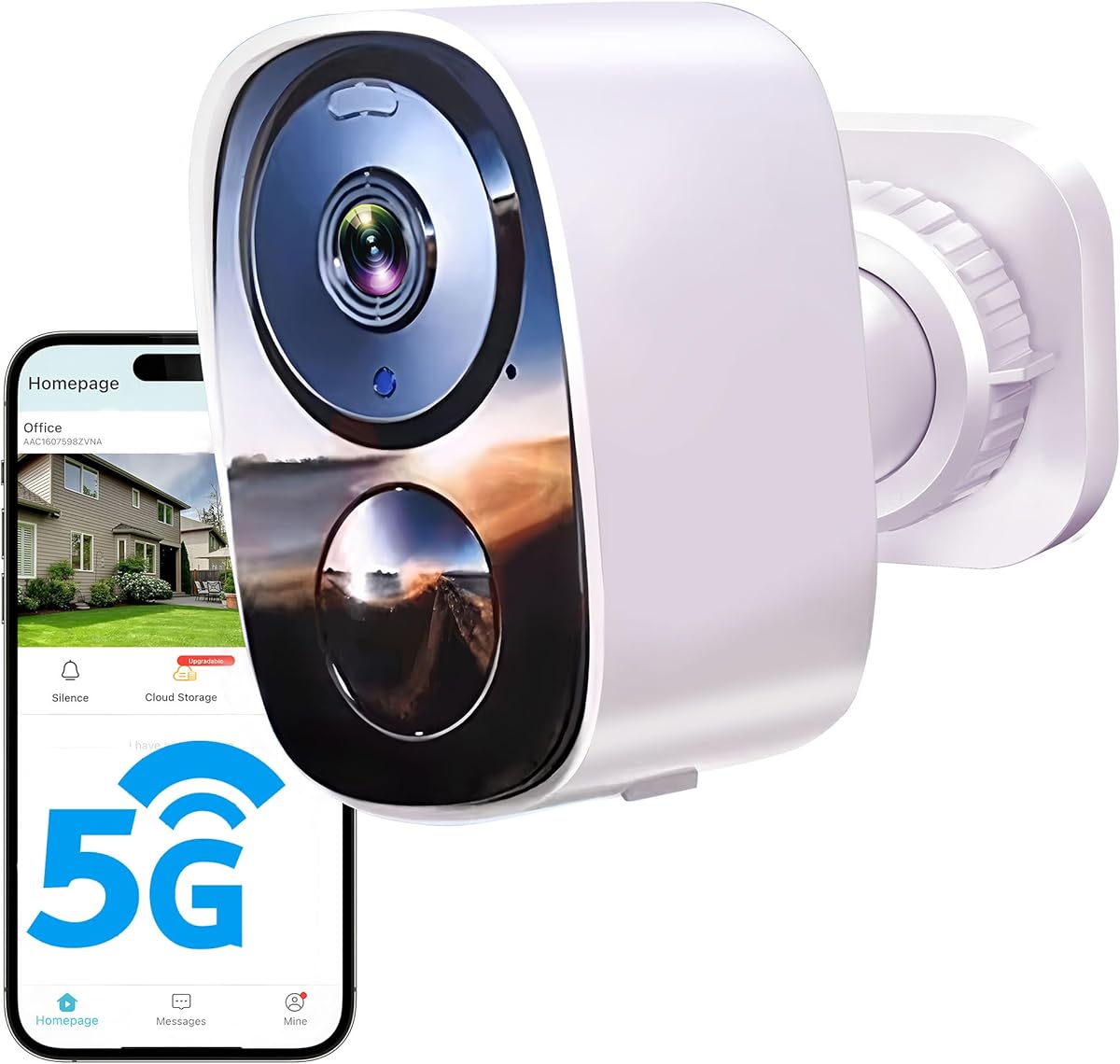
The camera records in 2K UHD and includes full-color night vision using built-in LED lights. It supports both 2.4GHz and 5GHz WiFi, with 5GHz offering higher speed at shorter distances and 2.4GHz generally extending farther. That flexibility can reduce setup friction, especially in homes where one band is congested or unable to reach the intended mounting point.
Battery duration is advertised as one to six months. The supplied test data states that a fully charged camera can run for 60 days when motion detection is triggered 100 times per day, with the longer estimate available at a lower trigger frequency. Battery life will vary with temperature, recording behavior, signal strength, and activity levels, so the maximum figure should be treated as a best-case scenario.
Storage options include a free cloud plan and local microSD support up to 256GB. The free cloud tier provides SD-quality footage, while HD access is available through paid plans. A card is not included. AI motion detection, push notifications, two-way audio, a spotlight, and a siren add useful functions for a basic home-security setup.
Its main limitation is that conventional dual-band WiFi does not make it a specialist long-range camera. It is best for installations within dependable router coverage or with the included flexibility to choose between WiFi bands. For buyers seeking inexpensive, wire-free monitoring with modern detection and storage choices, it offers a practical feature set without the complexity of a hub system.
Supporting both 2.4GHz and 5GHz gives installers a useful way to improve stability. The 2.4GHz band usually travels farther, while 5GHz can provide a faster response when the camera remains close to the router. Test both options from the exact outdoor location before finalizing the mount.
The camera can work without a paid cloud plan, but the included free tier is limited to SD-quality recordings. Local microSD storage offers a separate path for retaining footage directly on the camera. The 256GB card limit is useful, but the card must be bought separately.
We may earn a commission when you buy through this link, at no additional cost to you.
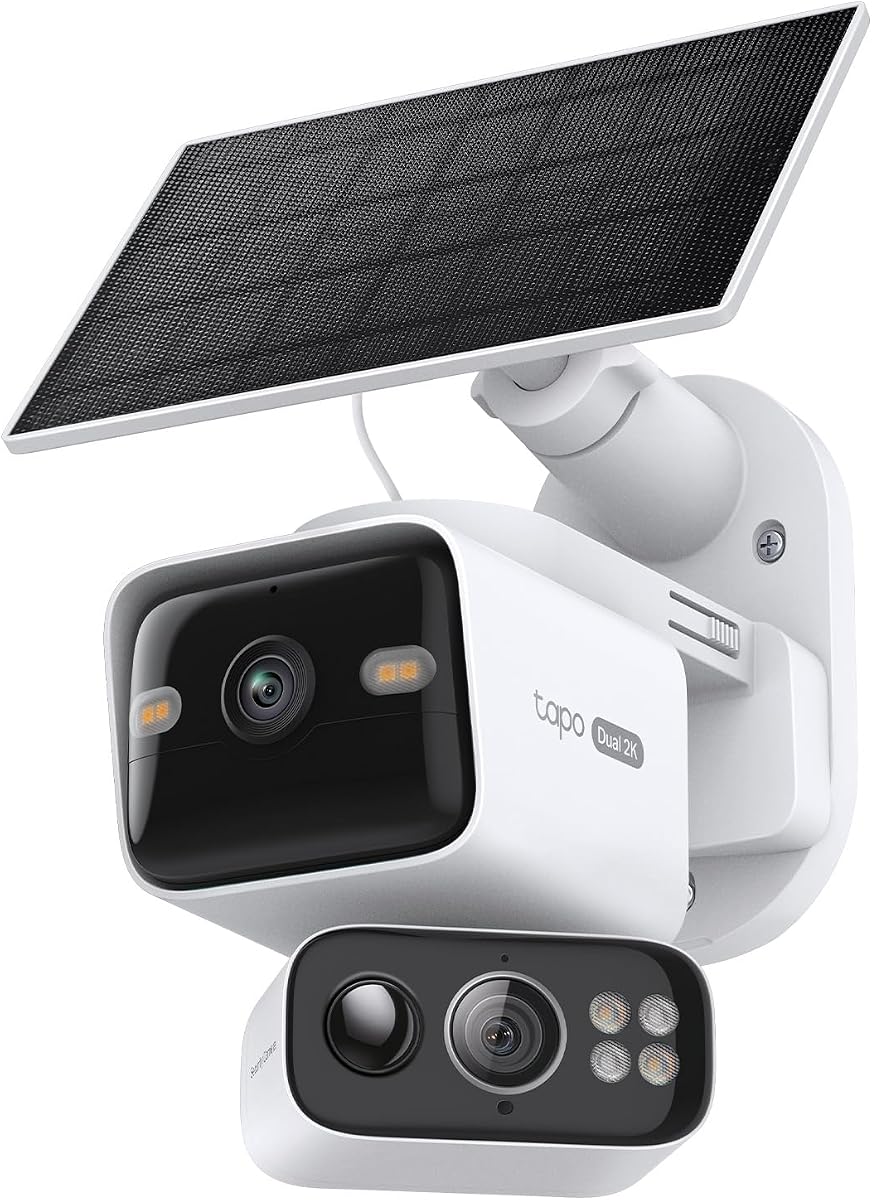
The Tapo C645D KIT is the most balanced standalone camera in the group, combining two 2K lenses, pan and tilt movement, solar charging, local recording, intelligent detection, and dual-band WiFi. Its 4.4 rating is the highest among the rated products, and the camera was also identified as a USA Today Top Pick at CES 2026.
We may earn a commission when you buy through this link, at no additional cost to you.
One fixed ultra-wide lens covers 165 degrees, while a separate pan/tilt telephoto lens provides sharp zoomed detail. Their fields of view can cover two areas at once, reducing the chance that a person walking from one part of a property disappears into a blind spot. The fixed lens can also guide the moving lens toward detected activity, producing synchronized tracking across the scene.
Detection distinguishes people, vehicles, and pets without requiring a subscription for those core classifications. That makes the camera attractive for users tired of paying for basic event alerts. A 10,000mAh internal battery provides backup, while the solar panel is stated to supply a full day of operation after one hour of direct sunlight. Under cloudy conditions, the battery can last up to four months on a charge.
Night viewing can use vivid color spotlights or more discreet infrared operation. Both 5GHz and 2.4GHz WiFi are supported, with the longer-distance advantage generally associated with 2.4GHz. The product also benefits from Tapo's cybersecurity focus and participation in the CISA Secure-by-Design pledge, which may matter to privacy-conscious buyers.
Its limitation is distance. The C645D KIT does not claim the open-air reach of a HaLow camera or a PTZ model with a 50x lens, and the 5GHz band has a shorter practical range. It is therefore most suitable for buyers who value wide-area awareness, tracking, dual lenses, and solar convenience over extreme distance. For a broad yard or driveway with ordinary WiFi coverage, it is an excellent compromise.
The fixed 165-degree lens maintains a broad view while the pan/tilt telephoto lens follows more specific details. This arrangement is more versatile than a conventional single-lens pan/tilt camera because one view can remain stable while the other reacts to movement.
One hour of direct sunlight is stated to provide a full day of operation, and the 10,000mAh battery preserves monitoring when sunlight is limited. Solar charging requires temperatures above 32 degrees, so cold-climate buyers should account for seasonal reduced charging and plan accordingly.
We may earn a commission when you buy through this link, at no additional cost to you.
The Swann MaxRanger4K Mini 3-Pack is a complete starting point for buyers who want several 4K wireless cameras without assembling a hub and add-on devices individually. Its 4.1 rating reflects a capable package, and the included base station makes local recording and long-range camera placement substantially easier.
We may earn a commission when you buy through this link, at no additional cost to you.
The system uses 900MHz Wi-Fi HaLow to support camera placement up to 1000 feet in line of sight and as much as 330 feet through obstacles. The product description specifically highlights penetration through walls, ceilings, and trees. This makes the kit more suitable for a farmhouse, workshop, or business compound than a collection of standard WiFi cameras tied to one indoor router.
Each camera captures 4K video through a wide 110-degree lens. True Detect+ AI sensing identifies heat, motion, people, and vehicles, allowing the system to trigger recording, notifications, a siren, sensor lights, and two-way communication. Night2Day color night vision and infrared mode provide choices for detailed color viewing or discreet low-light monitoring.
The base station includes a 32GB microSD card, expandable to 512GB, and supports local recording without a subscription fee. That makes the kit appealing to users who want dependable event retrieval without relying on a cloud account. Remote access is handled through the Swann Security app for iOS and Android.
The cameras are rechargeable and support USB-C, with optional solar charging also available. This gives owners a path to wire-free placement if they have compatible solar equipment. The principal compromise is the shared base station: it must be positioned where the cameras can maintain a strong HaLow link. Actual range will vary, so testing a representative location before mounting all three cameras is sensible.
The package includes three cameras, a base station, local storage, and a mobile-app ecosystem. This is simpler for new users than purchasing a separate hub and individual add-on cameras, particularly when coverage is needed around several widely separated areas.
A 32GB card is included and can be expanded to 512GB, allowing footage to remain on the base station without a recurring monitoring charge. Users who want off-site backup can still explore the app's cloud options, but local control is the kit's clearest ongoing-cost advantage.
We may earn a commission when you buy through this link, at no additional cost to you.
The Swann Max Ranger 4K Solar Add-on is a high-rated expansion camera for people with a compatible MaxRanger4K system. Its 4.4 rating is among the strongest in the list, while the combination of 4K video, 900MHz Wi-Fi, solar charging, and no monthly fee targets remote coverage on large properties.
We may earn a commission when you buy through this link, at no additional cost to you.
Its most prominent claim is a range of up to 2000 feet depending on local conditions. The underlying 900MHz network technology is designed to provide stronger signal strength through walls and other obstacles than standard WiFi. For a property where the nearest suitable router is far away, this low-frequency approach can solve a coverage problem that ordinary dual-band cameras cannot.
A high-end sensor supports 4K Ultra HD color video during the day and at night. True Detect plus AI senses heat, motion, people, and vehicles, then uses those classifications to trigger recording and alerts. The integrated solar panel means the camera can remain wire-free without frequent manual charging, which is particularly useful on gates, barns, driveways, and remote outbuildings.
The absence of a monthly fee is beneficial when the camera is added to an established local-recording system. It can cover another distant zone without adding another recurring cloud expense. Buyers should, however, ensure that their existing hub supports this model and understand that the long-range figure is not guaranteed in every environment.
This add-on is best for owners who want to expand a working Swann ecosystem rather than start over. Its high rating, clean solar design, and 4K capture make it a solid extension. The key question is compatibility: shoppers without a MaxRanger4K Hub should select a complete kit or standalone camera instead of purchasing this unit as their first security device.
This camera delivers its intended value when paired with a compatible MaxRanger4K Hub and existing cameras. It fills a distant blind spot without extending indoor router coverage or running a new power cable, and local recording lets the expanded setup remain subscription-free.
The 2000-foot figure represents a maximum in favorable conditions, not a guaranteed distance through every structure. Trees, terrain, walls, metal, and other obstructions reduce effective range. A site test can prevent a poor camera location and help buyers determine whether a shorter-range standard WiFi camera would work equally well.
We may earn a commission when you buy through this link, at no additional cost to you.
The Swann MaxRanger4K Solar 3-Cam Kit is the premium complete system in this guide, combining three solar-powered 4K cameras with a long-range hub-based ecosystem and local recording. It is the most comprehensive option for a large property that needs multiple distant camera positions without conventional cabling.
We may earn a commission when you buy through this link, at no additional cost to you.
The system claims up to 2000 feet of open-air range and 650 feet in typical use. Its advanced wireless technology is designed to penetrate walls, trees, and obstacles with fewer dropouts than traditional WiFi. That makes it particularly relevant for farms, sprawling homes, warehouses, and commercial properties where the router or hub cannot sit beside every camera.
Each camera captures 4K Ultra HD footage and has enhanced color night vision with sensor-light visibility up to 100 feet. True Detect+ identifies heat, motion, people, and vehicles, coordinating recordings, mobile alerts, spotlights, sirens, and two-way audio. These active deterrence tools can turn a passive recording system into a system that visibly responds to a detected threat.
Every outdoor camera includes a built-in solar panel and an IP66 weatherproof rating, allowing wire-free placement in exposed areas. The kit includes a 64GB microSD card, stated to support up to 12 months of rolling local recordings. Users can monitor, play back, talk, and manage the system through the Swann Security app, and the product is advertised without monthly fees.
The supplied data does not include a customer rating for this kit, so no numerical rating can be responsibly inferred. Its main limitations are cost relative to smaller packages and the need to position the central hub carefully. Nevertheless, it offers the strongest all-around package for buyers who want maximum placement flexibility, multiple 4K viewpoints, solar power, local retention, and no recurring monitoring charge.
A hub-based HaLow network gives each camera more placement freedom than a standard WiFi product. The stated 2000-foot open-air reach and 650-foot typical-use figure make the kit attractive for properties where cameras must cover distant gates, fields, buildings, or parking areas.
The included 64GB card is specified for up to 12 months of rolling local recordings. This reduces reliance on cloud subscriptions and gives users a straightforward way to retain recent activity. Actual retention varies with scene activity, recording settings, and how often clips are retained.
We may earn a commission when you buy through this link, at no additional cost to you.
The AX1800 Outdoor WiFi Extender is not a camera, but it is relevant to this guide because improving the outdoor network around a property can be essential for getting a conventional WiFi security camera online. Its 4.8 rating is the highest listed, reflecting a well-received networking product designed for backyards, garages, farms, pools, and other outdoor spaces.
We may earn a commission when you buy through this link, at no additional cost to you.
The extender uses WiFi 6 and offers AX1800 class speeds, divided between 574Mbps on 2.4GHz and 1201Mbps on 5GHz. Six high-gain antennas are intended to provide a stable signal across larger outdoor areas. This can be useful when a camera is beyond reliable coverage from the home router but still has line of sight to a strategically placed network unit.
Three operating modes make it adaptable. Repeater mode extends an existing network, router mode creates a new network, and access point mode provides a wired-focused option through Gigabit Ethernet. The flexibility lets installers choose between a quick wireless extension and a more stable wired connection where running Ethernet is practical.
The IP65 housing is designed to resist rain, dust, and extreme temperatures. Power can come from the included 12V adapter or through Power over Ethernet, and the unit supports vertical or horizontal mounting. The description states that setup can be completed in about five minutes and that it is compatible with 99% of routers, though exact performance still depends on the source network.
This product should be matched to cameras that use ordinary 2.4GHz or 5GHz WiFi. It cannot extend the proprietary HaLow connection used by MaxRanger systems, and it will not replace a camera's hub. For buyers searching specifically for a long-range outdoor camera, this is an accessory rather than a direct recommendation. Its value appears when it solves a coverage gap that would otherwise prevent a standard WiFi camera from connecting.
Repeater mode is useful when a cable run is not possible, access point mode can provide a more stable wired network, and router mode can create an independent outdoor connection. Choosing the correct mode makes a larger difference than antenna placement alone.
This device expands conventional WiFi coverage but does not record video, detect motion, or store footage. It also cannot extend a HaLow hub network. Use it to support standard WiFi cameras and smart outdoor devices, not as a substitute for a surveillance system.
We may earn a commission when you buy through this link, at no additional cost to you.
The Blink Outdoor 4 XR 4-Pack is a complete four-camera system built around the Sync Module XR, a hub designed to extend the reach of ordinary Blink Outdoor 4 cameras. Its 4.0 rating matches the BU-H900, and the included cameras, hub, batteries, and mounting hardware make it convenient for covering several parts of a property.
We may earn a commission when you buy through this link, at no additional cost to you.
Cameras can be installed up to 1000 feet from the module in open air or 400 feet in typical use. According to Blink, that is four times farther than cameras operating on WiFi alone. The XR system uses 900MHz technology to avoid typical WiFi congestion, resulting in a stated 20% faster live view and up to 70% fewer disconnects.
Power is handled by two-year battery claims when the cameras are used with the XR hub and included Energizer Lithium AA batteries. That longevity makes the system attractive for fence lines, gates, sheds, and other positions where running cables or frequently replacing batteries would be inconvenient.
The Sync Module XR can store events locally on a microSD card up to 256GB, although the card is sold separately. Buyers can also use Blink's cloud service following a free 30-day trial. The Blink app supports arming, disarming, grouping cameras, live viewing, and routines, while Alexa compatibility adds voice control for those who already use the platform.
The main purchasing consideration is deciding between local and cloud storage from the outset. The XR module can support up to 10 Blink devices, giving owners room to expand beyond the four included cameras. Its open-air and typical-use range figures are clearly differentiated, which helps set realistic expectations. For buyers seeking an established brand ecosystem, four included cameras, and strong battery convenience, the 4-Pack is a versatile choice.
The package includes four Outdoor 4 cameras, the Sync Module XR, eight lithium AA batteries, mounting kits, a USB-C cable, and a power adapter. It offers a straightforward way to establish multi-point coverage without purchasing each component separately.
A microSD card in the XR module can hold up to 256GB, providing a local alternative to subscription storage. The card is not included, and the cloud option begins with a free trial before a paid plan is required. Compare retention and access needs before deciding which route fits.
We may earn a commission when you buy through this link, at no additional cost to you.
The right camera depends on property size, obstruction levels, power access, and the kind of evidence you need. Review the following factors before choosing a camera or a complete system.
Wireless range should be evaluated as more than a single maximum-distance number. Open-air claims assume a clear path between the camera and hub or router, while real installations often include walls, trees, sheds, terrain, and reflective surfaces. Standard 2.4GHz and 5GHz WiFi can work well near a router, but a 900MHz HaLow or XR system is better suited to cameras positioned hundreds of feet away. Check the stated typical-use distance as closely as the open-air maximum.
Prioritize a system that reports a realistic obstructed range, then test the intended camera location before mounting several units. Signal quality, antenna placement, router congestion, and power adapters can matter as much as the advertised specification.
Resolution determines how much usable detail remains in the frame, but magnification determines whether distant subjects are large enough to inspect. 2K is suitable for ordinary yard and entry monitoring, while 4K offers a clearer basis for identifying faces, license plates, clothing, or wildlife. A camera with 50x optical zoom is a different category from one that only supports digital cropping, because optical magnification preserves more detail before enlargement.
Choose higher resolution for broad properties and evidence review. If your main subject is genuinely far away, prioritize optical zoom and autofocus over extra wide-angle coverage or a second lens.
Outdoor cameras need a usable night image whether or not visible light is available. Infrared provides discreet, long-range monochrome coverage, while spotlights produce more detailed color video but may create glare, reflections, or light pollution. Some cameras offer both modes, allowing the owner to use color when someone approaches and switch to infrared for quieter monitoring.
Compare the stated infrared and color-light distances separately. A 1200-foot infrared specification is very different from a 100-foot color specification, and actual visibility still depends on the subject, weather, and scene.
Battery operation removes the need to run power cables, while solar charging can extend the interval between manual charges. The amount of direct sunlight, seasonal temperature, camera activity, and signal strength all affect battery life. A long advertised duration may assume infrequent motion triggers rather than continuous recording. USB-C power and optional solar panels can provide useful fallback options.
For hard-to-reach locations, favor a camera with a high-capacity battery or integrated panel. Confirm cold-weather charging requirements and make sure the chosen location receives enough direct sun throughout the year.
Basic motion alerts can be noisy, especially on large properties where vegetation and animals move constantly. AI classification for people, vehicles, and pets is more useful because it lets users focus on relevant events. Custom detection zones, sensitivity controls, and schedules add further control. A siren, spotlight, or two-way audio adds active deterrence and can sometimes stop an incident before damage occurs.
Prioritize accurate classification if notification fatigue is a concern. If immediate intervention matters, look for a camera that combines detection with a speaker, light, or alarm rather than recording footage alone.
Local microSD storage keeps footage on the camera or hub and can avoid a monthly cloud charge. It is valuable for privacy-conscious users and properties with unreliable internet. Cloud storage provides convenient off-site access and backup, but its retention, video quality, and cost should be reviewed before relying on it. Some free tiers exist, but they may limit resolution, retention, or features.
Check whether a storage card is included, its maximum capacity, and whether continuous recording is supported locally. If cloud backup is important, calculate the long-term plan cost and confirm that your preferred recording quality remains available.
An IP66 rating indicates protection against dust and powerful water jets, making it appropriate for exposed outdoor positions. Weather resistance does not eliminate the need for a sensible mounting angle, protected cable route, and stable bracket. Field of view should be matched to the site: wide lenses suit yards and entrances, while telephoto lenses and PTZ movement help with distant approaches.
Use a fixed wide view for continuous coverage and a moving or zoomed view for details. For very large areas, several cameras may be more dependable than one camera expected to cover every direction.
Standalone cameras are convenient for small installations, but a hub-based system can provide stronger long-range links, coordinated recording, local storage, and easier expansion. Add-on cameras are often the most economical way to extend an existing compatible system, but they cannot operate alone. Before buying, verify the required hub, app, power accessories, storage medium, and subscription rules.
Choose a proprietary ecosystem only if its range and app experience meet your needs. For a one-camera installation, confirm that the camera offers direct WiFi access and the remote features you actually intend to use.
Start by mapping the property and identifying what must be seen. Walk the intended camera positions, note walls and vegetation between each location and the router or hub, and test the network before permanent installation. Mount cameras high enough to discourage tampering, angle the view toward likely approaches, and avoid pointing directly into bright sources that can obscure night footage. For PTZ models, confirm that the mechanical range covers the important zone.
Follow the manufacturer's pairing process through the appropriate app, then configure a strong password, update firmware, and enable the desired detection types. Create separate detection zones for entry points, roads, and noisy areas. Set notification sensitivity and schedules so that the system is useful rather than overwhelming. Test live view, recording playback, two-way audio, spotlights, sirens, and local or cloud storage under both daytime and nighttime conditions.
For maintenance, clean the lens gently and keep solar panels free of dirt, leaves, and snow. Inspect brackets, seals, cable entries, and camera alignment every few months. Check storage capacity and test whether recordings are being saved where expected. Keep batteries charged, replace them according to observed performance, and avoid using the maximum battery estimate as a maintenance schedule. Updating the app and firmware can improve stability, detection, and security.
A dedicated low-frequency camera-and-hub system is generally the most reliable option for distances of several hundred feet or more. Products using 900MHz Wi-Fi HaLow or a comparable XR architecture are designed to penetrate obstructions better than conventional 2.4GHz or 5GHz WiFi. For shorter distances, an outdoor access point can improve a standard WiFi camera's connection. Site testing remains important because walls, terrain, vegetation, and interference affect every system.
No. Some cameras connect directly to a router or use a dedicated outdoor access point, while add-on cameras require a compatible hub. Products described as NVR or add-on devices cannot provide all of their advertised functions until linked to the correct recorder. Check whether the camera works independently, what app it uses, and whether the required hub is included before making a purchase.
4K is helpful on large properties because it preserves more detail when a distant subject occupies only a small part of the frame. It becomes especially useful for identifying license plates, clothing, facial features, or wildlife. Resolution alone does not improve a weak signal or bring a faraway subject closer, so buyers should still consider range, lens quality, autofocus, and night illumination.
Solar charging can work in winter, but output depends on daylight, weather, panel orientation, and temperature. Some models have minimum operating or charging temperatures, and the Tapo C645D KIT specifically states that solar charging requires temperatures above 32 degrees. A rechargeable battery backup helps maintain operation during cloudy periods, but cold weather can temporarily reduce battery performance and charging speed.
Local storage avoids recurring fees and keeps recordings on equipment under the owner's control, making it attractive for privacy and predictable long-term costs. Cloud storage is more convenient for off-site access, sharing, and backup, but the free tier may limit quality or retention. The ideal choice depends on how much footage must be preserved, how it will be accessed, and whether the buyer prefers predictable local control or off-site convenience.
Infrared night vision uses infrared illumination to create a monochrome image and usually reaches farther while remaining less noticeable. Color night vision uses visible white light to retain natural color, but its reach is often shorter and it can create glare or illuminate the property. Products that support both let users choose color for identification and infrared for discreet or energy-efficient monitoring.
The right count depends on entry points, blind spots, the size of important areas, and the required level of detail. A PTZ camera can cover changing directions, while a dual-lens model can watch two areas at once, but neither replaces multiple cameras when consistent coverage is essential. Map the property, identify vulnerable approaches, and choose camera positions that provide useful views without relying on a single unit to cover everything.
No. An outdoor extender improves conventional WiFi coverage but does not record footage, detect events, or store video. It can help a standard 2.4GHz or 5GHz camera connect when the camera is moderately distant from the router. It cannot extend a proprietary HaLow hub connection, so buyers needing several hundred feet of reliable reach should choose a compatible long-range camera system.
The Tapo C645D KIT is the strongest all-around standalone pick because its dual 2K lenses, 165-degree fixed view, 360-degree pan, solar charging, intelligent tracking, and subscription-free detection cover many common outdoor needs. The Blink Outdoor 4 XR 4-Pack is the best value-oriented complete system, offering four cameras, a dedicated XR hub, long stated reach, and long battery life. The Swann MaxRanger4K Solar 3-Cam Kit is the premium choice for buyers prioritizing the greatest coverage, 4K detail, solar power, and local storage.
Before buying, prioritize the actual distance between the camera and its hub or router, the obstructions in that path, and the level of detail required. Close-range users may get more value from dual lenses and smart detection, while large properties benefit from 900MHz HaLow or XR systems and multiple camera positions. Also verify hub compatibility, local-storage requirements, battery assumptions, weather ratings, and the exact night-vision distances before ordering.
Ratings, product configurations, and current pricing can change, so review the latest listing and manufacturer support information before making a final decision. Compare the complete system cost rather than only one camera, especially when add-on products cannot operate independently. For the widest selection, use the comparison table as a starting point and then evaluate each camera against the specific conditions of your property.