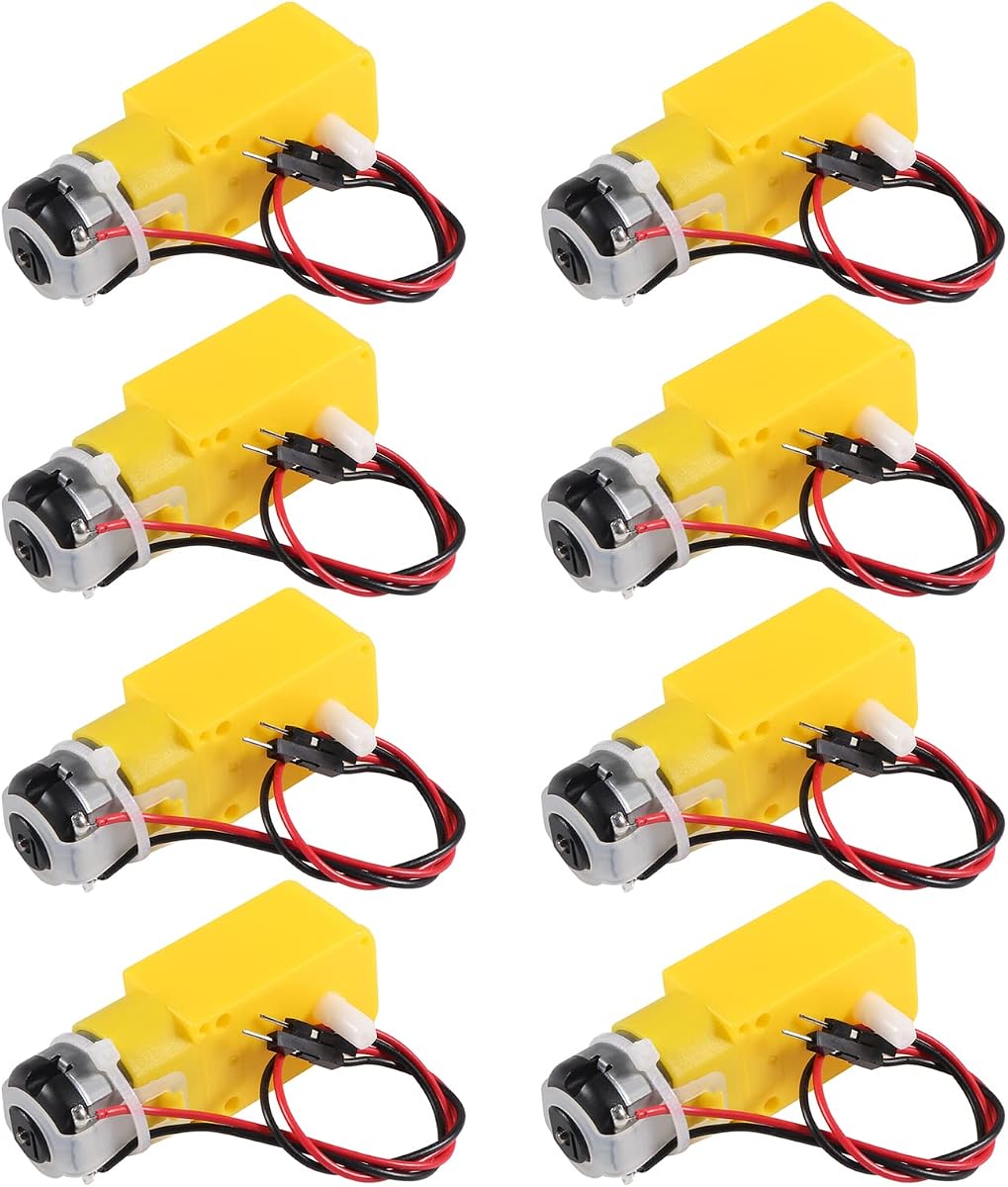
8pcs TT Gearbox Motor Set
4.5Editor score
Eight motors and four wheels
1:48 reduction ratio
Preinstalled breadboard connectors
This guide compares the best DC motors for robots, including gearboxes, encoders, torque, speed, voltage, mounting, and application suitability.
DC motors for robots range from tiny brushed units for lightweight builds to metal-geared drive motors for heavier vehicles. A suitable motor must match the robot's power supply, load, speed, wheel or mechanism, and available mounting space while providing enough torque for reliable movement.
We compared these ten options using the supplied specifications, customer ratings, gearbox construction, shaft details, encoder support, voltage requirements, and intended robot applications. The list includes multi-packs, planetary and spur-gear motors, encoder-equipped units, and compact models for cars, smart robots, and educational projects.
Each review explains the most useful strengths, limitations, and best-fit projects, while the comparison table highlights the differences that matter most. Product details and availability can change, and current prices should be checked on each listing before making a purchase.
4.5Editor score

4.7Editor score

4.6Editor score
The comparison below organizes every motor by its most important supplied characteristics, including drive configuration, electrical range, torque or speed data, feedback options, and intended uses. Use it to narrow the field before checking physical dimensions and shaft compatibility.


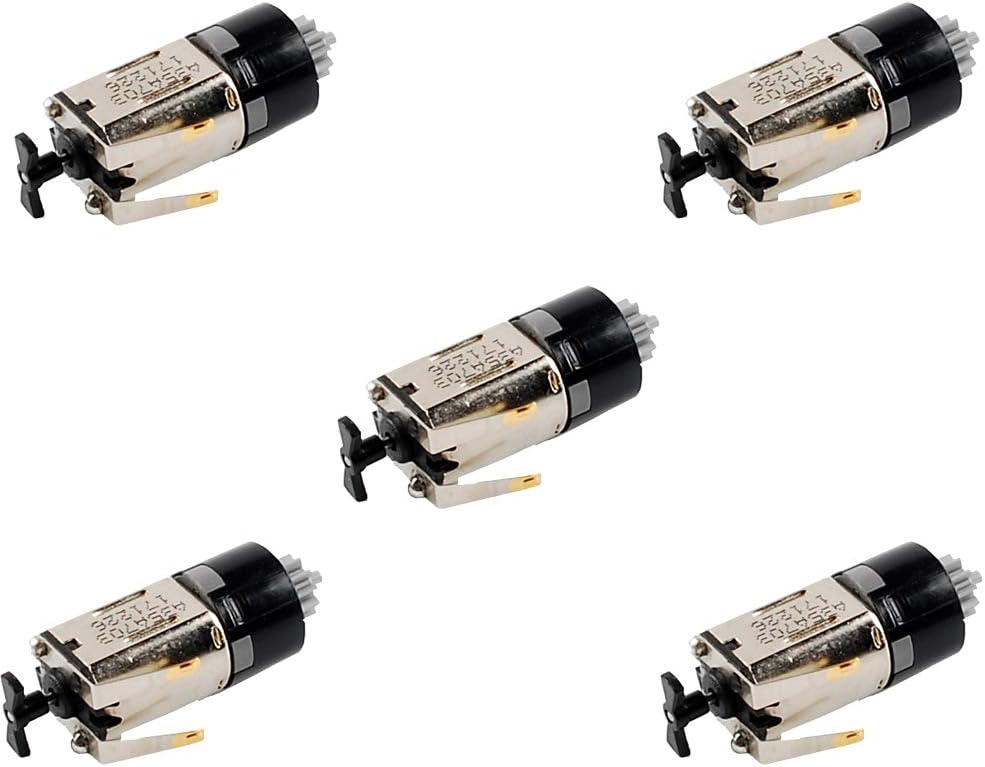

This two-pack combines a 1:90 all-metal TT gearbox with an integrated 12-PPR Hall encoder, making it one of the strongest choices for robots that need controlled movement and position feedback. Its supplied rating is 4.7, and the headline specifications distinguish it from basic TT motors by adding a metal shaft, a metal gearbox, and a dedicated encoder interface.
We may earn a commission when you buy through this link, at no additional cost to you.
The motor operates across 3-12V, giving builders flexibility when using common battery or regulated supply arrangements. Its listed no-load output speed is 113 RPM, while rated torque is 1.0 kg.cm and stall torque is 1.8 kg.cm. The AB-phase encoder provides two quadrature outputs, enabling a controller to measure speed and angular position rather than relying only on timed commands.
The main trade-off is the high 1:90 reduction ratio. It exchanges raw speed for stronger low-speed torque, which can be beneficial in small drive wheels, but it may feel sluggish in a lightweight robot that needs to move rapidly. The encoder also needs a separate 3.3-5V supply and suitable signal wiring, adding complexity compared with a simple two-wire motor.
Choose this option when closed-loop position control, repeatable wheel movement, or a durable TT-format gearbox matters more than maximum speed. It is especially suitable for smart cars, educational robots, and compact robotics platforms where encoder data can improve motion control. For a basic first robot, a simpler TT set may be easier, but this is the more capable choice for projects ready to use feedback.
The 12-PPR Hall encoder gives the controller a way to evaluate wheel rotation and position. That feedback can support more consistent navigation and help a robot detect when a wheel stalls, slows unexpectedly, or stops responding as commanded.
The all-metal gearbox and metal shaft are valuable in a robot because wheels and gearboxes experience repeated loads, impacts, and vibration. This construction is a meaningful upgrade over basic plastic TT options when the mechanism is expected to work regularly.
We may earn a commission when you buy through this link, at no additional cost to you.
This planetary DC gear motor is positioned for high-load robotic mechanisms that require much more torque than a small TT motor can provide. It carries a 4.6 rating and is described as a 6-22V metal-geared motor with 90 kg.cm high torque and an 8mm D-shaped output shaft.
We may earn a commission when you buy through this link, at no additional cost to you.
Its broad voltage range can accommodate multiple battery and power-system arrangements, while the stated 200W description suggests a substantially more powerful unit than the miniature motors in this guide. The metal planetary gearbox and high-torque specification make it relevant for robot drives, rotating tables, lock mechanisms, curtain systems, and other geared equipment.
The important limitation is that no encoder is listed. A builder cannot assume that a standard motor controller can directly read wheel speed or position from this unit. The 8mm D-shaft also requires a compatible hub, coupler, or mounting arrangement, and the substantial motor may be excessive for a small educational rover.
This is a strong choice for a heavy-duty robot, custom robotic arm, or other torque-sensitive actuator. Select it when the mechanism must move a meaningful load and open-loop speed control is sufficient. For precision wheel positioning, a robot controller should be paired with an external encoder or feedback sensor suitable for the installed mechanism.
A listed 90 kg.cm output torque allows the gearbox to handle greater resistance than small robot drive motors. This is useful for mechanisms that lift, rotate, or push against a load rather than merely rolling freely across a floor.
The 6-22V operating range works with a variety of supplies, and the description notes that changing the wiring connection changes motor rotation. Reversing polarity is convenient during assembly, although an appropriate driver and current handling remain necessary.
We may earn a commission when you buy through this link, at no additional cost to you.
This eight-motor TT set is a practical starting point for a multi-wheel robot, especially for students or builders assembling several small platforms. It has a 4.5 rating, a 1:48 gear ratio, a 200 RPM rating at 6V, and a 3-6V operating range. The package also includes four wheels and 200mm leads fitted with 2.54mm connectors.
We may earn a commission when you buy through this link, at no additional cost to you.
The preinstalled connectors are a major convenience for prototypes. They make it easier to connect the motors to a breadboard or terminal block without fabricating a temporary cable connection. The combination of eight motors and four wheels also provides enough hardware for multiple experiments, allowing a builder to replace a damaged unit or construct several chassis configurations.
The set does not include encoders, so closed-loop speed and position control are not available from the listed hardware. It also has a lower gear ratio than the 1:90 encoder-equipped TT option, producing greater speed but less reduction than that model. The 0.8 kg.cm stall torque listed at 6V should be considered for light-duty applications.
This is a good match for Arduino smart cars, school robotics kits, distance-measurement experiments, and entertainment robots. Choose it when affordability, quantity, and quick assembly matter most. Builders requiring accurate wheel feedback should plan to add separate sensing or choose an encoder-equipped motor instead.
Eight motors and four wheels cover the basic needs of a four-wheel chassis and leave additional motors for comparisons or replacement. This makes the set more useful for iterative classroom and hobby work than buying one motor at a time.
The 200mm, 28 AWG wires with 2.54mm connectors shorten prototype assembly time. They are especially convenient for beginners who want to test a chassis before designing permanent wiring.
We may earn a commission when you buy through this link, at no additional cost to you.
This 12V encoder gear motor offers a middle ground between tiny TT mechanisms and heavy-duty planetary drives. It has a 4.4 rating, a listed output speed of 500 RPM, full metal gears, an encoder, a mounting bracket, and a rubber tire wheel. The package is especially convenient for smart-car and robot-model builds that need more than a bare motor.
We may earn a commission when you buy through this link, at no additional cost to you.
The supplied mounting bracket and wheel reduce the amount of chassis fabrication required. A 65mm motor diameter makes it more substantial than a 25mm miniature unit, yet the 500 RPM output speed remains responsive for a small smart car. Encoder support gives the controller a route to closed-loop speed and position measurement.
The main constraint is size and power-system alignment. A robot restricted to a 3.3V or 5V microcontroller will need a suitable 12V supply and an appropriately rated motor driver. The supplied 65mm dimensions also require adequate chassis clearance, and the exact encoder wiring details should be confirmed before designing a connector board.
Choose this motor for a smart car, educational robot model, or compact rover that benefits from a wheel, bracket, gearing, and feedback in one package. It is less suitable for miniature mechanisms or very lightweight builds. When a faster, more complete kit will reduce assembly time, it offers a practical and balanced option.
Including a rubber tire wheel and mounting bracket makes this closer to a ready-to-build drive module than a standalone motor. That convenience can be valuable when a builder wants to concentrate on controls, sensors, and program logic.
The integrated encoder enables the control system to compare commanded movement with measured rotation. That can improve repeatability and provide useful wheel-speed information during navigation or obstacle-handling tests.
We may earn a commission when you buy through this link, at no additional cost to you.
The CQRobot 70:1 gearmotor offers clearly documented electrical and mechanical performance, making it a strong general-purpose choice for robot chassis drives. It has a 4.6 rating, a 37mm diameter, a 54.8mm length, a 6mm D-shaped shaft, and a supplied metal mounting bracket.
We may earn a commission when you buy through this link, at no additional cost to you.
Two voltage versions are described. At 6V, the listed figures are 5W maximum power, 75 RPM no-load speed, and 15 kg.cm stall torque. At 12V, they rise to 10W, 150 RPM, and 27 kg.cm. This makes it possible to choose a power level based on the battery and motor driver rather than committing to a single operating point.
One limitation is that the motor has no listed encoder, so precise wheel-position feedback is not provided. Stall torque is a maximum value rather than a continuous rating, and the drive electronics must handle the motor's startup and stall current. The 6mm D-shaped shaft also calls for a correctly sized hub or coupler.
Choose this motor for robots, smart balance cars, RC-style models, measuring devices, and other projects that benefit from a compact metal gearbox with meaningful torque. It is a particularly understandable option for builders who want the tradeoff between speed and torque to be clearly stated at both 6V and 12V.
Published speed, power, and stall-torque figures at 6V and 12V make capacity planning easier. Builders can relate motor output to a chosen battery system and recognize the increased power available at the higher voltage.
The 37mm body and included bracket suit many small robotic platforms. The metal gearing provides a durable mechanical foundation while the 70:1 ratio emphasizes controlled low-speed movement.
We may earn a commission when you buy through this link, at no additional cost to you.
This two-pack of compact 12V gear motors is aimed at RC-style smart cars and other hobby mechanisms. It has the highest supplied rating in the group at 5.0, together with a 6-12V operating range, a 350 RPM output speed, metal gears, and a double-shaft design.
We may earn a commission when you buy through this link, at no additional cost to you.
The 25mm diameter makes the motor manageable for small vehicle chassis, while the double-sided shaft gives builders access to both ends of the rotor. A 4mm steel D-shaped shaft helps prevent a hub or pulley from slipping when torque is transferred to a wheel or custom mechanism. The package includes two motors, which can form a complete powered pair for many small cars.
No encoder is listed, so this is an open-loop drive option unless feedback is added elsewhere. The copper rotor and metal gears are presented as durable, low-noise construction, but actual noise and performance depend on load, mounting, and operating conditions. The shaft flat is 8mm long, so a coupler must engage the correct section.
Choose this option for smart robot cars, RC conversions, small toys, controllers, and other compact powered mechanisms. Its dual-motor pack, compact format, and moderate operating speed make it especially appealing for a symmetrical chassis design.
The double-shaft design allows a wheel, gear, or pulley to be mounted from either end. This can simplify drivetrain layout and offer options for keeping a driven component close to a particular chassis wall.
The steel D-shaped shaft resists slipping compared with a completely round shaft of the same nominal diameter. It is a useful detail for compact robots where wheel hubs need to maintain a secure connection.
We may earn a commission when you buy through this link, at no additional cost to you.
The Gikfun Type 130 set contains six miniature brushed DC motors intended for lightweight robotics and hobby builds. It has a 4.2 rating, a 1.5-6V operating range, and a 3V recommended operating point. Each motor measures 15 by 20mm, making the set among the most compact options in this guide.
We may earn a commission when you buy through this link, at no additional cost to you.
The supplied 15cm red and black leads make direct electrical connection straightforward, and the case pack supports several experiments. The listed reference current of 0.35-0.4A and speed of 16,000 RPM at 3V give useful baseline data for selecting a driver and assessing whether a small wheel or pulley is appropriate.
These are bare motors rather than geared units. The very high no-load speed means they deliver little sustained output torque without reduction, so they are better suited to small fans, windmills, light mechanisms, or custom gear trains than heavy loads. The 2mm shaft also requires a small, precise coupler, and the 0.35-0.4A current should not be ignored when selecting a controller.
Choose this set for tiny robots, solar or battery-powered cars, brush-bots, and educational experiments where low mass and simplicity matter. It is an appealing option for learning how gears change speed and torque, provided the builder is comfortable designing the reduction mechanism.
A 15 by 20mm motor body leaves more room for sensors, batteries, and control boards in a small chassis. That makes the set useful for very compact robots where component weight and dimensions are tightly constrained.
Because the motors are not supplied with gearboxes, learners can experiment with reduction ratios and observe the relationship between speed and torque. The result is a more hands-on introduction to drivetrain design.
We may earn a commission when you buy through this link, at no additional cost to you.
This five-pack of micro planetary reducer motors is aimed at compact DIY robots that need reduction in a small mechanism. It carries a 4.4 rating, and the supplied performance points show how output changes across four voltages: 110 RPM at 3V, 135 RPM at 3.7V, 154 RPM at 4.2V, and 180 RPM at 5V.
We may earn a commission when you buy through this link, at no additional cost to you.
The listed current draw ranges from 42mA at 3V to 58mA at 5V. Those figures make the motors attractive for small battery-powered platforms where current capacity and weight need careful management. A set of five also gives builders enough motors for several robots, wheel positions, or replacement stock.
These are low-voltage units, so they are not suitable for a 6V, 12V, or higher robot supply without appropriate regulation and protection. The data does not mention a gearbox ratio, stall torque, shaft dimensions, or encoder, so those details should be confirmed from the package or seller before committing to a specific hub or control system.
Choose this set for micro robots, compact mechanisms, and educational planetary experiments. Its strongest advantages are small scale, low current demand, and a clear voltage-to-speed relationship. Builders should prioritize checking the physical shaft and gearbox details before assembling a permanent chassis.
Each planetary motor combines a compact motor with reduction in one assembly. Five units are sufficient for a four-wheel platform plus a spare, or for building multiple small robots during an educational program.
The documented progression from 110 RPM at 3V to 180 RPM at 5V gives builders a way to tune speed through supply voltage. This is straightforward, although a stable regulated supply will produce more repeatable results than a varying source.
We may earn a commission when you buy through this link, at no additional cost to you.
This compact brushed DC motor is a straightforward option for replacing a small motor in compatible RC cars, toy vehicles, models, and hobby mechanisms. It has a 4.4 rating, accepts 6-12V, and is described as reaching a maximum of 12,000 RPM while operating with low noise.
We may earn a commission when you buy through this link, at no additional cost to you.
The 2.3mm shaft and approximately 12mm shaft length make it possible to compare directly with an existing motor before purchase. The listing appropriately recommends checking the original motor size, voltage, shaft diameter, and wiring. That advice is important because a nominal replacement motor may still differ in current draw, speed, and physical clearance.
The absence of a gearbox makes this a high-speed mechanism rather than a ready-to-use wheel drive. The 12,000 RPM figure indicates that a robot wheel would normally need substantial reduction through gears, belts, or a multi-stage transmission. The motor also requires an appropriate brushed motor driver, and the listing does not state an encoder or exact current rating.
Choose this motor for small experiments, custom gear trains, and compatible replacement projects. It is most suitable when a builder needs a simple rotating source rather than a complete robot drivetrain. Confirming physical fit and electrical requirements before ordering can prevent an otherwise capable motor from becoming an unsuitable replacement.
Because the motor is not supplied with a reduction gearbox, it can serve as the high-speed stage of a custom transmission. A builder can select the reduction needed for the wheel, robot joint, or driven accessory.
The small shaft and compact body are useful for fitting into existing mechanisms, but appearance alone is not enough. Comparing voltage, shaft dimensions, wiring, and available chassis clearance helps prevent fit or performance problems.
We may earn a commission when you buy through this link, at no additional cost to you.
This three-pack of mini N20 gear motors is intended for small robot cars and other compact DIY mechanisms. It has a 4.6 rating, a 3-6V operating range, and a full metal gearbox. The 3mm D-shaped shaft and 9mm shaft length are clearly specified, helping builders assess wheel-hub and coupler compatibility before ordering.
We may earn a commission when you buy through this link, at no additional cost to you.
The geared format makes this a more convenient choice than a bare high-speed motor for small vehicles. A full metal gearbox is desirable in a mechanism subject to impact, vibration, and repeated starting loads. Three motors also provide enough hardware for a typical three-wheel robot or a spare for a small fleet.
The listing does not provide a numerical gear ratio, torque rating, no-load speed, or encoder support. Those omissions make it harder to predict performance before assembly, and the included motor may not offer the low-speed control of a larger TT or planetary unit. Builders should also allow space for the motor's wire connection and gearbox housing.
Choose this set for miniature robot cars, compact builds, and makers who want three geared drive motors in one package. It is best for light-to-moderate mechanisms where size matters more than advanced feedback or extensive published performance data. Matching the 3mm D-shaft to a proper hub is the most important installation check.
A three-pack is well suited to a three-wheel robot and leaves a spare motor for testing or replacement. This is useful for classroom builds where several identical compact chassis may be assembled.
The full metal gearbox adds mechanical strength without moving into the size and mass of a larger drive unit. It suits small platforms where every millimeter of chassis space matters.
We may earn a commission when you buy through this link, at no additional cost to you.
The right robotic motor depends on the load, robot size, power supply, control method, and drivetrain. Comparing voltage, speed, torque, gearing, feedback, shaft dimensions, and mounting requirements prevents an otherwise suitable motor from creating mechanical or electrical problems.
Voltage is the first constraint because it must match the robot's battery, regulator, and motor driver. The listed range includes 3-6V TT motors, 6-22V planetary models, 6V or 12V configurations, and bare motors designed for 6-12V. A motor should not be treated as a simple passive load: the driver must support its operating voltage and current, and the supply must provide enough capacity when several motors start at once.
Choose a motor whose stated range comfortably includes the intended supply, then verify the motor driver's voltage and current ratings. Lower-voltage micro motors suit small battery systems, while 12V models are common in larger smart cars. Do not power a 3V motor directly from a 12V pack merely because the connector appears to fit.
Torque determines whether a motor can accelerate, climb, push, or hold a load. The list ranges from compact motors without published torque figures to a planetary unit rated at 90 kg.cm and a 70:1 gearbox with 27 kg.cm stall torque at 12V. Stall torque describes the maximum torque at a standstill, not the sustainable output, so it should be treated as a reference point rather than a continuous duty rating.
Estimate the robot's mass, wheel size, incline, and expected resistance before choosing a ratio. Higher reduction generally improves available wheel torque while reducing speed, whereas a lower ratio favors speed. Match the motor to the mechanism rather than choosing solely by the largest torque figure.
Gear reduction converts a motor's high free-running speed into useful robotic speed and torque. TT motors use a 1:48 ratio in the eight-pack and 1:90 in the encoder-equipped option, while the CQRobot uses 70:1. Planetary units offer compact coaxial layouts, and the mini N20 motor provides a geared but slower format. The exact ratio affects acceleration, cruising speed, and the amount of torque available at the wheel.
For ordinary small car wheels, a moderate or high reduction is often easier to control. For fast lightweight rovers, less reduction may be appropriate. Make sure the gearbox can physically fit the chassis and that its output shaft matches the selected wheel hub, pulley, or coupler.
Motor speed should suit both the robot and the control electronics. Published output speeds include 200 RPM for the eight-pack TT set, 113 RPM for the 1:90 encoder motor, 350 RPM for the compact 12V gear motor, and 500 RPM for the encoder gear motor with a wheel. Bare motors run much faster, reaching 16,000 RPM for the Type 130 set and a stated 12,000 RPM maximum for the replacement-style mini motor.
High speed can make a vehicle twitchy and difficult to control, while very low speed may limit useful movement. Consider whether the project needs rapid travel, precise positioning, or a balanced combination. Gearing, wheel diameter, and motor control settings can also alter the final behavior of an assembled robot.
An encoder reports rotation so a controller can compare intended movement with actual wheel behavior. The two-pack 1:90 TT motor includes a 12-PPR AB-phase Hall encoder, and the 12V encoder gear motor also includes feedback. The other listed motors do not advertise encoder support, making them more naturally suited to open-loop speed control.
Choose an encoder-equipped model when line following, wheel odometry, position holding, or stall detection is important. Confirm encoder resolution, output voltage, signal type, and cable arrangement before designing a controller. A higher-resolution signal is not automatically easier to use, so software and wiring complexity should be considered alongside data quality.
The output shaft must match the wheel or driven component. Listed examples include a 3mm D-shaped N20 shaft, an 8mm D-shaped planetary shaft, a 6mm D-shaped CQRobot shaft, a 4mm D-shaped double shaft, a 2mm Type 130 shaft, and a 2.3mm mini replacement shaft. Diameter is only part of the check: the shaft length, flat profile, and whether the motor is single- or double-ended also matter.
A D-shaped shaft can resist slipping but requires a hub with a matching flat. Measure the available clearance and inspect the original wheel before ordering. If no matching hub is available, use a correctly sized coupler or fabricate an adapter that cannot contact the rotating motor housing.
Motor dimensions influence chassis design, battery placement, center of gravity, and available sensor space. The Type 130 motor measures 15 by 20mm, while the CQRobot measures 37mm in diameter and 54.8mm in length. Some products include a bracket or wheel, which can simplify assembly, whereas bare motors require the builder to design mounting points and hubs.
Choose the smallest motor that can safely handle the intended load. Overly small motors can stall or overheat, while an oversized unit may make a miniature robot unstable. Confirm that the bracket holes, shaft height, wire exit, and surrounding body all have enough space in the actual chassis.
Metal gearing and shafts are generally preferable where repeated loads and impacts are expected. All-metal construction is explicitly featured in the 1:90 TT encoder motor, the 12V encoder gear motor, the CQRobot, and the two-pack 12V gear motor. Accessories also influence build readiness: one set includes eight motors and four wheels, another includes a wheel and bracket, and several options require separately sourced hubs or mechanisms.
Review the entire package rather than focusing only on the motor. Extra wheels, preattached leads, and a mounting bracket can make a product more convenient, while additional bare motors can be useful for projects with several driven axes. Confirm that the included accessories match the intended design and that spare parts are genuinely useful to the build.
Before installation, confirm the motor voltage, current requirement, shaft dimensions, rotation direction, and mounting orientation. Connect the motor through a driver that is rated for its voltage and current rather than driving it directly from a microcontroller pin. Verify the wiring with the robot raised from the ground so an unexpected rotation cannot damage the chassis or nearby objects.
Install the motor and gearbox rigidly, but avoid clamping the motor housing in a way that distorts the gearbox or blocks ventilation. Couple the shaft to the wheel, pulley, or driven gear without creating side pressure. For encoder-equipped models, route encoder wires away from motor power wiring where practical and confirm the encoder's required supply voltage before connecting the controller.
Begin with a controlled test at the intended voltage, checking for smooth rotation, unusual noise, excessive heat, or repeated stalling. Add load gradually, keep the motor's current within the driver's limits, and reduce load if it stops. Remove power before changing wiring, and periodically inspect the shaft, couplings, gearbox, mount, and wiring for looseness, wear, dust, or heat damage.
A 3-6V motor is often convenient for compact Arduino projects because it can work with common low-voltage battery and regulator arrangements. The 8pcs TT set operates at 3-6V, while the three-pack N20 set also uses 3-6V. The motor still needs a suitable driver, and the microcontroller and motor supply should share a reliable ground.
They are better when the controller needs accurate speed or position feedback. The 12-PPR encoder in the 1:90 TT option and the encoder in the 12V gear motor can support closed-loop control, odometry, and stall detection. They are more complex to wire and program, so a simple rover with fixed-speed commands can still work well with a non-encoder motor.
A higher ratio generally provides more wheel torque and lower speed, while a lower ratio provides faster movement with less reduction. The listed 1:48, 1:90, and 70:1 options each suit different combinations of vehicle weight, wheel size, and terrain. Consider the required speed, available motor torque, and controller's ability to manage the resulting current.
A bare motor can be used, but usually a reduction mechanism is needed. The Type 130 motor is listed at 16,000 RPM at 3V, and the 12V mini replacement motor is listed up to 12,000 RPM, so direct wheel attachment would generally be impractical. A gear train or suitable gearbox can reduce speed and increase usable torque.
Compare the motor's output speed and torque with the mass of the robot, wheel radius, expected incline, and any load the mechanism must move. Also account for the 1:48 or 1:90 reduction, since torque at the wheel is affected by the entire drivetrain. A motor that stalls during startup or under normal load is not adequately matched.
A separate driver is normally required because microcontroller pins cannot safely supply the current drawn by a motor. The driver should match the motor's voltage, current, and whether its direction needs to be reversed. Some brushless-style control functions are not appropriate for the brushed DC motors in this guide, so verify the driver's topology before wiring it.
A geared motor includes reduction inside its package, producing lower output speed and greater torque than the bare motor can provide directly. Bare motors are more flexible for custom gear trains, fans, windmills, and educational experiments, but they require more mechanical design. A geared motor is usually more convenient when the goal is directly driving a small robot wheel.
Compare the original motor's voltage, body size, shaft diameter, shaft length, speed, and mounting arrangement before ordering. The 12V mini replacement motor has a 2.3mm shaft and approximately 12mm shaft length, but those figures only make it suitable if the physical and electrical specifications match. A replacement with the same shaft dimensions may still differ in current or torque.
The TT Motor with Encoder stands out as the most capable general choice because it combines a metal gearbox, 1:90 reduction, 12-PPR feedback, and a wide 3-12V range. The eight-piece TT set is the practical budget option for classroom prototypes, while the CQRobot 70:1 gearmotor provides clearly documented torque and speed figures in a compact, bracket-mounted format.
For any project, prioritize power-system compatibility first, followed by torque, speed, gearing, and feedback. Then verify the shaft dimensions, mounting space, and included accessories. A more advanced encoder motor is not automatically the right choice for a simple rover, while a high-torque motor can be unnecessary in a very light robot.
Ratings, product configurations, and availability can change over time, and current prices should be checked on the linked listings. Compare the final motor against the robot's actual mass, load, chassis, controller, and driver before ordering, then favor a mechanically secure fit and a supplier that provides the details needed for a successful build.