
Industrial 8-Ch ESP32-S3 WiFi Relay Module
4.8Editor score
Ethernet and wireless control
Integrated PoE network module
Isolated RS485 interface
Eight digital input channels
Our Ethernet Relay Module guide compares ten industrial and compact options for channel count, Modbus support, PoE, isolation, digital inputs, and installation.
An Ethernet relay module connects remotely operated switches to a network, making it useful for industrial control, smart buildings, agriculture, security, and automated equipment. The strongest choices balance channel capacity, reliable wired communication, useful power options, protection circuits, and an enclosure suited to the installation environment.
We compared all ten products by their stated channel counts, Ethernet and serial interfaces, Modbus and network-control support, digital inputs, power options, isolation features, installation hardware, and stated relay ratings. The list covers compact two-way boards, eight-channel industrial models, a 30-channel enclosure, and ESP32-S3 devices that combine Ethernet with wireless control.
Each review explains where the module stands out, where its design may be less suitable, and whom it is best equipped to serve. Ratings and specifications reflect the supplied product information, while product availability and prices can change. Buyers should confirm the latest listing, documentation, and electrical requirements before making a final selection.
4.8Editor score

4.9Editor score

4.8Editor score
The comparison below organizes the ten modules by their most consequential differences: number of outputs, supported control methods, power input, field-input capability, communication interfaces, and physical installation format.



This 8-CH Ethernet Relay Module is a capable industrial switching unit with a stated rating of 3.4, the lowest in this group. It earns its place in the roundup because the core design combines eight relay outputs, Ethernet control, Modbus RTU and Modbus TCP support, PoE, MQTT control, a broad DC input range, and a rail-mount enclosure.
We may earn a commission when you buy through this link, at no additional cost to you.
The module is designed for automation systems where a controller needs to switch several loads through one wired network connection. Its flash-on, flash-off function allows an operator or software system to energize a relay for a defined period and then switch it off automatically. Optocoupler isolation helps protect control electronics from high-voltage circuits, while reverse-proof circuitry is intended to reduce damage from incorrect connections.
Power can be supplied through a wide DC 7–36V input or PoE, which gives installers more freedom when the available infrastructure differs. The MQTT support and Alibaba Cloud MQTT application demo are especially relevant for cloud-connected or message-based automation, although users will still need to understand addresses, commands, and network configuration.
This is a strong choice for installers who prioritize conventional Ethernet relay control, Modbus compatibility, and flexible power. Its lower customer rating warrants checking the current listing, documentation, and seller support before purchase, but the stated feature set remains more complete than many basic network relay boards.
The combination of Modbus RTU, Modbus TCP, MQTT, PoE, and wide-voltage DC input makes this module adaptable to both local industrial networks and cloud-oriented control arrangements. It is particularly useful when one device must work with a PLC, software controller, or remote service.
A rail-mounted ABS case, status indication, isolation, and reverse-polarity protection create a more installation-ready package than a bare relay board. These physical and protective details are valuable in control cabinets, utility rooms, and other unattended installations.
We may earn a commission when you buy through this link, at no additional cost to you.
The Waveshare 8-Ch Ethernet Relay Module carries a 4.1 rating and presents a balanced combination of industrial features. It controls eight channels over Ethernet, supports Modbus RTU and Modbus TCP, offers MQTT operation, accepts PoE or DC 7–36V power, and comes in a rail-mounted ABS industrial enclosure.
We may earn a commission when you buy through this link, at no additional cost to you.
Its timed flash-on, flash-off command is useful for pumps, indicators, buzzers, and temporary equipment activation. MQTT support, paired with an Alibaba Cloud MQTT application demo, gives software developers a starting point for sending relay commands through a broker rather than relying exclusively on direct protocol polling.
Optocoupler isolation is included to help separate sensitive control electronics from the relay side, and reverse-proof circuitry is intended to limit the consequences of incorrect wiring. The stated contact rating is up to 10A at 250VAC or 30VDC, but that is a maximum rating rather than permission to run every load at every voltage. Inrush, coil characteristics, switching type, and load characteristics still need evaluation.
The Waveshare is a good general recommendation for cabinet-based automation where eight outputs, Modbus, and PoE are desired but digital field inputs are unnecessary. Compared with the first product, it offers a more favorable listed rating and clear MCU and network indicators, although it does not list digital inputs.
Supporting Modbus RTU, Modbus TCP, and MQTT allows the module to fit common industrial polling systems as well as broker-based remote-control arrangements. That makes it a practical middle ground for integrators working across different equipment.
The ABS rail-mount case simplifies cabinet installation, and four LEDs plus network indicators provide visible status information. These features can reduce troubleshooting time compared with an unmarked bare board.
We may earn a commission when you buy through this link, at no additional cost to you.
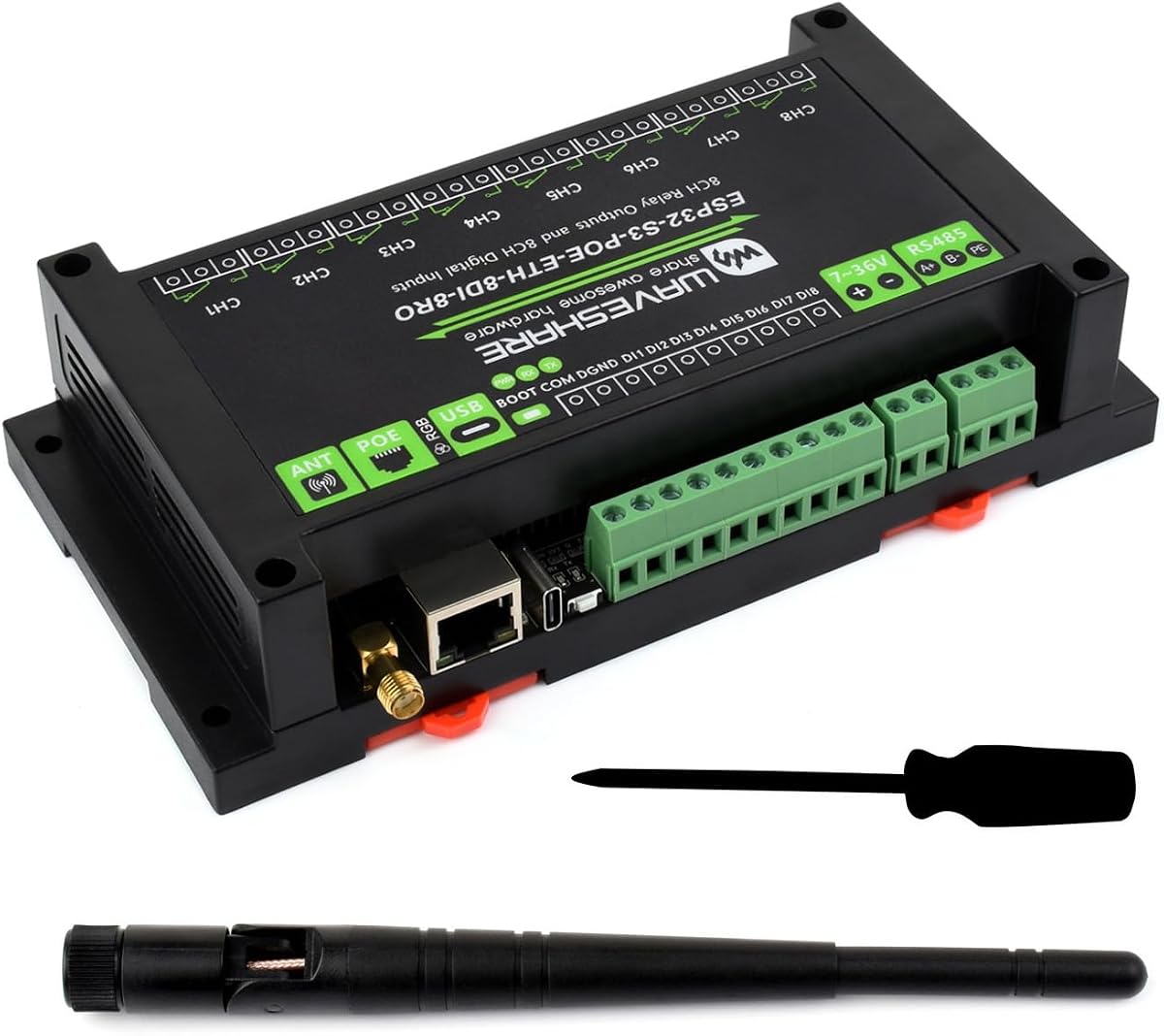
This industrial ESP32-S3 module has a 4.8 rating and is the most versatile option in the roundup. It combines eight relay outputs, eight digital inputs, an Ethernet port, 2.4GHz Wi-Fi, Bluetooth LE, RS485, and a built-in PoE module in one device.
We may earn a commission when you buy through this link, at no additional cost to you.
The ESP32-S3 controller uses a 32-bit LX7 dual-core processor operating up to 240MHz, and the module supports the Arduino IDE. Multiple isolation and protection circuits, including power isolation and optocoupler isolation, make it a strong candidate for mixed industrial and automation projects where a controller may need to read field contacts as well as switch outputs.
Its digital inputs accept both passive dry contacts and active wet contacts through bi-directional optocoupler isolation. RS485 expands the options for connecting industrial modules or sensors, while Ethernet and wireless links permit different control paths. The built-in PoE module carries both network connectivity and power over one cable, a major convenience where PoE infrastructure is available.
This premium pick suits technically capable users who want more than standard Modbus relay switching. The tradeoff is complexity: custom firmware, wireless configuration, and security may require more planning than a fixed-protocol controller. For users who need broad interfaces and flexible development, however, it is an unusually capable Ethernet relay module.
Ethernet, Wi-Fi, Bluetooth LE, and RS485 give integrators several ways to reach the eight relays. This redundancy makes the module suitable for installations that combine centralized automation with local fallback or commissioning access.
Eight digital inputs support both dry-contact and wet-contact arrangements, adding feedback and monitoring possibilities. Bi-directional optocoupler isolation strengthens the module's suitability for industrial signal wiring.
We may earn a commission when you buy through this link, at no additional cost to you.
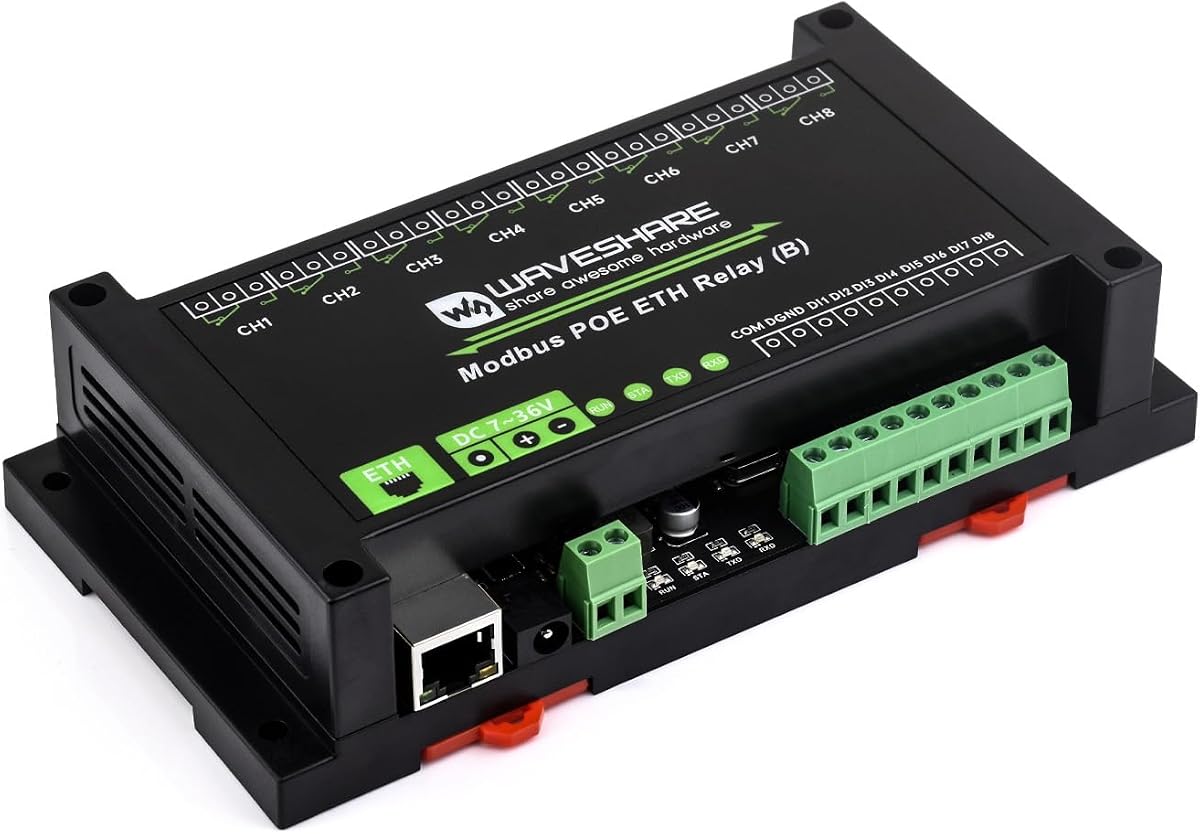
The 8-CH Ethernet Relay Module (B) has the highest stated rating in the group at 4.9. It also offers one of the most complete conventional control packages, combining eight relay outputs and eight digital inputs with Modbus RTU, Modbus TCP, and a wide selection of network communication modes.
We may earn a commission when you buy through this link, at no additional cost to you.
Its stated modes include TCP Server, TCP Client, UDP, UDP Multicast, HTTP, and MQTT. Configuration can be completed through software or a web browser, and the module can obtain a dynamic IP address through DHCP or connect to a DNS server. These choices make it easier to integrate with different host systems rather than forcing one fixed network pattern.
The digital inputs support passive dry contacts and active wet contacts, with bi-directional optocoupler isolation. Power is flexible: a DC power connector can accept a plug, screw terminals accept DC 7–36V, and the PoE port complies with IEEE 802.3af. An ABS rail-mount enclosure adds installation convenience and protection for cabinet deployment.
This is our leading recommendation for buyers seeking a fixed industrial Ethernet relay with extensive protocol options and both input and output channels. It is less attractive for a beginner who wants only simple web switching, because the many configuration methods demand accurate documentation and careful network planning.
TCP Server, TCP Client, UDP, UDP Multicast, HTTP, and MQTT support cover common integration patterns. Buyers can choose an operating mode that matches the host, PLC, or cloud service rather than depending on one narrow control method.
The module accepts a plugged DC source, a screw-terminal supply across 7–36V, or IEEE 802.3af PoE. This flexibility is useful in retrofit projects where the available power connection is not known until installation begins.
We may earn a commission when you buy through this link, at no additional cost to you.
This ESP32-S3 Ethernet Relay Module has a 4.6 rating and combines eight relays, eight digital inputs, Ethernet, RS485, Wi-Fi, and Bluetooth LE. It is a close relative of the premium PoE model, but its supplied specifications do not list an integrated PoE module.
We may earn a commission when you buy through this link, at no additional cost to you.
Power isolation and optocoupler isolation are included among the multiple protection circuits, while the digital inputs support passive dry and active wet contacts. The relays are rated up to 10A at 250VAC or 30VDC, and the module is described as suitable for directly controlling household appliances or devices below 30V DC.
A major advantage is the supplied development environment. It supports the Arduino IDE and comes with an SDK, tutorials, online resources, and technical support. That makes it a sensible platform for developers who want to write custom control logic, expose local wireless access, or integrate the eight inputs into a broader monitoring system.
Choose this model when Ethernet is required but wireless and custom programming are also valuable. It may not be the simplest option for a standard Modbus installation, and buyers should not assume PoE support without confirming it in the current documentation. Its flexibility makes it especially attractive for prototyping and specialized automation.
Arduino IDE support, a comprehensive SDK, tutorials, and technical support give developers a clearer path than an undocumented controller. This is valuable when relay behavior must integrate with custom sensors, schedules, dashboards, or site-specific logic.
Ethernet supports stable wired automation, RS485 supports industrial peripherals, and Wi-Fi plus Bluetooth LE offer flexible commissioning paths. The combination makes the module useful across both permanent installations and mobile setup configurations.
We may earn a commission when you buy through this link, at no additional cost to you.
The Waveshare 30-Ch Ethernet Relay Module is the clear high-capacity choice, with a 4.2 rating and 30 controlled outputs. It uses Modbus RTU and Modbus TCP over Ethernet, supports MQTT, accepts PoE or a wide DC input, and includes an industrial rail-mount case.
We may earn a commission when you buy through this link, at no additional cost to you.
A single 30-channel controller can replace numerous small boards where a facility needs to switch many independent loads. The intended applications listed for this module include industrial control, smart homes, smart agriculture, and breeding or farming operations. The timed flash-on and flash-off command can simplify temporary activations in all of those environments.
The module uses a dedicated relay driver chip with built-in flyback diode protection, intended to produce stronger and more stable relay drive behavior. Optocoupler isolation and reverse-proof circuitry add further protection. Four LEDs and network indicators show MCU and signal-transceiving status, which helps operators identify activity during commissioning.
This is the best recommendation for projects with a genuinely high channel count. It is less appropriate when only a few outputs are needed because the enclosure and wiring become unnecessarily substantial. Since the listing does not state digital input support, buyers who require feedback sensing should choose a module that expressly includes it.
Thirty outputs in one network device can simplify installations that would otherwise require several controllers, separate addressing, and additional network drops. Consolidation is especially helpful in agriculture and facility automation with many repetitive loads.
The dedicated driver chip and flyback diode protection strengthen the drive stage and manage inductive switching transients. These are meaningful advantages in installations where relays operate frequently or control inductive equipment.
We may earn a commission when you buy through this link, at no additional cost to you.
The Waveshare Industrial 8-Channel ESP32-S3 WiFi Relay Module has a 4.7 rating and is particularly notable for its isolated RS485 interface and real-time clock. The clock is a meaningful addition for automation that must operate according to schedules even when other parts of the system are unavailable.
We may earn a commission when you buy through this link, at no additional cost to you.
The ESP32-S3 uses an Xtensa 32-bit LX7 dual-core processor running up to 240MHz and supports 2.4GHz Wi-Fi and Bluetooth LE. Its isolated RS485 interface can connect with Modbus industrial modules or sensors, while an Ethernet chip and optional PoE version support wired network installations.
Power and servicing options are unusually flexible. A USB Type-C port handles power, debugging, and firmware downloading, and a wide 7–36V input supports direct power. Built-in indicators show device status, while the listing notes official Wiki resources for setup and development.
This module is a strong choice for programmers and industrial integrators who value scheduling, serial-device connectivity, and development access. The stated PoE availability depends on the version, so the buyer should verify the exact configuration. It also offers less explicitly documented field-input capability than the eight-input alternatives.
The onboard RTC supports scheduled tasks, which is useful for irrigation, lighting, access routines, and equipment windows that must follow a daily timetable. It reduces reliance on continuous network availability for time-based operations.
USB Type-C provides a straightforward route for power, debugging, and firmware downloads. Combined with official Wiki resources and status indicators, it makes maintenance and customization more approachable.
We may earn a commission when you buy through this link, at no additional cost to you.
This Waveshare 8-Ch Ethernet Relay Module (B) has a 4.2 rating and emphasizes responsive input-driven behavior. It supports digital-input linkage or toggle control, includes a built-in debouncing algorithm, and provides eight Ethernet-controlled relay outputs with Modbus and MQTT support.
We may earn a commission when you buy through this link, at no additional cost to you.
Input linkage is valuable when a physical contact should immediately determine the state of an associated output. Debouncing helps prevent repeated or unstable triggering from mechanical contacts, while toggle control offers an alternative operational pattern. Optocoupler isolation and a dedicated relay driver with flyback diode protection support reliable integration with field signals and switched loads.
The module accepts DC 7–36V or PoE and uses a rail-mounted ABS plastic enclosure. Four LEDs and network indicators show microcontroller and signal-transceiving status, which helps during setup and maintenance. A reverse-proof circuit is included to help protect against incorrect connections.
This model fits installations that need physical inputs to influence relay behavior but do not need a specific fixed number of input channels. Buyers should verify the current documentation for input count and supported linkage details. Overall, it is a well-equipped and practical option for industrial control cabinets.
Linkage and toggle modes allow a digital input to operate a relay according to the installation's needs. Debouncing improves stability when the input originates from a mechanical contact rather than a clean electronic signal.
A dedicated relay driver and flyback diode protection strengthen the output stage, while optocoupler isolation separates control and power domains. These protections are particularly relevant for inductive or electrically noisy loads.
We may earn a commission when you buy through this link, at no additional cost to you.
The Pinhaijing LAN Ethernet 2-Way Relay Board has a 4.8 rating and is the most approachable compact option. It controls two relays over a local Ethernet connection using TCP or UDP, includes a web server, and provides local password protection for remote cloud control.
We may earn a commission when you buy through this link, at no additional cost to you.
Its compact dimensions and exposed-board format make it suitable for a small enclosure, project box, or electronics cabinet. The FR-4 PCB measures 6.8 by 4.8 centimeters, uses 1.6mm-thick board material, and includes mounting holes. A power indicator shows operating status, while individual relay indicators show the state of each channel.
The board accepts 5V or 9–24V input, giving it more flexibility than a module designed only for one low-voltage supply. However, the supplied specifications do not mention PoE, Modbus, digital inputs, optocoupler isolation, or a rail-mount industrial enclosure. It should therefore be viewed as a compact network controller rather than a fully specified industrial I/O platform.
This is the best budget recommendation for a small automation, remote switching, or learning project that needs only two outputs. It offers a simpler and potentially lower-cost route into Ethernet control, provided the user can provide suitable enclosure, wiring, and electrical protection.
TCP, UDP, and a web server give basic users several ways to issue commands. The result is a practical module for controlling two loads without committing to an eight- or 30-channel industrial device.
A small 6.8 by 4.8cm FR-4 board with mounting holes fits space-conscious installations. The relay and power indicators provide basic visual confirmation of board operation and output state.
We may earn a commission when you buy through this link, at no additional cost to you.
The 8-CH Modbus Ethernet Relay has a 4.0 rating and combines eight outputs with one of the broadest selections of wired communication modes. It supports Modbus RTU, Modbus TCP, TCP Server, TCP Client, UDP, UDP Multicast, HTTP, and MQTT.
We may earn a commission when you buy through this link, at no additional cost to you.
Configuration is available through software or a web browser. The module can obtain a dynamic address through DHCP and connect to a domain name server through DNS, both of which help it fit managed business or industrial networks. Its status LEDs and network indicators provide visible feedback for controller and signal-transceiving activity.
Three power methods add deployment flexibility: a DC power port with a plug, screw terminals accepting DC 7–36V, and an IEEE 802.3af-compliant PoE port. The flash-on, flash-off function allows a command to energize a relay temporarily before switching it off, while optocoupler isolation helps protect the control electronics from high-voltage circuits.
This module is a solid choice for integrators who want a standard eight-channel relay with extensive network options and no need for digital inputs. Its feature set is broad, but buyers should still verify the supplied documentation, especially network settings and command syntax, before using it in critical equipment.
TCP, UDP, HTTP, MQTT, and both Modbus variants cover a wide range of host systems. This makes the module suitable for industrial controllers, local software, and broker-based remote automation.
DHCP support reduces manual address assignment, while DNS connectivity makes remote or hosted access more practical. Software and web-browser configuration offer alternatives for initial setup and later adjustments.
We may earn a commission when you buy through this link, at no additional cost to you.
The right Ethernet relay module depends on load count, control environment, available power, network protocol, and the amount of protection required. Comparing these factors before purchasing helps avoid an overpowered unit or a controller that lacks necessary inputs and industrial safeguards.
Start with the number of independent loads that must be switched. The roundup includes a two-output board for simple projects, several eight-channel controllers, and a 30-channel model for larger facilities. Count outputs rather than total terminals, because screw terminals may be dedicated to power, Ethernet, digital inputs, or relay contacts. A modest margin can be useful when a future expansion is likely, but an oversized module adds cost, wiring, and cabinet space that may not be justified.
Check which control methods the host system actually uses. Modbus TCP and Modbus RTU are important for PLC and industrial integration, while HTTP is convenient for browser-based control and MQTT supports message-based or cloud-connected systems. Some modules also provide TCP Client, TCP Server, UDP, or UDP Multicast modes. Matching the module to the existing controller is safer than assuming every communication method operates identically.
Review every available power path before installation. The industrial models in the list support DC 7–36V, while the compact board accepts 5V or 9–24V. PoE can carry network traffic and power over one cable, reducing installation work where compatible networking is already present. Verify the PoE standard, connector arrangement, and whether the network switch supplies the required power. Never assume a port labeled PoE will work with every injector or passive network arrangement.
Digital inputs expand a relay controller from a simple output device into a two-way I/O system. They can report switch status, receive commands from field sensors, or trigger linked outputs. The listed versions with digital inputs support both passive dry contacts and active wet contacts through bi-directional optocoupler isolation. Check the exact input count because not every product in the roundup states it, and confirm whether a particular channel is a digital input or a relay contact.
Industrial installations benefit from optocoupler isolation, power isolation, reverse-polarity protection, flyback diode protection, and input debouncing. These features help reduce electrical interference, unintended behavior, and damage from wiring errors. They do not replace correctly rated fuses, breakers, grounding, surge protection, or safe enclosure design. Treat the module's protection circuits as layers within a complete electrical safety plan rather than as permission to overload a relay or expose sensitive circuits to unsuitable voltages.
A rail-mounted ABS case is preferable for a control cabinet because it supports secure placement and protects the electronics. The compact Pinhaijing board requires the user to provide a suitable housing. Consider mounting access, cable bend space, terminal visibility, ventilation, and the distance between the module and heat-producing equipment. Industrial status LEDs are also useful because they can reveal network activity and relay state without requiring connection to the controller.
ESP32-S3 models add Wi-Fi, Bluetooth LE, Arduino IDE support, development resources, and custom firmware possibilities. This can be a major advantage for a specialized project requiring local control, sensor integration, or custom schedules. It also introduces more setup complexity and raises the importance of wireless security, password protection, and network segmentation. Fixed-protocol Modbus modules are often more direct for a standard industrial control task.
The industrial modules state contact ratings up to 10A at 250VAC or 30VDC, but maximum ratings should not be read as continuous operating limits for every load. Motor, heater, lamp, and capacitor-driven loads can have high inrush current or inductive transients. Check the exact relay documentation, coil behavior, load type, switching frequency, and any fuse or snubber requirements. A module with fewer channels may also be a better choice when a small number of high-current loads requires careful switching.
Begin by identifying every relay load, its voltage and current, and whether it is resistive, inductive, or motor-driven. Draw the power and contact wiring, check polarity, and select an appropriate enclosure, breaker or fuse, grounding arrangement, and surge protection. Before energizing outputs, configure the network address and verify that the controller cannot accidentally activate a load during testing.
Connect the module according to its documentation, then power the control electronics before engaging the load circuit. If using Modbus, verify the TCP port, unit identifier, register map, and read-versus-write permissions. If using HTTP, MQTT, TCP, or UDP, change default credentials, isolate the control network where practical, and confirm the host receives the intended state before trusting an automated command. Test each relay channel individually with a harmless load first.
For care, keep the enclosure clean, dry, and securely mounted. Check terminal tightness and signs of overheating periodically, especially when switching inductive or high-current equipment. Update custom ESP32-S3 firmware from trusted sources, preserve configuration backups, and review protocol documentation after controller or network changes. Do not exceed stated contact ratings, and have a qualified electrician assess mains wiring and enclosure requirements.
An Ethernet relay module switches electrical loads through commands received over a wired network. It is commonly used for industrial equipment, smart-building systems, lighting, pumps, irrigation, access controls, and remote power management. Unlike a simple mechanical switch, it can be integrated with a PLC, computer, cloud service, or custom software.
Modbus TCP is generally more natural on an IP network because it carries Modbus data inside TCP traffic. Modbus RTU over Ethernet is still available in some modules and can be useful when integrating with equipment designed around serial-style register arrangements. The best choice depends on the controller, gateway, documentation, and existing network architecture.
Several modules in this roundup can receive both network connectivity and power through an IEEE 802.3af-compatible PoE connection. PoE can simplify cabling when a compatible switch or injector is available. The installer must verify the module's exact PoE requirements and ensure that the network equipment supplies compatible power.
Digital inputs are useful when the controller must read a physical contact, monitor equipment state, or trigger a relay locally. They are not required for a simple system that only sends remote on and off commands. Modules with inputs supporting both dry and wet contacts offer greater flexibility, but their input count and isolation should be confirmed before purchase.
The stated relay ratings allow switching up to 250VAC or 30VDC, and some product descriptions specifically mention 220VAC appliances. That does not mean every appliance is suitable. Motor, compressor, heater, and other high-inrush loads may require contactors, relays, fuses, or other appropriate equipment, and mains installation should be handled safely.
A fixed Modbus module is primarily designed around a defined industrial protocol and can often be configured without custom programming. An ESP32-S3 module combines Ethernet with Wi-Fi, Bluetooth LE, RS485, and firmware-development support, allowing more customized behavior. It offers greater flexibility but usually requires more configuration, security planning, and technical effort.
It depends on how many independent loads need switching and whether the system also requires inputs for sensors or feedback. The 30-channel model may be better for a larger installation, while the two-way board is sufficient for a small project. Count outputs, available inputs, wiring space, and required control methods before deciding.
Change default passwords, use authenticated access, restrict control networks with firewalls, and avoid exposing administration interfaces directly to the public internet. VPN access or a properly secured gateway is generally preferable to unrestricted port forwarding. For MQTT deployments, secure broker credentials and topic permissions, and audit unexpected commands or state changes.
The 8-CH Ethernet Relay Module (B) stands out as the strongest all-around conventional option, combining Modbus, numerous network modes, eight outputs, digital inputs, and flexible power options. The ESP32-S3 PoE module is the premium choice for users who want Ethernet, wireless control, RS485, and custom development, while the Pinhaijing two-way board serves compact projects on a simpler scale.
Prioritize the requirements that affect daily reliability: match the channel count to the load, support the protocol used by the controller, confirm the voltage and PoE arrangement, and verify whether digital inputs are required. Industrial users should also give careful attention to isolation, enclosure quality, relay contact limits, inrush current, and safe circuit protection.
Product listings, ratings, documentation, and prices can change, so check the current Amazon pages and manufacturer resources before ordering. Confirm the exact hardware revision, included accessories, power requirements, command manual, and wiring diagram to ensure that the selected Ethernet relay module fits the intended installation.