
63A 2-Pole Enclosed Safety Disconnect Switch
4.7Editor score
IP66 weather-resistant enclosure
Quick-make, quick-break operation
Silver alloy power contacts
This guide compares the best generator disconnect switch options for whole-home, portable, manual, automatic, outdoor, and industrial electrical setups.
A generator disconnect switch provides a controlled, visible way to isolate a generator, inverter, or other backup power source from an electrical system. The right device depends on the current rating, voltage, phase, enclosure, neutral configuration, and whether you need manual or automatic transfer. A mismatch can limit essential loads or create serious installation problems.
The products in this guide were compared using their stated electrical ratings, switching mechanisms, environmental protection, installation features, certifications, and intended applications. The list covers manual home transfer switches, automatic service-entrance equipment, general-duty safety switches, and compact outdoor disconnects for generators, motors, welders, boats, and other equipment.
Each review explains what distinguishes the switch, where it fits best, and which trade-offs deserve attention before installation. Ratings and specifications reflect the supplied product information, while availability, certification details, and pricing can change, so shoppers should verify the exact model and requirements with a qualified electrician.
4.7Editor score
4.9Editor score

4.6Editor score
This side-by-side comparison organizes each switch by its role, capacity, electrical configuration, and installation environment, making it easier to identify a model suited to portable generators, standby systems, or equipment isolation.





This 200 Amp manual generator transfer switch is designed for homeowners who want broad whole-home backup capability without relying on an automatic transfer switch. Its 4.2 rating reflects a practical combination of useful capacity, manual operation, and outdoor-ready construction. The stated 48,000W capacity and 200 Amp rating make it especially relevant to homes with large household loads.
We may earn a commission when you buy through this link, at no additional cost to you.
A major strength is its simple double-throw lever, which provides a clear physical choice between utility and generator power. Because the operating principle is mechanical rather than electronic, it avoids sensitive control components that may require more maintenance. The NEMA 3R galvanized-steel enclosure is designed for outdoor exposure, while the lock hole and grounding position support safe operation and electrical isolation.
The trade-off is that the switch does not transfer power automatically. Someone must operate the lever and confirm that connected loads remain within the generator's capability. Installation also requires planning around the home's service configuration, conductor sizing, grounding, neutral bonding, and local electrical requirements. Although wiring lugs and an installation guide are included, this is not a casual do-it-yourself project for most buyers.
This is a strong recommendation for owners of a suitably sized portable generator who need more capacity than a small essential-load switch and prefer manual control. It is less appropriate for someone expecting seamless standby operation or for a property whose electrical arrangement does not match the switch's design.
The stated 200 Amp and 48,000W capacity makes this model relevant to dryers, stoves, HVAC equipment, and other high-demand circuits when paired with a compatible generator. Capacity alone does not guarantee performance; the generator, conductor sizes, and connected loads must all be coordinated.
The manual lever and absence of sensitive electronics simplify long-term ownership and maintenance. A lock hole, grounding position, and visible selection lever also help users establish a disciplined operating routine around power changes.
We may earn a commission when you buy through this link, at no additional cost to you.
The Original, Patented, UL/CSA Approved Manual Transfer Switch has a 4.7 rating and focuses on transferring power to essential loads rather than replacing an entire residential service. It is presented as the original EZ Generator Switch, with approval from UL, CSA, and ETL, making certification one of its most important distinguishing features.
We may earn a commission when you buy through this link, at no additional cost to you.
Its flexibility is notable. The product supports bonded or floating neutrals and is described as battery-inverter friendly, which broadens its usefulness for portable generators, solar systems, inverters, refrigeration, heating, lighting, sump pumps, and other essential equipment. The installation approach does not require touching existing circuit breakers or risking backfeeding through the normal electrical panel.
As a manual device, it asks the owner to initiate the change and confirm the correct source is selected. It also does not provide the service-entrance capacity of a large automatic system. Buyers must carefully match the switch, generator output, conductor ratings, and selected loads, especially where neutral bonding must follow the equipment instructions.
This switch is a compelling option for a backup-power setup centered on a refrigerator, freezer, lights, internet equipment, or a sump pump. It is best suited to users who want an approachable essential-load system and value multiple approval standards, not to someone seeking automatic whole-home standby service.
Support for bonded and floating neutrals makes it easier to compare with different generator and inverter arrangements. The battery-inverter-friendly description is valuable for users combining portable generators with modern power-conversion equipment.
Keeping the transfer function outside the main breaker panel can reduce the risk of accidentally energizing the utility line from a generator. Installation must still follow the manufacturer's diagram and local electrical code.
We may earn a commission when you buy through this link, at no additional cost to you.
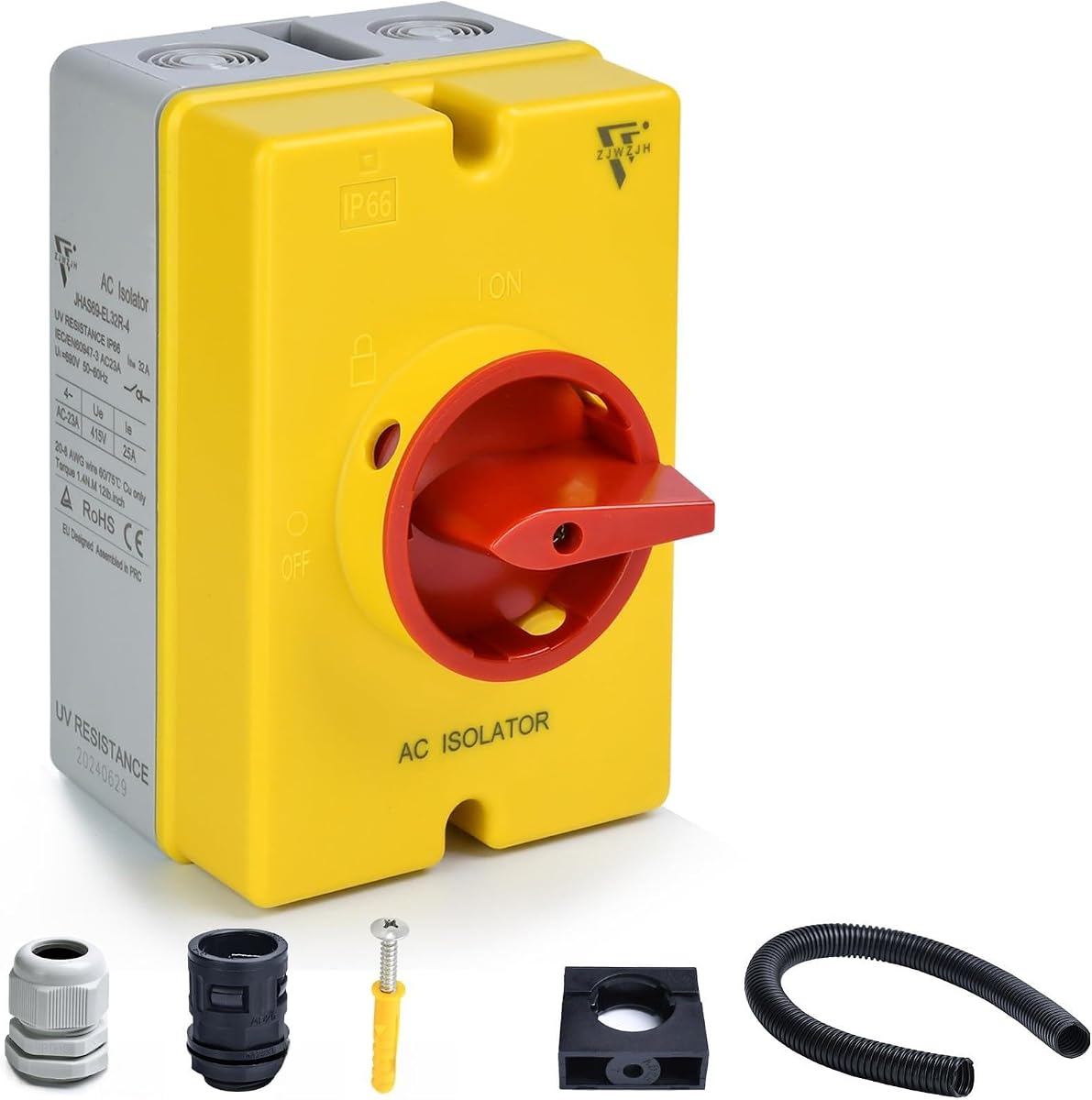
The 32 Amp four-pole AC disconnect is built for generator, motor, air-conditioning, substation, and general distribution isolation. Its 4.4 rating and three-phase design distinguish it from standard two-pole residential models. The product supports a broad stated voltage range up to 690V AC, while the four-pole configuration is particularly relevant to three-phase systems.
We may earn a commission when you buy through this link, at no additional cost to you.
Environmental protection is a central strength. The IP66 enclosure is described as resistant to corrosion, windblown dust, rain, splashing water, and hose-directed water, making it suitable for exposed indoor or outdoor installations. The rotating handle supports padlocking, adding a practical control during maintenance or unexpected system changes.
This is a specialized device rather than a straightforward home-backup panel. Buyers must confirm that four poles, three-phase operation, the available fault-current environment, and the conductor arrangement suit the installation. The included screws, cable connectors, pipe joint, corrugated pipe, and fixed components help with mounting, but proper sealing and electrical integration remain essential.
The switch is a good fit for a contractor or property owner needing a robust, lockable isolation point on a three-phase generator or motor circuit. For a typical 120/240V household generator, a simpler two-pole residential safety switch or transfer panel will usually be more appropriate.
Four-pole switching gives this model a clear identity among the products reviewed. It is better suited to three-phase motor, generator, and distribution applications than to a conventional single-phase home transfer arrangement.
The IP66 enclosure helps protect the operating mechanism from dust and powerful water jets. Proper mounting and cable entry sealing remain necessary to preserve the enclosure's intended performance.
We may earn a commission when you buy through this link, at no additional cost to you.
This 63 Amp two-pole safety disconnect combines useful capacity with a rugged enclosure and straightforward isolation control. Its 4.7 rating places it among the strongest products in the list, and the stated applications—generators, welders, boats, chemical processing, agriculture, construction, and water treatment—show its industrial orientation.
We may earn a commission when you buy through this link, at no additional cost to you.
The quick-make, quick-break mechanism is designed for positive connection and disconnection, while clear ON/OFF indicators reduce operating ambiguity. Silver alloy contacts are specified for conductivity and arc resistance, with the stated benefit of minimizing contact welding and oxidation. The UV-resistant ABS enclosure provides impact, heat, and corrosion resistance in demanding environments.
This product is a disconnect rather than a transfer switch, meaning it provides isolation but does not automatically or manually alternate between utility and generator sources in one mechanism. The 440V and 63 Amp ratings therefore need to be matched carefully to the connected equipment and conductor sizes. It is not a substitute for a residential transfer panel when whole-home source selection is required.
It is a strong recommendation for a portable generator, welder, boat, or industrial load requiring a dependable external lockable isolation point. Buyers who need to choose between two live power sources should look instead to one of the dedicated transfer switches in this guide.
The UV-resistant ABS enclosure and IP66 rating make this switch suitable for exposed service where dust, water jets, temperature changes, and physical impact are concerns. Installation details still determine whether those protections are effective in the field.
A quick-make, quick-break action helps operators establish an unambiguous open state. The ON/OFF indication and padlock-capable handle support both routine operation and maintenance security.
We may earn a commission when you buy through this link, at no additional cost to you.
The General Electric / GE TGN3323 (GEN) is included as a safety-switch option for readers seeking a recognizable general-purpose electrical isolation device. The supplied information identifies it as a re-certified safety switch, but it does not provide a customer rating or detailed current, voltage, enclosure, and pole specifications.
We may earn a commission when you buy through this link, at no additional cost to you.
That limited disclosure is the defining consideration here. Safety switches are used in a wide range of generator, motor, and equipment applications, but model identifiers alone do not establish the correct amperage, voltage, phase, grounding arrangement, or environmental rating. Buyers should inspect the enclosure label and documentation before treating it as suitable for a specific circuit.
The re-certified designation may offer reassurance that the unit has passed through a formal recertification process, but the provided product data does not detail which organization performed that process or which standards apply. It should therefore be verified rather than assumed. The absence of a current rating also makes direct comparison with the other products in this guide impossible from the available information.
This model may suit a buyer who recognizes the TGN3323 and can confirm its exact specifications and certification for the intended installation. Without those details, it is better treated as a specialist option requiring careful label verification than a universally suitable generator disconnect.
The model number should be matched against the device label and manufacturer documentation. Verify current, voltage, poles, enclosure rating, and disconnect classification before including this switch in an installation plan.
A general-purpose safety switch primarily isolates power. If the project requires selection between utility and generator sources, choose equipment explicitly designed and listed for that transfer function.
We may earn a commission when you buy through this link, at no additional cost to you.
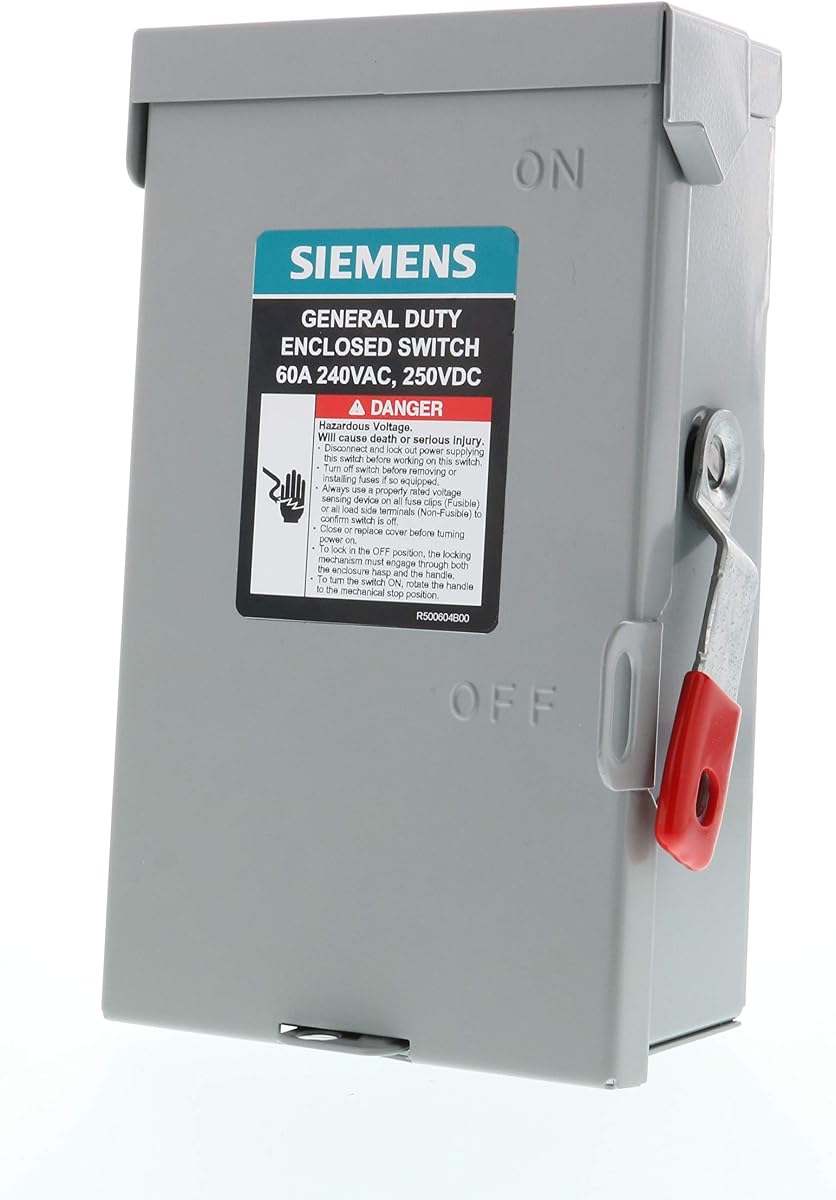
The Siemens 2P 60A 240V general-duty safety switch is a straightforward outdoor disconnect for 120/240V, single-phase, two-wire circuits. Its 4.6 rating reflects a well-specified product with a visible blade, double-break action, and a quick-make, quick-break mechanism designed for positive operation.
We may earn a commission when you buy through this link, at no additional cost to you.
A visible blade makes the open or closed position easier to understand from outside the enclosure, an important feature during maintenance and troubleshooting. The durable ON/OFF indication is embedded in the steel door, where it is less likely to be scratched or faded. Its compact size also makes the switch easier to handle and useful where installation space is limited.
The non-fusible configuration is the central caveat. This switch does not include fuses and therefore does not provide overcurrent protection on its own; upstream breakers or other protective devices must perform that job. It also isolates a single supply rather than transferring between two sources. A generator connected through this switch may still require a separate transfer mechanism to prevent unsafe interconnection.
The switch is a good fit for a homeowner or installer seeking a straightforward, recognizable outdoor disconnect for a generator subfeed, welder, or other 120/240V equipment. It is particularly attractive when a clearly visible OFF position and rugged door-mounted indication are priorities.
The visible blade and double-break action make it easier to confirm physical isolation. This is valuable during service because an upstream breaker may be off while conductors or internal components remain energized from another path.
Because the device is non-fusible, appropriate overcurrent protection must be provided by the circuit. Do not assume that opening this switch protects conductors from overload or short-circuit conditions.
We may earn a commission when you buy through this link, at no additional cost to you.
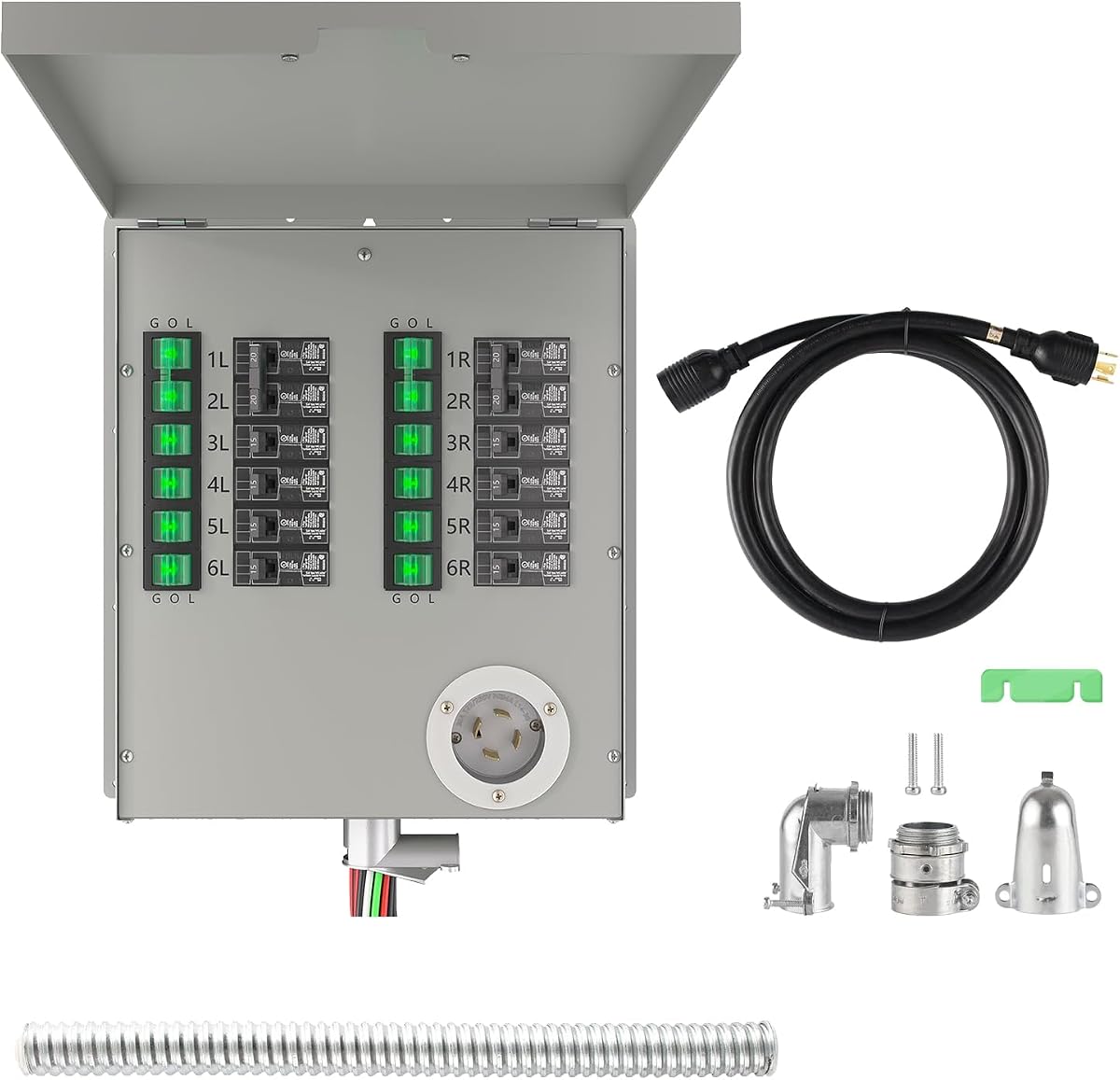
The Nature's Generator 30A non-automatic transfer switch combines a 4.9 rating, a 12-circuit home backup panel, and UL approval. It is positioned for users who want to manage selected household circuits with a portable generator rather than install a large service-entrance transfer system. The panel is rated for 12 circuits at 120/240V and 30 amps.
We may earn a commission when you buy through this link, at no additional cost to you.
Its compatibility claim is unusually broad, covering gasoline, diesel, propane or LPG dual-fuel generators, lithium battery power stations, solar generators, mini wind turbines, and micro hydro systems. The supplied description says no adapter or modification is needed for these categories, although the actual generator connection still has to follow the included instructions and electrical rules.
Manual selector switches let users choose the source for individual circuits, while illuminated rocker switches indicate generator power status. A rugged steel enclosure, L14-30P inlet, 30A power cord, and pre-wired components create a more installation-ready package than a basic safety switch. The non-automatic design also remains under direct user control rather than switching without notice.
This is an excellent recommendation for a 30A portable generator or compatible power station serving a defined group of essential circuits. It is not a substitute for a 200A standby transfer switch, and manual operation means the owner must initiate the change. Its strongest appeal is the combination of circuit management, broad source compatibility, and a supplied connection kit.
Twelve circuit positions let an installer define which loads receive backup power. This is more flexible than energizing every connected load, but each selected appliance still needs to fit within the generator and circuit capacity.
Support for conventional generators and portable renewable-energy systems is a major advantage. Buyers should still confirm the exact plug, output, neutral, and grounding configuration before connecting any source.
We may earn a commission when you buy through this link, at no additional cost to you.
This 60 Amp, 120/240V single-phase safety switch is a general-duty outdoor isolation device with a 3.9 rating. It offers a two-pole, two-wire, non-fusible design, visible ON/OFF indicators, a quick-make, quick-break mechanism, and padlocking provisions on both the handle and enclosure door.
We may earn a commission when you buy through this link, at no additional cost to you.
The combination of handle and door padlocks is particularly useful for maintenance security. It helps prevent unauthorized operation while work is underway, while the embedded indicators help users identify the switch state without relying on a worn label. Its double-break action is intended to provide dependable electrical disconnection through two contact breaks.
The fault-current information deserves attention. The product data says the switch is intended primarily for supply circuits rated 240V AC or less, with an available fault current below 100,000A when used with class R or T fuses, or up to 10,000A maximum with class H fuses. That language should be checked against the installation's protection and available fault current before approval.
This switch is most appropriate for someone who needs a lockable, outdoor, 60A isolation point and does not require automatic or manual source selection within the same device. Its lower customer rating may encourage a closer comparison with similar safety switches, but the specified safety features remain relevant for well-matched installations.
Padlocking both the operating handle and the door discourages accidental or unauthorized switching during service. A suitable lock and a documented lockout procedure should be used as part of a complete safety program.
The stated fault-current limits depend on fuse class and circuit conditions. A qualified installer should verify the design against the available fault current rather than relying only on the amperage rating.
We may earn a commission when you buy through this link, at no additional cost to you.
The Generac 200 Amp Next Gen automatic generator transfer switch represents the premium, whole-home option in this guide. With a 4.6 rating, it provides service-entrance-rated automatic transfer for a compatible Generac standby generator, replacing the main utility disconnect and moving the entire home to backup power without manual action.
We may earn a commission when you buy through this link, at no additional cost to you.
Its factory-installed surge protection is a meaningful premium feature. The commercial-grade surge protective device is intended to guard appliances and electronics from transient voltage spikes. The enclosure is aluminum with an electrostatically applied, baked powder-coat finish and a NEMA 3R rating for indoor or outdoor installation in demanding weather conditions.
The mechanical interlock is especially important because it physically prevents utility and generator power from connecting simultaneously. The supplied description associates this feature with NEC Article 702 requirements for standby systems, although the entire installation still must be designed and approved under applicable code. Compatibility is limited to single-phase Generac standby and Guardian systems using the specified Evolution or Power Zone 200 controllers.
This switch is the strongest recommendation for a homeowner investing in an integrated Generac standby ecosystem. It handles simultaneous 120V and 240V loads, including HVAC, well pumps, ranges, sump pumps, and refrigeration, but only if the generator and service equipment are properly coordinated. The installation replaces the main disconnect and is a substantial electrical project, not a portable-generator add-on.
The switch responds to a compatible Generac standby system and transfers the home automatically when utility power is unavailable. This removes the need for a resident to operate a lever during an outage.
The mechanical interlock helps prevent simultaneous utility and generator connection, while the integrated surge protective device adds a layer of transient-voltage defense. Both features must be included in the overall standby-system design.
We may earn a commission when you buy through this link, at no additional cost to you.
The 30 Amp outdoor pull-out AC disconnect is a compact isolation device for 120/240V, single-phase, three-wire, two-pole circuits. It has a 4.4 rating, UL certification according to the supplied description, a galvanized steel cover, and a non-fusible pull-out operating design.
We may earn a commission when you buy through this link, at no additional cost to you.
Its pull-out handle provides a direct way to disconnect the circuit. When released, the handle stores in a closed compartment within the enclosure, which reduces the chance of misplacing a separate operating handle. A lock hole allows the owner to add a lock for security in locations such as a garage, yard, or campsite.
The all-metal cover is designed to resist outdoor weather, rain, dust, and corrosion, while pre-drilled holes on the sides, bottom, and back provide installation flexibility. Ample internal wiring space is another practical benefit. Nevertheless, this is a non-fusible disconnect and does not include overcurrent protection or source-transfer capability, so a compatible breaker and safe interconnection method are still required.
The model is well suited to a smaller portable generator, outdoor equipment subfeed, or other 30A application where the primary goal is a compact, visible, lockable isolation point. It is not a practical choice for a large home, nor should it be connected to utility and generator sources at the same time without an approved transfer arrangement.
Storing the removable handle inside the closed enclosure helps keep operating hardware readily available and discourages loss. The lock hole adds an extra deterrent against unauthorized activation or disconnection.
Several knockout locations allow the installer to select a practical route for conduit and conductors. The galvanized cover supports outdoor exposure, but correct sealing and weatherproof entry are still necessary.
We may earn a commission when you buy through this link, at no additional cost to you.
The correct choice depends on whether you need simple isolation, manual source selection, or automatic whole-home transfer. Electrical ratings, installation environment, generator configuration, and local code requirements should be evaluated before selecting a device.
A safety switch disconnects a supply and provides a visible OFF state, but it does not inherently alternate between utility and generator power. A transfer switch combines source selection with controls intended to prevent unsafe backfeeding. If the generator will connect to circuits that normally receive utility power, choose a listed transfer device or have a qualified electrician design a code-compliant transfer arrangement.
Match the switch's current rating to the conductors, protective devices, and connected load. A 200 Amp unit is not automatically suitable for every 200 Amp generator, and a 30 Amp unit cannot support a 60 Amp load. For portable generators, compare the generator's rated running and surge output with the combined current drawn by essential appliances, allowing for motor starting demands.
Residential generators commonly use 120/240V split-phase power, while commercial and industrial equipment may require 120/208V, 240/480V, or three-phase service. A two-pole switch disconnects both legs of a single-phase system; a four-pole switch may be needed to disconnect all phases and a neutral in a three-phase arrangement. Using the wrong pole configuration can leave portions of the system energized.
Manual transfer switches provide direct lever or selector control and usually have fewer electronic components. They require someone to initiate the change and may not suit users who need backup power without human intervention. Automatic transfer switches coordinate with a compatible standby generator, detect source conditions, and transfer the service automatically. Their controls, compatibility requirements, and installation complexity are usually greater.
Generators and electrical equipment are often installed near garages, sheds, or exterior walls. Look for an outdoor-rated enclosure and an appropriate ingress-protection level. NEMA 3R is used for outdoor transfer equipment in the products reviewed, while IP66 describes a high level of protection against dust and powerful water jets for certain industrial disconnects. Enclosure markings and local rules determine the acceptable choice.
Generator neutral arrangements differ among portable, standby, inverter, and battery-based systems. Some systems require a bonded neutral, while others use a floating neutral or separate neutral bonding. A transfer switch or safety switch must be installed according to the generator manufacturer's instructions and the electrical code. Misconfigured bonding can create shock hazards or interfere with inverter operation.
A non-fusible disconnect does not protect conductors from overload or short circuits; that role belongs to properly selected breakers or fuses. Products differ in their stated available-fault-current limits, which can depend on fuse class. Review the complete installation, including upstream protection and available fault current, rather than selecting a switch from amperage alone.
Consider enclosure dimensions, conduit entry locations, handle clearance, working space, and the amount of room needed for wiring. Some products arrive with pre-wired components, power cords, wiring lugs, conduit fittings, or mounting hardware, which can simplify assembly. These conveniences do not replace code-compliant design, correct conductor sizing, grounding, and inspection.
Before installation, identify every circuit that will receive generator power, calculate the expected running and starting loads, and confirm that the generator output, transfer switch, inlet, conductors, and breakers all match. Obtain the wiring diagram and instructions supplied with the equipment. Most installations affect the service or require access to utility conductors and should be completed by a qualified licensed electrician.
During normal operation, follow the manufacturer's procedure for starting the generator, confirming that the switch is in the correct source position, and connecting or energizing the selected loads. Never remove covers or operate internal components while energized. A lockout procedure should cover both the generator and the utility source so that work cannot begin until both are controlled.
For care, inspect the enclosure, handle, seals, and cable entries periodically for moisture, corrosion, physical damage, or signs of overheating. Keep the operating mechanism free of debris and operate it only as intended. Test the transfer function according to the manufacturer's maintenance schedule, document the procedure, and have a qualified professional investigate any heat discoloration, buzzing, difficult movement, or inconsistent indication.
It depends on how the generator is connected. A portable generator feeding selected household circuits generally needs a listed transfer arrangement so utility and generator power cannot connect simultaneously. A simple extension cord to an appliance does not require a home transfer switch, but it must be used according to the generator and appliance instructions. Never backfeed a generator through a household outlet.
A disconnect switch provides a way to open a circuit and establish a visible OFF state. A transfer switch is designed to select between power sources and helps prevent backfeeding. Some products include additional control or interlock features, so shoppers should read the exact function and installation instructions rather than relying on the product name.
Only if its ratings, conductor configuration, and source-selection design support the intended service. A 30A, 12-circuit panel can power selected loads within its limits, while a 200A service-entrance transfer switch can support whole-home systems when paired with a compatible standby generator. The generator must also produce enough power for the connected household loads.
Choose a rating that covers the continuous load, startup surge, generator capability, conductor size, and upstream protection. For a portable generator, list the appliances you intend to run and calculate their combined demand. For a fixed installation, an electrician can evaluate the load calculation and electrical code requirements more reliably than a general rating rule.
Only if the model is rated or listed for outdoor installation and the wiring methods, conduit entries, and seals preserve that rating. Products with NEMA 3R or IP66 markings offer different forms of environmental protection, but neither label permits an otherwise unsuitable installation. Weatherproof cable entries and correct mounting are also necessary.
No. A non-fusible disconnect opens the circuit but does not contain fuses to interrupt overcurrent. Suitable breakers or fuses must be installed in the circuit according to conductor size and fault-current conditions. The switch, protective devices, and conductors must all be coordinated.
Portable generators and inverter-based systems can use different neutral configurations. A bonded neutral connects the generator neutral to equipment grounding, while a floating neutral separates those functions unless the transfer equipment provides the required bonding point. Incorrect bonding can create dangerous voltage on grounded surfaces, so the installation must follow the generator and switch instructions exactly.
Inspection frequency depends on use, environment, and the manufacturer's guidance. At minimum, owners should visually check for corrosion, moisture, damaged wiring, discoloration, and a secure cover during routine use. Transfer switches serving a home should receive periodic professional testing, especially because a failed mechanism may become apparent only during an outage.
The Nature's Generator 12-circuit panel stands out for controlled essential-circuit backup and broad source compatibility, while the 63A enclosed safety switch offers rugged isolation for generators and industrial equipment. For a homeowner seeking premium whole-home operation, the Generac 200 Amp automatic transfer switch offers automatic source selection, service-entrance integration, surge protection, and a mechanical interlock.
Prioritize the function before the enclosure or extra feature. A visible outdoor safety disconnect is appropriate for equipment isolation, a manual transfer panel is suited to selected circuits, and an automatic service-entrance switch is appropriate for a compatible standby system. In every case, match voltage, amperage, poles, phase, neutral configuration, grounding, fault-current conditions, and conductor sizes to the actual installation.
Product availability, certifications, ratings, and pricing can change, so confirm the current listing and exact model before purchasing. Have a licensed electrician review the generator, transfer equipment, wiring method, and local code requirements. That final compatibility check is more valuable than any headline feature and helps ensure the selected disconnect operates safely when backup power matters most.