
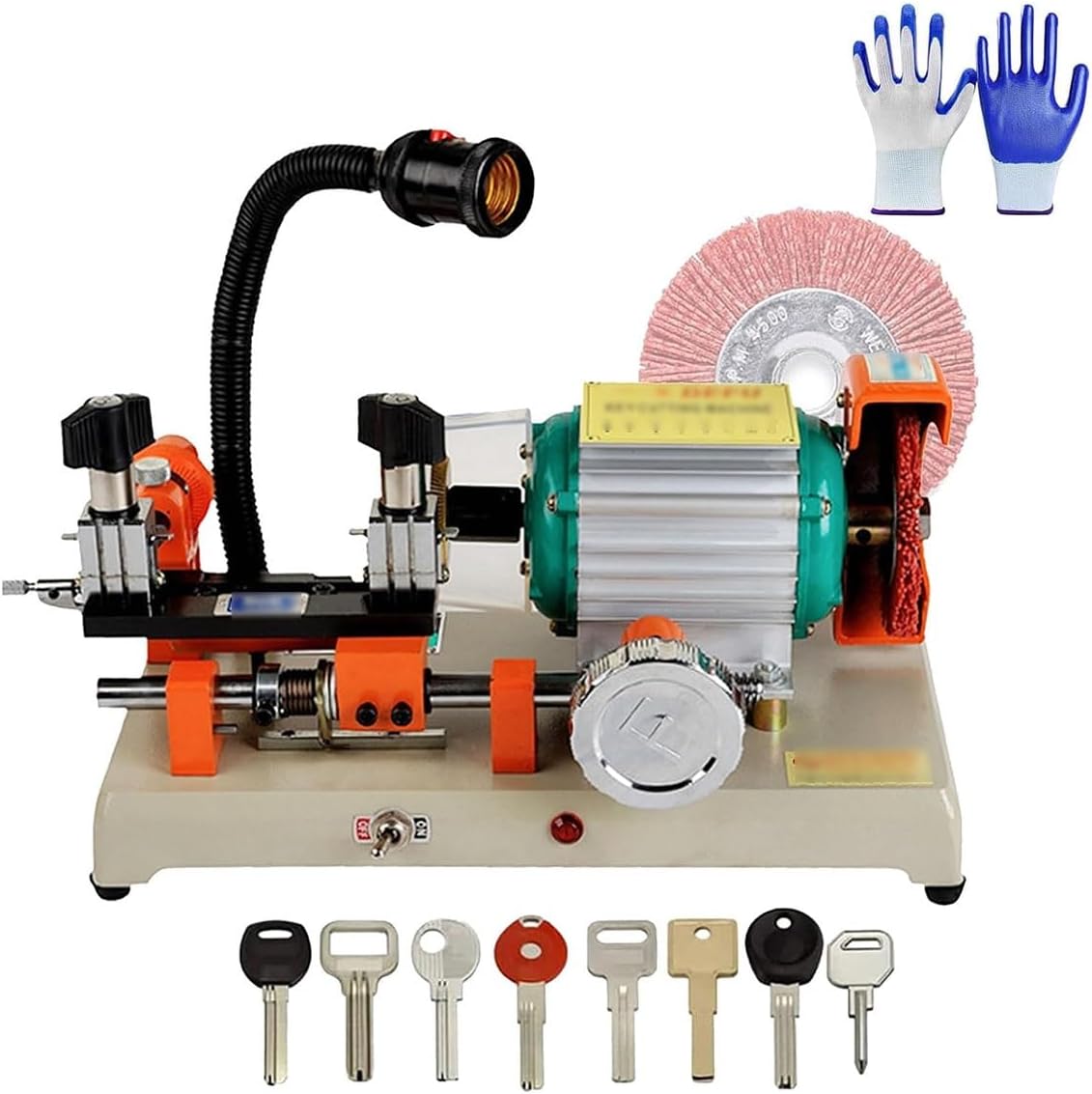
Five-Type Horizontal Copy Cutter
4.3Editor score
Simple automatic feed operation
110V 100W power configuration
Multifunctional steel fixture
Beginner-friendly electric start
This guide compares the best Key Duplicator Copy Machine options, covering motors, key compatibility, feeding systems, precision, portability, and safety.
A key duplicator copy machine turns blank metal keys into usable copies without requiring a trip to a locksmith. The best unit balances accurate cutting, dependable clamping, practical key compatibility, and straightforward operation, while also giving locksmiths, hardware employees, and serious hobbyists a durable tool for repeat work.
This guide compares ten key duplicating machines based on the features listed in their product information, including motor configuration, cutting power, automatic or manual feeding, fixture design, supported key types, portability, maintenance needs, and built-in safety guidance. It covers vertical and horizontal machines for automotive, mechanical, household, and specialty keys.
Each review explains the machine's most useful attributes, practical limitations, and ideal buyer, while the comparison table provides a quick side-by-side view. The top selections highlight strong options for different priorities, from beginner-friendly automation to premium dual-head capability; current prices and availability can change, so verify those details before purchasing.
4.3Editor score

5.0Editor score

3.4Editor score
This comparison organizes all ten machines by format, power, feeding method, key compatibility, and practical features, helping you identify the most suitable option for automotive, mechanical, or general-purpose duplication work.




This vertical manual duplicator combines a 120W brushless copper-core motor with adjustable speed, making it a distinctive option for users who want greater control while cutting metal keys. Its listed 4.2 rating reflects a generally capable machine, although key limitations mean it is not suitable for every duplication task.
We may earn a commission when you buy through this link, at no additional cost to you.
The adjustable motor speed is the standout feature. It allows operators to tailor cutting behavior to different key materials and drilling or milling requirements, while the horizontal moving handle supports controlled manual work. A hardened ball-bearing slide, upgraded synchronous belts and pulleys, and an external transformer contribute to smoother control and added torque.
There are important boundaries. The manufacturer explicitly says the cutter is not suitable for cutting key edges, and Fordss keys are incompatible. Safety goggles and Fordss clamps are also not included. Its manual cutting method and broad voltage claims are useful, but operators must confirm that their key blanks, workspace, and local electrical setup are suitable.
This machine is best for a portable workshop, hobbyist collection, or locksmith who regularly copies compatible wavy, cylindrical, and mother-and-child bead keys and values speed adjustment. It is less suitable for users who need automatic feeding, dual-head versatility, or Fordss-key support.
The adjustable motor speed gives the operator more control than a fixed-speed cutter. That flexibility is particularly useful when moving among different compatible metal key types or when a particular blank calls for a measured cutting approach.
At 6.72kg, the machine is comparatively easy to move and store. The external transformer and stated 110V-220V compatibility also broaden its usefulness in different work environments, provided the correct connection is used.
We may earn a commission when you buy through this link, at no additional cost to you.
This horizontal auto-feeding duplicator is a strong all-around choice for vehicle and mechanical keys. It carries a 5.0 rating in the supplied data and stands out for combining automatic cutting, a reinforced base, widened fixture spacing, and an upgraded laser positioning system.
We may earn a commission when you buy through this link, at no additional cost to you.
Automatic feeding is designed to promote uniform cuts, reducing the need for repeated manual movement. A long press activates electric mode, making the machine approachable for beginners while remaining efficient for routine duplication. The steel clamp supports hollow, wavy, and cylindrical keys, and the wider spacing is intended to accommodate thicker and longer housings.
The trade-offs are mostly operational rather than fundamental. The machine must remain level both horizontally and vertically, should not be moved excessively, and requires regular cleaning and lubrication. Operators must also wear eye protection, keep hair and clothing away from moving components, and avoid wet environments.
This is the strongest general recommendation for a user who values straightforward setup, automatic feeding, and broad fixture compatibility. It suits vehicle key specialists, hardware counters, and experienced hobbyists who want a manageable learning curve without giving up useful positioning and clamping features.
Uniform key movement is central to producing repeatable cuts. The auto-feed system helps maintain a consistent path, while laser positioning supports alignment between the original and the new blank.
Widened fixture spacing allows the machine to handle varied housings, including thicker automotive-style blanks. The strengthened base helps the assembly remain stable during operation, although leveling remains an important setup step.
We may earn a commission when you buy through this link, at no additional cost to you.
This five-type horizontal cutter is a straightforward option for new users and occasional duplication work. Its 4.3 rating indicates a generally positive result, while automatic feeding, a simple long-press control, and a 110V US plug make it convenient for standard workshop environments.
We may earn a commission when you buy through this link, at no additional cost to you.
The multifunctional steel fixture can copy hollow, wave, and cylindrical key types. To start electric mode, the user long-presses the start button for one to three seconds. That straightforward interaction, combined with automatic feed and uniform cutting, is useful for operators who do not want a complicated control system.
Its 100W motor has less stated power than several competing models, so demanding materials or extended production schedules may warrant consideration of a more powerful machine. The product information also mentions five types in the title while specifically naming hollow, wave, and cylindrical profiles in its description.
The machine is a sensible starting point for a homeowner, small hardware counter, or new locksmith who values simplicity and automatic feeding. It is less compelling for high-volume professional work or operators who require explicitly documented support for a broader range of automotive and specialty profiles.
Automatic feed reduces the amount of manual control required during a cut. Once the original and blank are positioned, the long-press electric start offers a clear operating method for new users.
The described lightweight construction helps with storage and setup. It avoids some of the complexity found in dual-head or heavily adjustable machines, making it approachable for a first duplication setup.
We may earn a commission when you buy through this link, at no additional cost to you.
This automatic keys cutting machine pairs a 120W copper-core motor with automatic feeding, knife walking, laser positioning, and an LED work light. Its 5.0 rating and extensive fixture support make it a compelling choice for operators who need to handle a varied mix of key shapes.
We may earn a commission when you buy through this link, at no additional cost to you.
The front clamping slot and rear two-way universal clamp offer flexible blank positioning. Automatic knife walking supports smoother movement, and the LED bulb improves visibility at the work area. The widened tool spacing and robust base are designed to accommodate thicker and longer mechanical car key housings.
Maintenance matters. The manufacturer calls for regular lubrication, routine cleaning, careful leveling, and limited relocation. A dust cover helps prevent debris from entering the mechanism, but it does not eliminate the need for basic upkeep. As with similar cutters, protective eyewear and a clear working area are essential.
This model is a good fit for locksmiths, automotive key workers, and hardware employees who regularly encounter wave, cylindrical, hollow, and thicker car mechanical keys. It is particularly attractive to buyers who value illumination and automatic movement over a premium dual-head configuration.
Front and rear clamping points make it easier to secure blanks with different dimensions. The universal rear arrangement and widened tool spacing are helpful for automotive-style housings that need more room.
The LED work light helps reveal the cutting area, while automatic knife walking reduces repeated manual movement. Together, these features can support a smoother and more repeatable workflow.
We may earn a commission when you buy through this link, at no additional cost to you.
This two-in-one key cutter is built around a 120W copper-core motor, combining manual and automatic operation in a horizontal format. Its 5.0 rating and flexible controls make it an appealing option for hardware stores and operators who want to choose their cutting approach from one machine.
We may earn a commission when you buy through this link, at no additional cost to you.
The steel clamp supports hollow, wavy, and cylindrical keys, and the upgraded optical maser positioning system is intended to improve alignment and reduce breakage risk. Automatic feed and cutting promote even cuts, while the long-press electric mode keeps activation direct. A sturdy base and widened spacing improve accommodation for larger or thicker blanks.
Users must still follow disciplined maintenance practices. The machine should be kept level in both directions, moved infrequently, covered while idle, cleaned, and lubricated regularly. Loose objects must remain away from the cutting zone, and protective eyewear is recommended.
This machine suits shops that want a flexible horizontal workflow without the complexity of a two-head system. It is a good match for mechanical and automotive key duplication involving supported profiles, especially when operators value the option between guided manual work and automatic feed.
The two-in-one design gives operators flexibility according to the job. Automatic feed can simplify repeatable cuts, while manual control remains useful for learning, adjustment, or less standardized work.
The upgraded positioning system works with hollow, wavy, and cylindrical key types. Widened clamp spacing provides additional room for blanks of differing thickness and overall size.
We may earn a commission when you buy through this link, at no additional cost to you.
The double-head key cutting machine is the premium, feature-oriented option in this group. Its 180W copper-core motor is the highest stated output here, while dual-head construction allows different keys to be equipped at the left and right ends for broader workflow flexibility.
We may earn a commission when you buy through this link, at no additional cost to you.
A micro-adjustable reverse pin provides precise depth control, an important feature when matching cuts across different lock types. The right clamp rotates in four directions, while two swivel clamps with hidden key markings support secure positioning on the left. Tungsten-carbide cutting tools are specified for ferrous keys.
Its 3.4 rating is the lowest among the rated products, so buyers should not overlook the comparatively limited customer feedback signal. The advanced feature set may also demand more careful setup than a basic horizontal cutter, and the supplied information does not describe automatic feeding in the same detail as some alternatives.
This machine is best for professional locksmiths, automotive specialists, or serious users who value dual-head capability, precise depth adjustment, and higher stated power. It is a stronger long-term proposition for varied workloads than for a first-time buyer seeking the simplest possible machine.
Having two ends available allows operators to work with different key arrangements and lock types. This is particularly valuable in a service environment where each incoming request may involve a different profile.
The micro-adjustable reverse pin offers fine control over cutting depth. Rotating and swiveling clamps further help the operator find a stable, accurate orientation for each blank.
We may earn a commission when you buy through this link, at no additional cost to you.
The 368A is a compact vertical profiler with a 5.0 rating, a 150W DC motor, and explicit support for five key profiles. Its 9.8 by 9.0 by 11.8-inch footprint and 18-pound weight make it especially interesting for mobile locksmiths and compact workshops.
We may earn a commission when you buy through this link, at no additional cost to you.
Hardened ball bearings support smooth positioning, while the synchronous belt and pulley upgrade is intended to improve torque transmission and reduce maintenance demands. A built-in storage drawer keeps small tools and accessories close at hand, helping reduce setup time. The motor is described as quieter and more energy-efficient than traditional alternatives.
The universal steel fixture is designed for convex pit, snake, cylindrical, tube, and composite bead types. These five named formats are a clear advantage over machines that list only two or three supported styles. The 110V, 60Hz plug-and-play design simplifies installation but limits compatibility compared with models advertising a wider voltage range.
This is a strong recommendation for mobile locksmiths and small automotive or hardware operations seeking a capable five-profile machine in a portable vertical format. It is less suitable for users who specifically require a horizontal feed mechanism, dual-head design, or 220V compatibility.
Convex pit, snake, cylindrical, tube, and composite bead coverage gives this machine a clearly defined range. That makes it easier for automotive operators to assess whether it matches the key types they actually encounter.
The compact vertical body and stated 18-pound weight support transport between jobs. Its storage drawer adds organization without requiring a separate tool box immediately beside the machine.
We may earn a commission when you buy through this link, at no additional cost to you.
This horizontal brush cutter duplicator emphasizes precision adjustment, a 120W all-copper motor, and a lightweight aluminum body. No customer rating is available in the supplied data, so the machine's appeal is best judged from its listed engineering and workflow features rather than a numerical review signal.
We may earn a commission when you buy through this link, at no additional cost to you.
The finely adjustable guide is the central feature, offering control over depth and supporting uniform duplication. The machine handles single-sided, double-sided, and four-sided slotting, while the all-copper motor is presented as a durable, reliable power source for standard and unusual keys.
There is a small amount of terminology inconsistency in the product description, including a passage referring to a precision wood duplicator. That line appears unrelated to the stated key-cutting function, so buyers should evaluate the actual machine specifications and images carefully before ordering.
This option may suit locksmiths and hardware professionals seeking precise depth control, a horizontal format, and support for several slotting configurations. Because it has no listed rating and the description is less consistent than the other products, careful comparison with current customer feedback is especially important.
The adjustable guide provides a way to control the depth of the cut rather than relying entirely on a fixed setting. This is useful when working with different key profiles or when fine corrections are needed.
Support for single-sided, double-sided, and four-sided work broadens the machine's application beyond a single duplication geometry. The aluminum body also keeps the overall assembly relatively light.
We may earn a commission when you buy through this link, at no additional cost to you.
This 110V-120V cutter combines an all-copper movement with manual and electric modes, automatic feeding, and a 4.5 rating. Its design is aimed at convenient duplication for hardware stores and users who want straightforward operation without losing direct control.
We may earn a commission when you buy through this link, at no additional cost to you.
The manual-electric dual design can be switched after plugging in the machine and pulling the handle to move it approximately two centimeters. Automatic feed supports even cutting, and a long press starts motorized mode. Front clamping, rear universal clamping, and automatic knife walking help position and move the key during duplication.
The machine must be kept level in both directions and moved sparingly. Routine lubrication, cleaning, and use of a dust cover are required to preserve reliability. Protective eyewear, dry surroundings, and clear separation from the cutting tools and brushes are also important.
This is a practical choice for hardware-store counters, mobile repair services, and hobbyists who want both manual and automatic options. Its improved base and wide spacing support thicker automotive-style housings, while the all-copper movement is intended to support longer service life.
The dual-mode setup offers flexibility as the operator becomes familiar with the machine. Manual control can be useful during setup, while automatic feeding helps standardize completed cuts.
A strengthened base and widened fixture spacing help accommodate thicker and longer key housings. These features are useful for automotive work, provided the machine remains properly leveled.
We may earn a commission when you buy through this link, at no additional cost to you.
This vertical duplicator is designed for equal-pit, corrugated, three-pillar, and four-pillar key types. It has no listed rating, but its intuitive clamp system, compact construction, and intended applications for cars, motorcycles, and doors make it worth considering for operators who prioritize portability.
We may earn a commission when you buy through this link, at no additional cost to you.
Adjustable clamps and alignment systems help position the original and blank accurately. The vertical copy format supports a relatively small footprint, while the lightweight build makes the machine easier to carry between a workshop, service vehicle, or other work location.
The supplied product information provides less detail about motor output, electrical requirements, feeding method, and supported materials than several competing listings. Those omissions make it especially important to consult the current product page and instruction documentation before assuming compatibility with a particular key blank.
This machine best suits mobile or space-conscious users who need a straightforward vertical duplicator for common automotive, motorcycle, and door keys. It may appeal to a first-time buyer, though those seeking clearly documented power, automatic feeding, and broad profile support may find a more fully specified option easier to evaluate.
The adjustable clamping arrangement is intended to make alignment more intuitive. That focus is useful for operators who duplicate equal-pit, corrugated, three-pillar, or four-pillar keys without a complex control panel.
The small, lightweight format suits limited workspaces and mobile service setups. Because the machine must remain horizontal and vertical during use, a stable work surface is still important.
We may earn a commission when you buy through this link, at no additional cost to you.
The right key duplicator depends on the key types you regularly copy, the volume of work, available electrical service, and the level of control you need. Comparing these factors before buying helps avoid paying for advanced features that your workflow will never use.
Begin with the physical shapes of the blanks and originals you expect to duplicate. The strongest listings identify their supported profiles, including hollow, wavy, cylindrical, snake, convex pit, tube, composite bead, equal pit, corrugated, and three- or four-pillar keys. These terms describe different groove and side-cut structures, so a machine that handles one profile may not accept another even if both are ordinary metal keys.
Check fixture capacity as well as the profile list. Wider spacing and adjustable clamps are helpful for thicker or longer automotive housings, while a universal steel fixture can make one machine more adaptable. Always verify the dimensions of your common blanks and whether the needed cutters and clamps are included before purchase.
Motor power indicates the machine's potential for consistent metal cutting, but wattage is only one part of the system. Models in this guide range from 100W to 180W, and several use copper-core or all-copper motor descriptions intended to support efficiency, torque, and durability. A stronger motor is generally more attractive for repeated service work, while a lighter machine may be adequate for occasional copies.
Consider how the motor works with the feed mechanism. A robust motor paired with automatic travel can produce more consistent results than a powerful motor used with less controlled manual movement. Review the stated cutting method, supported materials, and included tungsten-carbide cutters when those details are available.
Automatic feeding makes cuts more uniform and reduces repeated manual movement. Several machines use automatic knife walking, motorized feed, or a long-press electric mode, which can be especially helpful for beginners learning the positioning sequence. Manual or manual-electric options give operators more direct control when setup, adjustment, or individual key shape calls for it.
The best choice depends on workflow. For consistent batch duplication, automatic feed is a major productivity advantage. For mixed keys and learning, a two-in-one design may be more versatile. Read the activation instructions carefully because the stated start-button timing and mode-switching steps vary among models.
Precision depends on more than motor wattage. Clamping stability, alignment guides, base rigidity, slide components, and the cutter mechanism all influence whether a copy closely matches the original. Several products mention laser or optical maser positioning, hardened ball bearings, fine-adjustable guides, and micro-adjustable reverse pins as ways to improve alignment and depth control.
Prioritize features that solve a problem you actually face. If you repeatedly copy longer automotive housings, look for wide spacing and stable front and rear clamps. If you work with varied lock types, an adjustable guide and flexible swivel clamps may be more valuable than a fixed fixture.
Horizontal machines are laid out for a guided copying path and are common in professional duplication work. Vertical machines often use a compact footprint and may be easier to move between locations. The 368A is explicitly described as an 18-pound, 9.8 by 9.0 by 11.8-inch unit, while another vertical model weighs 6.72kg, illustrating the range of available portable designs.
Choose based on the work surface and transport demands. A mobile locksmith should prioritize weight, footprint, and a stable base. A permanent hardware counter may benefit more from a wide fixture, reinforced frame, or dual-head arrangement than from minimum size.
Electrical compatibility is a practical constraint that should not be overlooked. Most machines operate on 110V or 110V-120V, and one vertical model also states 110V-220V compatibility. The 368A uses a 110V, 60Hz plug, while the portable 120W model includes an external transformer and can be connected to a separately purchased 24V mobile power source.
Check the plug, voltage, frequency, and required accessories at the outlet where the machine will be used. Do not assume that a stated wattage guarantees compatibility with a local circuit. If portability is important, look for a documented low-voltage or mobile-power arrangement and confirm that any required adapter is purchased separately.
A duplicator is a precision tool that will experience repeated contact, cutting forces, and metal debris. Reinforced bases, copper-core motors, hardened slides, ball bearings, synchronous belt systems, and dust covers are all positive signs, but maintenance requirements remain essential. Nearly every product listing recommends regular cleaning and lubrication, keeping the machine covered, and avoiding damp environments.
A dust cover can reduce debris entry, yet it cannot replace routine care. Allow access to the guide, brush, clamp, cutter, and feed components, and follow the included instructions for oil type and cleaning intervals. Durable construction matters most when the machine is used consistently rather than stored for long periods between occasional jobs.
Every machine in this category operates with moving cutters, brushes, clamps, and potentially flying metal debris. Eye protection, clear hair and clothing, dry working conditions, secure clamping, and careful leveling are fundamental. A long-press start control and beginner-friendly instructions can improve usability, but no automation replaces correct setup or attentive operation.
Read the instruction manual before first use and confirm which accessories are included. One product specifically notes that safety goggles and Fordss clamps are not included, while another requires a separately purchased 24V source. Safety gear and compatibility accessories should be accounted for before the first cut.
Before operating the machine, read the instruction manual, identify the original key and a compatible blank, and confirm the required clamp, cutter, oil, and power connection are available. Place the duplicator on a stable, level surface in a dry area, with enough clearance around the feed path and cutting head. Secure hair, loose sleeves, jewelry, and other objects away from the brush and cutter, then put on protective eyewear.
Position the original in the designated fixture and the blank in the cutting fixture according to the machine's alignment marks and positioning system. Turn or engage the clamp by its specified handle, and check that neither key can shift. If the model offers automatic feed, activate electric mode using the stated long-press sequence and allow the cutter to travel along the proper path. Keep hands clear, monitor the first cut closely, and switch off the machine before making adjustments.
After finishing, disconnect the power, remove the keys, and clear metal particles from the brush, cutter, clamps, and base. Brush away debris carefully, lubricate the specified moving components with suitable oil, and keep the machine dry. Cover it while idle, store it upright or on its stable side as directed, and inspect the cutter, belt, clamps, and guide for wear before the next job.
A horizontal model with wide fixture spacing, reliable front and rear clamping, and support for thicker or longer housings is often suitable for automotive work. The 368A is worth considering for its explicit five-profile support, while the 120W automatic core drill and two-in-one horizontal cutter also describe compatibility with longer car mechanical key housings. Always confirm the exact blank shape and whether the required cutter and clamp are included.
No. Even capable machines support particular profiles rather than literally every key. A machine may handle hollow, wavy, and cylindrical keys while excluding automotive, edge-cut, Fordss, or other specialized formats. Check the published profile list, fixture dimensions, and machine exclusions before buying, especially if your work involves several unrelated lock systems.
Automatic feeding usually provides more uniform movement and can simplify repeatable work. It is particularly useful for beginners because less continuous handle control is required. Manual or dual-mode operation remains valuable for setup, unusual blanks, and operators who want direct control, so a machine offering both can be the most flexible choice.
Not necessarily. A lower-wattage machine may handle compatible light-duty blanks adequately, especially for occasional work or learning. Higher output becomes more relevant when the operator cuts harder metals, performs longer production sessions, or wants consistent performance with difficult automotive profiles. Motor design, feed control, clamping, and cutter quality also affect results.
Protective eyewear is the most important addition because cutting metal can produce flying debris. The machine should also be used on a stable, dry surface with hair, hands, clothing, and loose objects kept away from moving parts. Read the manual, maintain the cutter and brush, and stop the machine before opening, adjusting, or clearing it.
Follow the manufacturer's instructions, but the listed products generally call for regular lubrication and cleaning. Metal dust can shorten cutter life and interfere with alignment, while the feed and slide components depend on proper lubrication. Brush away debris after each job, lubricate at the specified points, and keep the cover on when the machine is idle.
Only if the particular model supports it and the voltage, connector, and power requirements are met. The 120W vertical manual duplicator states that it can connect to a 24V mobile power source, which must be purchased separately, and it also lists 110V-220V compatibility. Other models are primarily described as 110V or 110V-120V machines, so verify the electrical specifications before planning mobile use.
Confirm that the machine is level in both directions, the original and blank are compatible, and the correct clamp and cutter are installed. Review the starting sequence, particularly if electric mode begins after a one-to-three-second long press. Protect your eyes, clear the work area, and run the first cut under close supervision before attempting a full batch.
The 120W horizontal auto-feeding model is the leading all-around choice because it combines a 5.0 rating, automatic feeding, laser positioning, widened fixtures, and simple electric activation. The five-type horizontal cutter offers a more accessible starting point, while the double-head machine stands out for buyers who prioritize premium power, precise depth adjustment, and two-end versatility.
Before choosing, prioritize the key profiles you actually duplicate, the size of your blanks, and the consistency you need from each cut. Automatic feed and stable clamping suit routine work, manual-electric flexibility helps with mixed jobs, and dual-head or five-profile support matters when a mobile locksmith regularly encounters varied key shapes.
Finally, review the current listing, manual, included accessories, electrical requirements, and customer feedback before ordering. Ratings, product availability, and prices can change, and a machine's stated features should be matched carefully to the keys and workflow in your own workshop.