
Alstar 1.25-inch Laser Collimator
4.5Editor score
1.25-inch focuser fit
Seven red-beam levels
German and English instructions
A laser collimator helps bring a Newtonian telescope’s primary and secondary mirrors into proper optical alignment, helping viewers obtain clearer images and more consistent performance. The right tool should fit the focuser securely, project a visible beam, provide repeatable adjustments, and include clear instructions for the person performing the alignment.
The products in this guide were compared using the information supplied for each listing. Key considerations included telescope compatibility, 1.25-inch and 2-inch focuser support, adjustment controls, laser brightness, included adapters, construction, and whether the package also included a supplementary alignment aid.
Each review explains the strongest reasons to consider a particular model, along with its limitations and ideal owner. The list covers conventional red-laser units, a self-centering premium model, a smartphone-compatible electronic collimator, and a combined laser and Cheshire eyepiece bundle. As with all buying guides, current prices and availability can change.
4.5Editor score

4.5Editor score
4.7Editor score
As an Amazon Associate we earn from qualifying purchases.
The table below compares the ten collimators by their optical type, focuser compatibility, adjustment features, and included guidance or accessories, making it easier to identify the format that best fits a particular telescope and alignment routine.
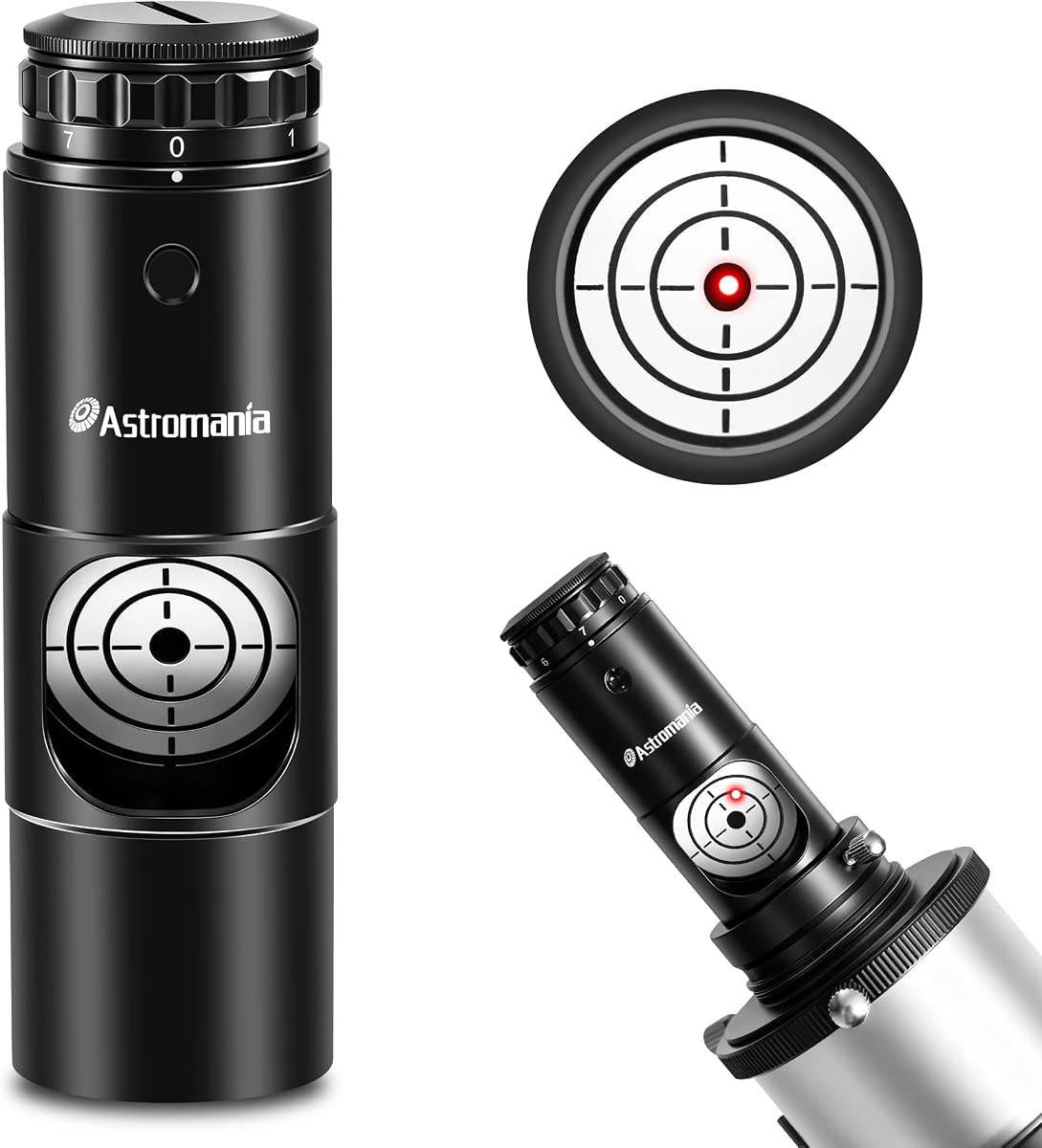


The Astromania Laser Collimator Telescope Alignment 1.25/2-inch for Newtonian Marca is the strongest all-around choice in this roundup, combining broad focuser compatibility with a 4.5 customer rating. Its removable 2-inch adapter allows the same unit to serve telescopes with either standard 1.25-inch or 2-inch focusers, reducing the need to purchase a second collimator after an upgrade.
We may earn a commission when you buy through this link, at no additional cost to you.
Seven brightness levels make the red beam easier to work with in both daylight and darker observing environments. The front emission opening, three adjustment positions spaced 120 degrees apart, and side window with a 45-degree disk all support a methodical alignment process. A metal body with anodized aluminum treatment adds durability, while the included CR2032 battery means the unit is ready for use with its specified power source in place.
The main compromise is its specific design focus. It is marketed for Newtonian Marca telescopes rather than as a universal optical-alignment instrument, and the listed 635–655 nm, 3.8 mW output places it in Class 3R. Users should therefore never look directly into the beam and should use ordinary laser-safety precautions. The included English and German instructions also may not suit every owner as clearly as a more broadly translated manual would.
This is the most balanced recommendation for a Newtonian owner who wants one tool for both common focuser diameters, adjustable beam visibility, and a straightforward single-person procedure. It is particularly useful for beginners who will value the adapter and clear procedural guidance, while more experienced observers still benefit from the multiple adjustment ports and selectable brightness.
The removable 2-inch adapter is the feature that most distinguishes this model from simpler 1.25-inch-only units. A telescope owner can begin with a standard focuser and retain the same basic alignment instrument if the optical tube is later moved to a 2-inch focuser.
Seven selectable brightness levels help balance beam visibility against ambient light. A lower setting can reduce glare during close adjustment, while a brighter setting can make the return path easier to follow in a dark or poorly illuminated observing area.
We may earn a commission when you buy through this link, at no additional cost to you.
The Astromania Laser Collimator 1.25-inch for Newtonian Marca Telescope Alignment is a focused option for owners whose reflectors use the standard 1.25-inch focuser. It carries a 4.5 rating and includes most of the conveniences associated with the larger dual-adapter model, including seven brightness levels, three adjustment openings, and English and German instructions.
We may earn a commission when you buy through this link, at no additional cost to you.
Its compact body is designed to move smoothly within a 1.25-inch focuser, which is useful when checking the beam from the open mirror end of the telescope. The included CR2032 lithium battery and metal construction support convenient, repeated use, while the side inspection window and front opening help the user identify the beam’s return path. This is a practical unit for travel to a dark-sky site or for storage in a compact observing kit.
The obvious limitation is compatibility. Without a listed 2-inch adapter, this model is not the most convenient choice for an observer who already uses a 2-inch focuser or plans to upgrade imminently. Its 635–655 nm red beam is also listed at 3.8 mW and Class 3R, so it should be operated with the same beam-safety awareness as the dual-size Astromania.
Buy this model if your telescope already has a 1.25-inch focuser and you want a straightforward, portable collimator without carrying an extra adapter. It is particularly attractive for a beginner who values clear instructions and one-person operation, and it is a sensible dedicated tool for Newtonian Marca telescopes that never leave the smaller focuser format.
The body is sized to fit naturally inside a standard 1.25-inch focuser, making it a direct choice for smaller Newtonian optical tubes. That specialization avoids the extra bulk of a 2-inch adapter and keeps the alignment tool easy to carry.
Three sealed adjustment openings, a side viewing window, and an included battery support the full setup process. Bilingual instructions provide useful assistance for a first-time owner who may not yet be familiar with the sequence of primary and secondary mirror adjustments.
We may earn a commission when you buy through this link, at no additional cost to you.
The SVBONY Laser Collimator for Newtonian Marca Telescope Alignment, 1.25/2-inch, is a versatile choice that carries a 4.5 rating. Its removable 2-inch adapter allows use with both common focuser sizes, while the seven-level red beam can be adjusted for daylight setup or darker observing conditions.
We may earn a commission when you buy through this link, at no additional cost to you.
The stated workflow is efficient: position the collimator in the focuser, observe the beam from the telescope’s mirror end, and adjust the relevant collimation screws. A solid metal body supports durability, and a full set of step-by-step instructions helps make the process accessible. The triple-cemented lens system is intended to improve red-dot stability, helping the user follow the projected return path with fewer distracting artifacts.
Users should still account for normal red-laser safety and avoid direct eye exposure. A seven-level beam also gives users more control than a fixed-output tool, although a high setting can create glare in a small or dark room. The listing positions the unit primarily for Newtonian Marca reflectors, so owners of entirely different optical systems should verify compatibility before purchasing.
This model is a good middle-ground recommendation for a standard Newtonian that may move between 1.25-inch and 2-inch focusers. It offers the broad compatibility and straightforward setup expected from a laser collimator without moving into the specialized self-centering design used by the premium HoTech option.
The laser method removes the need to move between the eyepiece and the back of the telescope repeatedly. Observing the return pattern from the open mirror end lets one person make incremental screw adjustments and immediately judge the result.
A triple-cemented lens is listed as improving the stability of the red spot. Clearer, steadier projection gives the user a more dependable visual target while the primary and secondary mirror adjustments are being refined.
We may earn a commission when you buy through this link, at no additional cost to you.
The SVBONY Red Laser Collimator Bundle with Telescope Lens combines an alignment tool with a 62-degree aspheric telescope eyepiece. The bundle is intended for 1.25-inch and 2-inch reflector telescopes and uses a removable 2-inch adapter, making the laser portion suitable for either focuser format.
We may earn a commission when you buy through this link, at no additional cost to you.
The collimator has seven red-beam brightness levels, allowing the user to adapt the projection to different ambient conditions. Its metal construction and simple mirror-end viewing procedure are designed to reduce alignment time. The included eyepiece adds value for a new telescope owner because its ultrawide apparent field can be useful for broad lunar views, star clusters, and larger deep-sky targets.
One important documentation issue is the inconsistent laser-class information in the supplied listing. One portion identifies a class IIIa unit with power below 5 mW, while another describes output at or below 1 mW and Class I. Owners should verify the specifications of the exact unit received, follow its printed safety guidance, and avoid looking into the beam. There is also no published customer rating in the supplied data for direct comparison with the rated models.
The bundle makes sense for a beginner who needs both an alignment tool and a general-purpose wide-field eyepiece, or for an existing Newtonian owner who wants one package to cover two needs. An experienced user who already owns a suitable eyepiece may find the laser unit alone more economical and less cluttered.
The laser collimator handles optical-axis adjustment, while the 62-degree eyepiece gives the owner a viewing option after collimation. This makes the bundle more complete for a new system than a standalone collimation accessory.
The included aspheric eyepiece is described as providing a 62-degree apparent field and broad viewing coverage. It is intended for targets that benefit from an expansive view, including lunar landscapes, selected clusters, and many deep-sky objects.
We may earn a commission when you buy through this link, at no additional cost to you.
The Alstar Laser Collimator Alignment for Marca Newtonian Telescopes 1.25 Inch is the best budget-oriented recommendation in this guide. It earns a 4.5 rating and supplies the core features needed for Newtonian alignment: a red laser, seven brightness levels, a front beam aperture, a side inspection window, and three adjustment openings arranged 120 degrees apart.
We may earn a commission when you buy through this link, at no additional cost to you.
The unit arrives fully adjusted but permits further fine-tuning when required. German and English instructions walk through the telescope adjustment sequence, making the product approachable for a beginner. Its metal construction should withstand regular use, and the compact format supports one-person collimation without requiring an assistant to watch the beam from another location.
The CR2032 battery is not included, so a new owner must have one available before starting. Compatibility is also limited to 1.25-inch focusers, with no 2-inch adapter mentioned. The listed red laser operates at 635–655 nm with output below 5 mW, making responsible beam handling essential even though the tool is intended for observational equipment.
This is a strong choice for a budget-conscious owner of a 1.25-inch Newtonian who wants adjustable brightness and clear instructions without paying for dual-focuser support. The small number of extra items it omits is compensated by a focused design that covers the essential alignment functions cleanly and compactly.
The product concentrates on the core laser-alignment functions without adding a second adapter or digital component. That simplicity makes it an accessible first alignment tool for owners of compatible Newtonian telescopes.
The collimator comes pre-adjusted, which can simplify the initial setup. Its three sealed adjustment openings preserve the initial alignment before the user makes deliberate corrections, and the side window helps show whether the beam is returning along its intended path.
We may earn a commission when you buy through this link, at no additional cost to you.
The Alstar Laser Collimator Alignment for Marca Newtonian Telescopes 1.25/2-inch combines a removable 2-inch adapter with a 4.0 rating. It is designed for Newtonian and reflector telescopes using either standard 1.25-inch focusers or the included 2-inch adapter, making it more flexible than the smaller Alstar model.
We may earn a commission when you buy through this link, at no additional cost to you.
The collimator arrives pre-calibrated and offers three adjustment positions at 120-degree intervals. A 45-degree side window with a central hole allows the user to monitor the reflected beam, while the front opening handles laser emission. Seven selectable brightness levels accommodate both daylight and nighttime conditions, and the included CR2032 battery supports immediate use.
Its 4.0 rating is lower than the ratings assigned to the other Alstar and Astromania laser units in the comparison, which may merit extra consideration for buyers who prioritize broad customer feedback. The red laser is also listed at 635–655 nm and 3.8 mW, so it should be handled as a Class 3R device and never viewed directly. The package is optimized for reflector telescopes rather than every optical alignment format.
The model is well suited to a Newtonian owner who wants one collimator for both focuser sizes and prefers a clearly described adjustment process. It is especially helpful for beginners because the unit is pre-calibrated, the battery is included, and the package includes step-by-step instructions.
Supporting 1.25-inch and 2-inch focusers in one package prevents the need to buy a second laser when upgrading a telescope. The removable adapter also keeps the primary tool compact between uses.
The side window provides a direct view of the reflected laser path. Combined with the pre-calibrated adjustment ports, it gives the user a clear way to make small corrections and evaluate each change.
We may earn a commission when you buy through this link, at no additional cost to you.
The SVBONY Red Laser Collimator for Newtonian Marca Telescope with 2 inch Adapter, bundled with a cell phone adapter, is an unusual combination for observers who want to record alignment or use a phone during observing. It holds a 4.4 rating and combines a red laser collimator with a clamp designed for a broad selection of phone models.
We may earn a commission when you buy through this link, at no additional cost to you.
The collimator has seven brightness levels and a metal body. Its phone clamp uses an adjustable locking mechanism with a steel bolt rather than a spring, while high-density EVA pads help protect the handset. The accessory supports eyepiece diameters from 25 to 48 mm and is listed as compatible with many telescopes, microscopes, binoculars, monoculars, and spotting scopes.
The wording around focuser and eyepiece compatibility is not entirely uniform: the title refers to a 2-inch adapter, while the detailed description says the bundle does not fit 2-inch eyepieces and identifies a 1.25-inch telescope fitting. A buyer should therefore verify the current package contents and dimensions rather than relying on the title alone. The extensive list of compatible phone models may also have been written for an earlier product generation, so physical dimensions remain important.
This bundle is most appealing to an owner who specifically wants a phone holder alongside a conventional collimator. It offers a practical clamping solution and adjustable laser brightness, but anyone who only needs a reliable alignment tool may prefer one of the simpler dual-focuser packages.
The steel-bolt locking mechanism offers a firm, adjustable hold for a compatible phone. High-density EVA pads help reduce contact pressure and guard the handset while the clamp is attached to the optical accessory.
The phone-adapter component is listed for use with a wider selection of optical instruments than telescopes alone. That makes it potentially useful for casual observation, microscope work, or binocular and monocular sessions when a secure phone position is useful.
We may earn a commission when you buy through this link, at no additional cost to you.
The SVBONY SV197 Collimating Cheshire Eyepiece and Red Laser Collimator bundle has a 5.0 rating, making it the highest-rated conventional option in the supplied comparison. It gives the user two alignment approaches: an electronic red laser for the telescope’s optical axis and a passive Cheshire eyepiece for observing the concentric reflection pattern.
We may earn a commission when you buy through this link, at no additional cost to you.
The SV197 is precision-machined from aluminum with fine crosshairs, a clear bright mirror, and a sighting hole. It requires no battery and can be used for secondary-mirror collimation during daylight. The laser portion supports 1.25-inch and 2-inch reflectors through a removable adapter, offers seven brightness levels, and uses a metal body. This combination allows a user to confirm laser-based results with a familiar visual reference.
The important limitation is that the Cheshire component should be used only in daylight, whereas the laser can be used in dark or bright conditions. The package is also larger than a standalone laser tool, and a user who already owns a Cheshire eyepiece may see limited added value in the combination. As with other red lasers in the roundup, direct eye exposure should be avoided.
The bundle is a compelling recommendation for a serious beginner or a Newtonian owner who wants both rapid laser alignment and independent visual verification. It also suits anyone who expects to perform secondary-mirror checks in daylight and wants a complete alignment setup rather than a single-purpose tool.
The Cheshire eyepiece provides a passive method for checking the secondary mirror and judging the concentric return pattern. It gives users a second way to confirm that the laser-based adjustments are producing a correctly aligned system.
The laser is useful in varying ambient light, including a dark observing area, while the Cheshire eyepiece is intended for daytime use. Together, the tools cover different stages of telescope setup and verification.
We may earn a commission when you buy through this link, at no additional cost to you.
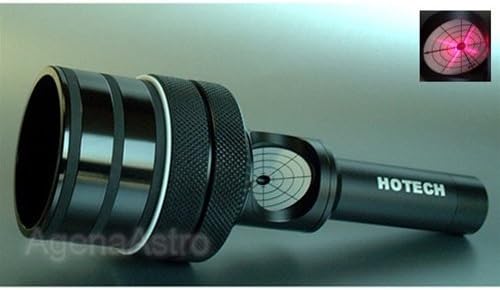
The HoTech 2-inch and 1.25-inch SCA Laser Collimator, Crosshair Model SCA-2C, is the premium recommendation, supported by a 4.7 rating. Its defining feature is the patented Self-Centering Adapter technology, designed to provide precise and repeatable positioning in 1.25-inch and 2-inch telescope focusers.
We may earn a commission when you buy through this link, at no additional cost to you.
The supplied explanation identifies a common problem with ordinary laser collimators: a small installation gap can allow the tool to sit off-axis, potentially undermining the accuracy of the instrument. HoTech’s SCA mechanism is intended to center the collimator automatically once it is installed. The unit arrives with the 1.25-inch SCA collimator and built-in self-centering adapter pre-installed in a 2-inch-to-1.25-inch adapter, along with a CR123 battery and manuals.
Its crosshair laser configuration provides a specific aiming pattern for Newtonian alignment, while the adapter addresses one of the less obvious sources of alignment error. The trade-off is a more sophisticated and premium-positioned product with a less straightforward physical package than a simple plug-in laser unit. Users should follow the included instructions to understand the centering mechanism and obtain repeatable results.
This is the pick for an advanced amateur who performs frequent alignments, uses a premium optical setup, or wants to minimize installation slop. It is also a sensible choice for a workshop or observatory that needs repeatable results across multiple focusers rather than occasional convenience alone.
The self-centering adapter is designed to place the laser accurately along the focuser axis. This directly targets the small mechanical gap that can otherwise cause an otherwise precise collimator to sit off-center and produce misleading adjustments.
The adapter system supports both 1.25-inch and 2-inch focusers and is intended to make installation repeatable. That consistency is particularly valuable when a telescope is collimated repeatedly or when several instruments share a common observing setup.
We may earn a commission when you buy through this link, at no additional cost to you.
The Ocal Pro V4.0 Electronic Collimator is a distinct alternative to the conventional red-laser models in this guide. It is designed for Newtonian and Schmidt Cassegrain telescopes and uses a smartphone-compatible optical alignment process rather than a visible laser beam projected directly down the telescope.
We may earn a commission when you buy through this link, at no additional cost to you.
Built-in software-guided calibration circles provide a visual framework for adjusting the optical axis. The supplied description says each unit is factory-centered to pixel-level accuracy, creating a precise baseline before the owner makes telescope adjustments. Its all-in-one portable design is intended for field use, mobile astronomy setups, imaging preparation, and routine fine-tuning.
There is no published customer rating in the supplied product information, so direct feedback is less available than for the rated laser models. The smartphone-dependent workflow may also require a separate compatible device and could be less appealing to someone who wants a simple, self-contained red laser with no screen-based guidance. Users should confirm compatibility and understand the software requirements before purchase.
The Ocal Pro V4.0 is best suited to a smartphone-oriented observer who works with either Newtonian or Schmidt Cassegrain equipment and values guided digital feedback. It is particularly relevant for critical imaging preparation, while traditional laser users may find a dedicated red-beam collimator more direct.
Built-in calibration circles give the user a structured visual target for optical-axis correction. The approach can make the process more approachable for an owner who wants more guidance than a bare laser return pattern.
Factory centering to pixel-level accuracy is intended to provide a dependable baseline. Fine adjustments can then focus on the telescope rather than on correcting avoidable errors in the collimator itself.
We may earn a commission when you buy through this link, at no additional cost to you.
The best laser collimator for telescope alignment is the one that fits the optical tube correctly, centers repeatably, shows a clear return path, and matches the owner’s preferred workflow. Compatibility, safety, included accessories, and ease of setup should be considered together rather than in isolation.
Start by confirming the diameter of the telescope’s focuser. Many Newtonian telescopes use a standard 1.25-inch focuser, while some use 2-inch focusers, and a model that physically fits the opening is essential. A removable adapter can provide useful flexibility, allowing one collimator to serve both formats as the telescope changes. Buyers should also consider the depth and clearance of the focuser because an ill-fitting body can sit unevenly or be difficult to secure.
Choose a collimator with the exact focuser fit you need, preferably with an adapter if future upgrades are possible.
Most products in this guide are designed specifically for Newtonian reflectors, sometimes with additional use on reflector-style systems. A Schmidt Cassegrain owner should verify whether the product addresses the telescope’s own collimation geometry and adjustment screws. The Ocal Pro V4.0 is the exception in this comparison because it is explicitly listed for both Newtonian and Schmidt Cassegrain telescopes. Checking the manufacturer’s stated compatibility helps prevent an otherwise suitable tool from being used with the wrong optical design.
Match the collimator to the telescope type before comparing brightness or convenience features.
A laser collimator must sit accurately along the optical axis for its return pattern to be meaningful. Ordinary focuser tolerances can introduce a small amount of slop, while a self-centering adapter is designed to reduce that source of error. The HoTech SCA-2C is the most explicit example of this approach in the roundup. For occasional alignment, a conventional well-fitting unit may be sufficient, but frequent users and exacting observers may value repeatable self-centering more than extra bundled accessories.
Prioritize repeatable centering when alignment precision is your main concern.
Brightness controls help the beam remain visible under different ambient conditions. Seven levels appear across most of the red-laser products here, allowing the user to reduce glare in a dark room or increase visibility in daylight. A featureless fixed beam can be harder to evaluate, while a stable, distinct return target makes incremental adjustment easier. The control is not merely a convenience: it can help the user keep the relevant beam position clear while working around the telescope.
Look for multiple brightness levels so the return path remains legible in your usual setup location.
Laser safety deserves attention because the beam is directed through the telescope. Some listings specify Class 3R, while others describe Class IIIa or Class I depending on the exact model or the version received. Do not assume that a low visual brightness means a low-power or harmless beam. Never look into the aperture or directly into the emitted beam, keep the unit away from children, and follow the safety instructions supplied with the exact product. If documentation is unclear, contact the seller or manufacturer before use.
Always confirm the exact laser class and follow the manufacturer’s beam-safety guidance.
Useful collimators offer more than a beam: they also help the user locate and interpret the return pattern. Three adjustment openings spaced 120 degrees apart are common across the Astromania and Alstar models, while a 45-degree side window with a central hole provides a view of the reflected path. A front emission opening completes the setup. These features help one person make small corrections, but the included instructions remain important for understanding what each visual change means.
Choose a model with clear adjustment ports and a visible return window for easier one-person work.
A manual can be the difference between a smooth first alignment and a frustrating setup. Astromania and Alstar products are specifically described as including detailed German and English instructions, and SVBONY’s standard model is listed with a step-by-step guide. Accessories add value when they fill a genuine need: a 2-inch adapter supports focuser upgrades, a Cheshire eyepiece offers a second alignment method, and a phone clamp helps with recording or observing. Avoid paying for extras that duplicate equipment already owned.
Favor a complete package only when its instructions or accessories solve a need you actually have.
Check the battery type, whether one is included, and how it is replaced. Several models use a readily available CR2032 cell, while the HoTech model includes a CR123 battery. A rear screw cap makes the power compartment accessible for routine changes. Portability also matters for field alignment: compact 1.25-inch units and the all-in-one Ocal Pro design are easier to carry, whereas larger bundles with adapters and eyepieces need more storage space.
Confirm battery compatibility and consider the full packed size before taking the tool to a field site.
Begin with the telescope in a stable setup and the optical tube in the orientation required by its manufacturer. Install the collimator in the focuser, make sure it is seated evenly, and remove the rear battery cap or activate the unit as instructed. Read the supplied guide before loosening the secondary-mirror screws, since the order of primary and secondary adjustments can differ among Newtonian designs.
Observe the return pattern from the open end of the optical tube rather than looking through the focuser toward the laser. Adjust the relevant collimation screws in small increments while watching the return spot or crosshair. With a conventional laser, the goal is a centered return pattern; with the Ocal Pro, follow the on-screen calibration circles. Use the lower brightness settings when the beam looks too glaring and increase the level only when the target becomes difficult to see.
After alignment, switch off the collimator, remove it from the focuser, and store it in a dry case. Keep the adjustment openings closed when the unit is not in use, since the seals help protect the internal mechanism from dust and accidental movement. Replace the battery if performance becomes inconsistent, clean the lens only with a safe lens-cleaning method, and never point the operating beam toward people, aircraft, vehicles, or animals.
Most laser collimators in this guide are designed for Newtonian reflectors, with several also intended for other reflector configurations. The Ocal Pro V4.0 is listed specifically for Newtonian and Schmidt Cassegrain telescopes. Always confirm both the telescope type and focuser diameter before buying, because a physically correct focuser fit does not guarantee that every adjustment procedure is appropriate for every optical design.
You need the size that matches your telescope’s focuser, not simply the telescope’s aperture. A removable 2-inch adapter can make one tool suitable for both common formats. If your telescope currently uses 1.25 inches but you expect a future focuser upgrade, a dual-size model may offer better long-term value than a dedicated 1.25-inch unit.
They can be used responsibly as alignment tools, but users must follow the safety instructions for the exact model. Never look into the beam, whether from the focuser or the open mirror end, and do not aim it at people, vehicles, aircraft, or wildlife. Several products in this guide are listed at output levels that warrant particular caution, so verify the specifications printed on or supplied with your unit.
Collimation is commonly checked before observing sessions, after a telescope has been moved or transported, and whenever the owner notices a decline in image quality. Rough handling, changing accessories, and repeated setup changes can affect alignment. A stable laser return pattern makes a quick visual check easier, although a full adjustment should still be performed when the pattern is no longer centered.
Yes, and daylight can be convenient because ambient light makes the optical path easier to see. The conventional red-laser models in this guide offer several brightness levels for different conditions. Lower levels can reduce glare in a darkened room, while a brighter setting may help during daytime setup. The SV197 Cheshire eyepiece is different because it is intended only for daytime use.
A laser collimator projects a beam through the focuser and displays its return pattern on the telescope’s primary mirror, allowing adjustment while viewing from the open end. A Cheshire eyepiece uses a bright window and sighting hole to show the secondary mirror’s reflection and concentric alignment pattern. The SVBONY bundle includes both, giving users an electronic method and a passive visual reference.
The telescope may need collimation, but the collimator itself can also be sitting off-axis within the focuser. Check that it is fully and evenly seated, confirm the correct adapter is used, and follow the manual’s centering procedure. A self-centering model such as the HoTech SCA-2C is designed to minimize installation slop, while conventional units may require careful seating and adjustment.
Most of the red-laser products operate as self-contained tools, and the SVBONY phone-clamp bundle is optional rather than necessary for basic laser alignment. The Ocal Pro V4.0 is the exception because it uses smartphone-compatible, software-guided calibration circles. Before purchasing that model, confirm that your phone and software environment support its required workflow.
The Astromania 1.25/2-inch model is the best overall choice because it combines a removable 2-inch adapter, seven brightness levels, three adjustment positions, clear inspection features, and a solid 4.5 rating. The Alstar 1.25-inch unit is the best budget pick for a compatible smaller focuser, while the HoTech SCA-2C earns the premium recommendation for its patented self-centering installation and 4.7 rating.
Prioritize physical compatibility and repeatable centering before choosing extras. Confirm the telescope type, focuser diameter, battery arrangement, laser safety information, and adjustment procedure. A dual-size adapter is valuable if you may upgrade, a Cheshire eyepiece is useful for visual verification, and a smartphone-guided system may appeal if you prefer digital feedback. Otherwise, a well-matched red-laser unit is direct, portable, and effective.
Finally, check current prices, package contents, ratings, and product documentation at the time of purchase. Listings can change their included accessories or specifications, and the safest choice is the one that still matches your actual focuser and optical system when you are ready to order.