AstroAI Digital Multimeter
4.7Editor score
Automatic range selection
True RMS measurement support
Battery test modes
Backlit display and flashlight
Dual-fuse overload protection
Best multimeter for motorcycle comparisons covering safety, accuracy, auto-ranging, True RMS, battery testing, display features, and practical tools for DIY
A motorcycle multimeter is more than a general electrical tester: it helps riders diagnose charging systems, batteries, lighting circuits, sensors, and intermittent wiring faults. A useful model should combine safe measurement limits with clear displays, understandable controls, and functions suited to the electrical demands of modern motorcycles.
The ten models below were compared using their stated measurement ranges, safety protections, display capabilities, automotive relevance, and user-facing features. The guide covers conventional multimeters, True RMS instruments, a manual-range option for direct control, and a smart clamp meter that simplifies many diagnostic tasks.
Each pick highlights a different balance of capability and convenience, from compact entry-level testers to professional instruments. Ratings and product details reflect the supplied information, while prices and availability can change, so readers should confirm current listings and motorcycle-specific requirements before buying.
4.7Editor score

4.6Editor score

4.8Editor score
The comparison below places each motorcycle multimeter side by side, highlighting measurement coverage, ranging method, display, and safety features to help riders identify the most appropriate diagnostic tool for their needs.


The AstroAI True RMS 6000-count meter combines an unusually broad diagnostic feature set with an approachable auto-ranging design. Its 4.6 rating reflects a well-rounded instrument for motorcycle owners who want to move beyond simple voltage checks. The large backlit LCD, data hold, auto shutoff, and kickstand make it practical in garages and roadside settings.
We may earn a commission when you buy through this link, at no additional cost to you.
Its measurement coverage is one of the strongest in this group. It handles AC and DC voltage and current, resistance, capacitance, frequency, duty cycle, continuity, diode testing, and temperature. True RMS support is particularly useful when alternating-current readings need to be evaluated without the simplifying assumptions associated with conventional averaging methods. A 6000-count display also provides more usable resolution than a basic 1999-count model.
The safety provisions are reassuring for vehicle electrical work. Two ceramic fuses, rated at F400mA/600V and F10A/600V in the supplied information, provide overload protection, while the silicone housing adds physical and electrical isolation. The main trade-off is the size of the feature set: temperature, frequency, duty cycle, capacitance, and multiple AC/DC options can feel excessive to a rider whose diagnostic needs are limited to battery and charging-system checks.
This is a strong choice for home mechanics who want one instrument to cover motorcycles, household electronics, and broader electrical troubleshooting. Auto-ranging removes much of the guesswork from range selection, while the backlit screen helps when the motorcycle is parked in a dim garage. Buyers should remove the test-lead cap before use and consult the manual to understand every mode before beginning a diagnosis.
Voltage, resistance, continuity, and diode testing cover the core needs of motorcycle electrical diagnosis. Capacitance, frequency, duty cycle, and temperature broaden the tool's usefulness when investigating electronic controls, charging components, or environmental readings.
True RMS is valuable for alternating-current diagnostics where distorted or non-sinusoidal waveforms can reduce the usefulness of a standard average-based reading. The feature is a meaningful advantage for users who work beyond basic motorcycle maintenance.
We may earn a commission when you buy through this link, at no additional cost to you.
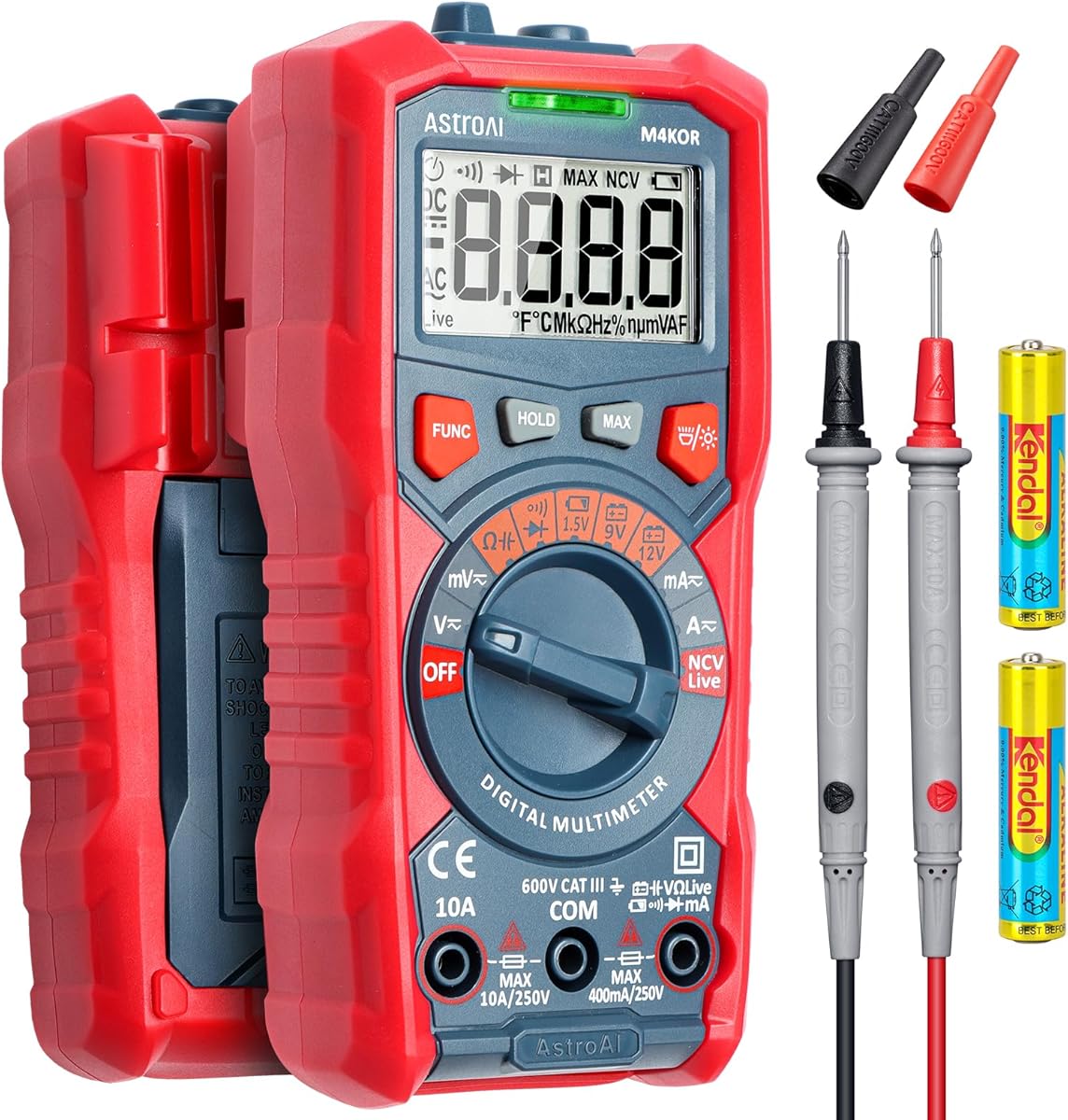
The AstroAI M4K0R balances useful diagnostic features with an approachable design, earning a 4.7 rating among users. It combines a 4000-count display, True RMS capability, auto-ranging, and dedicated battery testing in a package well suited to routine motorcycle electrical checks. The built-in flashlight is also useful when a fault can only be reproduced in a dark garage or after dark.
We may earn a commission when you buy through this link, at no additional cost to you.
Three battery-test modes cover 1.5V, 9V, and 12V batteries. That is relevant because many motorcycles use 12V systems, although the test function should not be treated as a complete battery-condition analyzer. A red indicator signals low voltage and green signals sufficient voltage, giving a quick preliminary indication rather than a full laboratory assessment. The meter also provides AC and DC voltage, current, resistance, continuity, diode, and live-wire testing.
Other practical details include data hold, maximum-value tracking, auto shutoff, a low-battery indicator, a continuity buzzer, and a backlit screen. Double ceramic fuses and a stated CAT III 600V safety standard add protection. The compromises are that the feature set is less extensive than the Fluke models, and current measurement is limited to 10A. Riders should also remember that a non-contact detector is a screening aid, not a substitute for appropriate lead-based verification.
This model is a strong selection for DIY riders who want battery, voltage, continuity, and resistance functions without navigating a professional-grade price tier. It is particularly useful for owners maintaining older 12V electrical systems and riders who want a backlight and flashlight in one meter. For advanced waveform-dependent diagnosis or highly specialized measurements, a more comprehensive instrument would be preferable.
The dedicated 12V battery mode gives motorcycle owners a convenient way to perform a basic charge-state check. Its color indicators make the result easy to interpret, although a battery can still need load, charging-system, or capacity testing after a preliminary result.
The backlit display and separate flashlight improve visibility around battery terminals, connectors, and wiring harnesses. These features are especially helpful during nighttime roadside checks where a bright work light may not be available.
We may earn a commission when you buy through this link, at no additional cost to you.
The Fluke 17B+ Digital Multimeter is the premium selection in this guide, combining a 4.8 rating with professional-grade measurement coverage. It supports AC and DC voltage to 1000V, current measurements to 10A, resistance, continuity, diode testing, capacitance, frequency, and temperature. The included type K thermocouple makes the temperature function ready for immediate use.
We may earn a commission when you buy through this link, at no additional cost to you.
Its CAT III 600V safety rating is designed for electrical systems in residential, commercial, and industrial environments, while the 1000V measurement capability adds useful headroom. For motorcycle work, the broad function set means a technician can investigate starting circuits, charging output, resistance faults, diode behavior, and component temperature with one instrument. The 10A current range is suitable for many branch-level motorcycle circuits when the correct input and connection method are used.
The principal downside is cost relative to general-purpose meters. Riders who only need occasional battery-voltage and continuity checks may not use capabilities such as capacitance, frequency, or temperature. Even so, the breadth and safety positioning make the 17B+ attractive for workshops, serious hobbyists, and riders who want a durable diagnostic tool for multiple vehicle systems.
Choose the Fluke 17B+ when diagnostic breadth and professional credentials matter more than minimal cost. It is a particularly sensible choice for owners who service several motorcycles, work on modern electronic systems, or want a meter that can remain useful as their skills expand. Confirm that the manual's input and range instructions are understood before every measurement.
The combination of voltage, current, resistance, continuity, diode, capacitance, frequency, and temperature functions reduces the need to own several separate test instruments. That makes the model useful for both motorcycle repair and general electrical work.
The included type K thermocouple can help investigate components that warm unexpectedly during operation. Temperature readings provide context when diagnosing charging systems, connections, or components that behave differently only after they have been running.
We may earn a commission when you buy through this link, at no additional cost to you.
The Fluke 15B+ is a professional-oriented digital multimeter with a 4.8 rating and a focused set of electrical measurements. It measures AC and DC voltage up to 1000V, AC and DC current up to 10A, resistance, continuity, diode behavior, and capacitance. That foundation covers the majority of electrical checks encountered during routine motorcycle troubleshooting.
We may earn a commission when you buy through this link, at no additional cost to you.
The CAT III 600V safety rating and clearly defined 10A current input reinforce its professional positioning. Riders can use it to check battery condition, charging-system output, lamp circuits, continuity, and resistance-based faults. Compared with feature-heavy models, the 15B+ offers a more focused instrument, which can be beneficial for users who want established core functions without navigating a crowded mode set.
The trade-off is that the meter provides fewer extras than the 17B+ and the feature-rich AstroAI models. There is no listed temperature measurement, duty-cycle function, or non-contact voltage detector in the supplied specifications. That means it may be less convenient for a technician who wants one meter for every possible electrical task, but it can still be an excellent core diagnostic instrument.
The 15B+ is best suited to serious riders, mobile technicians, and workshop users who value measurement range, safety, and established core functions. It is a particularly good choice when the objective is dependable electrical troubleshooting rather than a broad collection of secondary features. Users should still observe the correct input terminals, ranges, and probe placement.
Voltage, current, resistance, continuity, diode, and capacitance measurements cover most motorcycle electrical investigations. The streamlined selection can make the meter easier to use for technicians who primarily need dependable standard diagnostics.
The CAT III 600V classification and 1000V measurement capability provide meaningful range for electrical work. They do not eliminate the need for correct procedures, but they give the instrument a clear professional safety framework.
We may earn a commission when you buy through this link, at no additional cost to you.
The Klein Tools MM420 combines auto-ranging and True RMS operation with a rugged, workshop-oriented design. Its 4.7 rating reflects a strong balance of measurement capabilities, safety prompts, and physical durability. It measures AC and DC voltage to 600V, AC and DC current to 10A, resistance to 50MΩ, and also provides continuity, temperature, capacitance, frequency, duty cycle, and diode testing.
We may earn a commission when you buy through this link, at no additional cost to you.
LED lead-alert protection is a practical feature for motorcycle diagnostics, where a lead accidentally placed in the wrong socket can produce confusing results or create avoidable risk. The backlit LCD helps in dark workspaces, and the included kickstand, test-lead holders, and compatibility with optional magnetic hangers support hands-free work around a motorcycle.
The stated ability to withstand a 6.6-foot drop makes the MM420 appealing for active garages and field use. Its package includes leads with CAT III/CAT IV safety caps, a thermocouple, instructions, and two AAA batteries. On the other hand, it costs more than several general-purpose alternatives, and the exact safety category for a particular measurement environment must be considered carefully.
The MM420 is a strong recommendation for mechanics who want a durable, feature-rich meter without moving to a full clamp-meter format. It is especially suitable for frequent workshop use, riders who diagnose electrical issues outside ideal lighting, and users who value lead placement alerts. True RMS and automatic ranging also reduce the need for manual range changes during mixed diagnostic work.
The 6.6-foot drop specification and rugged construction are meaningful advantages in a garage, van, or crowded maintenance area. A meter that tolerates ordinary knocks is easier to use repeatedly than a more delicate handheld model.
The illuminated lead-alert system helps confirm that probes are connected correctly before measurements begin. That is a valuable safeguard for riders who may work on unfamiliar motorcycles or use the same instrument for several electrical tasks.
We may earn a commission when you buy through this link, at no additional cost to you.
The Crenova MS8233D is a versatile 6000-count meter with a 4.6 rating and a broad collection of electrical tools. It measures AC and DC voltage and current, resistance, capacitance, frequency, and duty cycle, while supporting continuity, diode, live-wire, and non-contact voltage tests. The ability to switch between manual and auto-ranging modes is a standout for users who want either speed or direct range control.
We may earn a commission when you buy through this link, at no additional cost to you.
Its non-contact voltage detector produces both sound and light alarms, and the supplied information indicates that the buzzer becomes faster as stronger AC voltage is detected. This can help locate an energized conductor before opening a connection or working in a confined area. The backlit screen, maximum and minimum tracking, data hold, low-battery warning, and auto power-off support efficient field use.
Protection is addressed through two built-in fuses and an insulated rubber holster, while the stated IEC61010-1 CAT III 600V standard provides a clear safety context. The package includes test leads, alligator clips, two AAA batteries, a carrying case, and a manual. The drawback is that the many modes and range options can feel unnecessarily complicated for a beginner dealing with a basic wiring issue.
The MS8233D suits experienced DIY riders and technicians who want flexibility, True RMS capability, and a non-contact voltage detector in one instrument. The manual-ranging option is particularly useful when a rider wants to monitor a known range or make deliberate range choices. New users should begin with basic voltage, resistance, and continuity functions and consult the manual before working with live circuits.
Automatic ranging makes quick checks less demanding, while manual selection gives experienced users greater control over the measurement range. This flexibility is useful in workshop environments where a technician may want repeatable, deliberate settings.
The audible and visual live-wire alerts help identify AC voltage without placing probes on a conductor. It is best treated as a preliminary screening method and followed by appropriate lead-based verification before the circuit is handled.
We may earn a commission when you buy through this link, at no additional cost to you.
The Klein Tools MM325 is a manual-ranging digital multimeter offering a 4.7 rating. It measures AC and DC voltage up to 600V, DC current to 10A, and resistance to 2MΩ, with continuity, diode, and battery-test functions. The manual range arrangement gives users direct control, making the model appealing to technicians who already know which range a diagnostic task requires.
We may earn a commission when you buy through this link, at no additional cost to you.
Its most motorcycle-relevant convenience is the battery-test mode, which can check whether a battery is working and is a useful addition to a garage tool kit. A backlit LCD supports low-light visibility, while LEDs illuminate to indicate proper test-lead placement. That warning helps reduce the chance of a setup mistake, particularly when switching between voltage, resistance, and current functions.
The main limitation is that the 2MΩ resistance range is lower than the 40MΩ or 50MΩ maximums offered by several other picks. It also lacks the broader feature sets found in the Fluke 17B+, Crenova MS8233D, and Klein MM420. Manual ranging requires more attention, although that is not necessarily a disadvantage for a confident user who values predictable range selection.
The MM325 is a good fit for riders who want the familiar feel of a manually controlled meter, want a dedicated battery-test function, or prefer fewer automated settings. It is particularly useful for basic motorcycle battery, fuse, lamp, and wiring diagnostics. The lead-alert indicators and illuminated display add safety and convenience without requiring a large feature-heavy interface.
Manual ranging lets an experienced user select a range deliberately rather than relying on automatic detection. This can be helpful when a reading behaves unexpectedly or when a specific range is preferred for a known circuit.
A dedicated battery-test mode complements the lead placement LEDs. Together, they support quick preliminary checks of the motorcycle battery and help ensure the meter is configured correctly for each test.
We may earn a commission when you buy through this link, at no additional cost to you.
The AstroAI 2000-count digital multimeter is an approachable entry-level tool for basic motorcycle electrical checks. It carries a 4.5 rating and covers AC and DC voltage, DC current, resistance, continuity, and diode testing. A rotary selector makes the operating model familiar, while the 3.5-inch-digit LCD and backlight keep readings visible in a garage.
We may earn a commission when you buy through this link, at no additional cost to you.
A stated sampling speed of two readings per second is adequate for many slow-changing measurements and general fault-finding. Data hold and a continuity buzzer make it easier to examine readings without immediately removing the probes. Double fuses, a silicone cover, and a low-battery indicator provide sensible protection, and the package includes test leads, batteries, and a user manual.
The key limitation is clearly stated: the meter cannot test all AC current and does not measure AC voltage below 100mV. It is therefore not the strongest option for detailed alternating-current analysis. Its 1999-count display and manual range selection also offer less resolution and convenience than the 6000-count auto-ranging models in this list. Buyers who need advanced AC work should choose a True RMS model instead.
For riders who want a simple meter for battery voltage, continuity checks, resistance measurements, and basic circuit testing, this model delivers the essentials in a manageable design. It is most suitable for occasional maintenance, entry-level learning, and straightforward garage use. The included manual should be reviewed before operation, particularly for input selection and range configuration.
The rotary selector and familiar measurement layout make the meter approachable for first-time multimeter users. It is a practical choice for common battery, fuse, lamp, and wiring checks before advanced diagnostics are needed.
The stated inability to test all AC current and the 100mV AC voltage limitation should guide the purchase decision. Riders focused on sophisticated AC analysis will receive more capability from a dedicated True RMS instrument.
We may earn a commission when you buy through this link, at no additional cost to you.
The INNOVA 3320 is an auto-ranging digital multimeter designed with automotive and household troubleshooting in mind. It has a 4.5 rating and emphasizes safe interaction with vehicle electrical systems. The large display, color-coded battery-status LEDs, and automatic scale selection make it a straightforward choice for routine motorcycle maintenance.
We may earn a commission when you buy through this link, at no additional cost to you.
Its 10-megohm input impedance is highlighted as suitable for automotive use because it reduces the risk of damage to a vehicle's electronic control unit. Automatic ranging removes the need to select the correct scale manually, which is especially helpful when checking an unfamiliar motorcycle circuit or moving between resistance and voltage measurements.
The model is less advanced than many newer competitors. It does not offer the listed True RMS capability, wide measurement function sets, or non-contact voltage detection found elsewhere in the guide. Its resistance function is described as a single setting for AC and DC voltage, which should be considered if the meter is expected to handle more specialized alternating-current work.
The INNOVA 3320 is best for riders who prioritize vehicle-safe design, simple operation, and battery status checks. It can serve as a dependable general tool for wiring and electrical fault-finding without requiring the user to manage many secondary modes. Those who need True RMS, temperature, capacitance, or advanced frequency analysis should choose a more specialized model.
The stated 10-megohm input impedance is a notable feature for automotive diagnostics because it is intended to limit the meter’s effect on sensitive vehicle electronics. That consideration is particularly relevant on motorcycles with electronic control units and complex instrument clusters.
Automatic ranging helps riders move between basic voltage and resistance checks without repeatedly consulting a range chart. It reduces setup time and makes the meter easier to use for occasional maintenance tasks.
We may earn a commission when you buy through this link, at no additional cost to you.
The Klein Tools CL460S is a smart digital clamp meter with a 4.7 rating, bringing a different diagnostic approach to the roundup. Instead of requiring manual mode changes for common functions, it automatically switches among continuity, voltage, current, and resistance. This can speed up preliminary checks on a motorcycle and reduce the chance that a rider forgets to move a selector.
We may earn a commission when you buy through this link, at no additional cost to you.
The clamp can measure AC and DC current up to 400A, while the meter also supports voltage to 600V, resistance to 40MΩ, capacitance, frequency, duty cycle, temperature, and diode testing. Auto-ranging and True RMS technology support dependable measurement selection and alternating-current accuracy. These are useful features for riders working on starter circuits, charging systems, or current-carrying harnesses.
Its transflective reverse-contrast LCD is designed for visibility in all lighting conditions, including direct sunlight. The slim, rugged construction is appropriate for jobsite use, and a built-in test-lead holder plus compatibility with an optional magnetic hanger supports hands-free work. The limitation is that a clamp meter is less convenient for every in-circuit resistance or continuity test than a conventional probe-based model.
The CL460S is a compelling choice for users who regularly measure current or want one instrument that can adapt to several test types. It is particularly useful outdoors, in crowded workspaces, and wherever a clamp-style current reading would be more convenient than opening a circuit. Riders needing mostly fine resistance work may still prefer a dedicated multimeter, but this model offers excellent flexibility.
The clamp design allows current to be measured by enclosing the conductor rather than disconnecting the circuit. That can be valuable for quick checks of motorcycle electrical systems where a conventional series connection is inconvenient.
Smart mode switching reduces repetitive selector changes, while the transflective display remains legible in direct sunlight. The combination supports fast workflows in garages, driveways, and outdoor repair settings.
We may earn a commission when you buy through this link, at no additional cost to you.
Choosing a motorcycle multimeter involves balancing electrical limits, measurement functions, safety protections, display quality, and the way the controls fit your diagnostic experience. The right instrument should support the checks you actually perform without adding avoidable complexity.
A motorcycle primarily operates on DC electricity, so adequate DC voltage and current ranges are the foundation of a useful purchase. Most riders need to measure battery voltage, charging-system output, switch and lamp circuits, and possibly current draw. Models listed here reach 600V or 1000V for voltage, while current capacities vary considerably. The Klein CL460S stands apart with a stated 400A clamp range, whereas several conventional multimeters are rated to 10A. Higher current capability is useful for branch circuits, but it does not mean every measurement should be made at maximum capacity. Correctly rated leads, inputs, and ranges remain essential.
True RMS is a meaningful differentiator when alternating-current waveforms are distorted or non-sinusoidal. It helps the meter represent AC readings more effectively than a basic average-based approach. The AstroAI 6000-count model, AstroAI M4K0R, Crenova MS8233D, Klein MM420, and Klein CL460S list True RMS capability. Riders doing only battery and DC-system work may not need it, but users investigating electronic modules, rectifiers, sensors, or modern control systems may benefit. Entry-level models that omit True RMS can still be appropriate for conventional DC diagnostics.
Auto-ranging selects the measurement range automatically, reducing setup time and the chance of choosing an unsuitable range. It is convenient for beginners and for riders moving between several diagnostic tasks. Manual ranging gives experienced users direct control and can be preferable when a known range is desirable or when a reading needs to be monitored under consistent settings. The Klein MM325 and AstroAI 2000-count model use manual selection, the Crenova supports both, and several other picks are auto-ranging. The best choice depends on confidence with electrical test procedures.
Display resolution affects how precisely a reading can be viewed. The 6000-count models offer more numerical detail than the 2000-count AstroAI meter, while the 4000-count AstroAI and other professional displays occupy the middle ground. A large backlit screen is valuable in dim garages, and the Klein CL460S adds a transflective display designed to remain readable in direct sunlight. Consider digit size, backlight quality, data hold, and whether the display can freeze a reading. For motorcycle work, readability during awkward positions and changing light is often as important as raw count resolution.
Fuses, insulated housings, correct input alerts, and safety categories help protect both the operator and the meter. Several models use double ceramic or built-in fuses, while the Klein MM325 and MM420 provide LEDs that illuminate when test leads are placed incorrectly. The Crenova and AstroAI M4K0R are listed with CAT III 600V classifications, and the Fluke models also carry CAT III 600V ratings. These categories describe appropriate use conditions and do not remove the need to follow the manual, disconnect power when appropriate, and avoid touching exposed conductors.
A dedicated battery mode can simplify a preliminary 12V battery check, and several meters also offer 9V or 1.5V battery ranges. The Klein MM325 and AstroAI M4K0R both include dedicated battery testing, while the INNOVA uses color-coded LEDs to indicate charge status. These modes are convenient but should not be confused with a complete battery capacity, load, or internal-condition test. Live-wire and non-contact voltage detection can also be helpful around unfamiliar wiring, though such alerts should be followed by direct verification with the leads.
A motorcycle multimeter should be easy to carry between a garage, driveway, and roadside location. Kickstands, lead holders, backlights, flashlights, and optional magnetic hangers make the instrument easier to position around a bike. The Klein CL460S offers a compact clamp format, while the MM325 and MM420 include test-lead storage and hanging options. A large display is useful, but a model that is too bulky for a tool bag can still be inconvenient. Riders should consider how they will store the meter, probes, and any temperature sensor as one organized kit.
Voltage, resistance, continuity, and diode testing form the core of motorcycle electrical diagnosis. Additional functions such as capacitance, frequency, duty cycle, temperature, and non-contact voltage detection expand the range of possible investigations. The Fluke 17B+ and AstroAI 6000-count meter provide broad function sets, while the Fluke 15B+ offers a focused professional core. More functions are not automatically better; they add value only when they match the owner’s needs. A rider doing basic battery and fuse checks may prefer simplicity, while a technician may want temperature and frequency measurement from the same device.
Before testing, identify the circuit and what the meter needs to measure. Inspect the meter, test leads, connectors, and fuses for visible damage, then install or verify the correct batteries. Read the manual, select the input socket appropriate to the measurement, and confirm that the rotary switch or smart function is set for the intended test. Never begin with an uncertain range or a lead that is not fully seated.
Measure voltage with the motorcycle in the state relevant to the diagnosis, such as key-on, engine-running, or during charging operation. For resistance and continuity tests, disconnect power and remove the component from the circuit when necessary. Current testing requires the circuit to be opened and the meter placed in series; do not connect the leads directly across a power source. Use the lowest suitable current input for the expected load and avoid leaving the meter in a current position while probes are attached to a battery.
After use, switch the meter off, remove probes from the input terminals, and store the leads loosely rather than tightly wrapped around the housing. Keep the instrument away from moisture, excessive heat, dust, and impact. Replace batteries promptly after a low-battery warning, and have damaged leads or fuses replaced with suitable parts. Periodic checks against a known source and routine visual inspection help ensure the meter remains trustworthy for future motorcycle repairs.
A meter with at least 600V of DC voltage capability covers normal motorcycle systems and leaves useful headroom for transient spikes. Models rated to 1000V provide additional margin for broader electrical work. Always follow the manufacturer’s safety instructions and avoid using the input or range in a way the instrument is not designed to handle.
True RMS is not essential for routine battery, fuse, lamp, switch, and DC continuity checks. It becomes more useful when investigating electronic modules, rectifiers, sensors, or AC readings that may be distorted. Riders who only need straightforward DC diagnostics can focus on range, protection, and display quality instead.
A multimeter with a 12V battery mode can provide a quick preliminary indication of charge state, and a standard voltage measurement can also show resting or charging voltage. Those readings do not fully reveal battery capacity, internal condition, or cranking performance. A load tester or other dedicated battery assessment may still be appropriate.
No. Start with the range and input appropriate to the expected current, and use the highest current input only when necessary. A mistake can open a fuse or damage the meter, so verify the jack, range, and lead placement before energizing the circuit. High-current inputs are normally intended for short-duration measurements rather than sustained loads.
A non-contact detector is useful for quickly screening energized conductors, but it can be influenced by nearby wiring, circuit conditions, and battery systems. It should not replace a properly configured lead-based voltage test. Confirm the circuit state and test with the appropriate meter function before handling connections or components.
An auto-ranging meter selects the measurement range automatically, which is faster and less prone to setup mistakes. A manual-ranging meter requires the user to choose the range, giving experienced technicians more deliberate control. Manual models can be useful for familiar diagnostic work, while auto-ranging is often easier for mixed tasks and new users.
Lead-alert LEDs help show when probes are connected to the wrong input relative to the selected function. This reduces confusion and can prevent avoidable damage. The feature is especially helpful when changing between voltage, resistance, and current measurements in a cramped workshop or during a roadside repair.
A clamp meter can measure current through a conductor without opening the circuit. The Klein CL460S in this guide is a clamp-style model with a stated current capacity up to 400A. Probe-based meters normally require opening the circuit and placing the meter in series, so a clamp meter offers a different and sometimes safer workflow for current checks.
The AstroAI 6000-count True RMS model is the strongest all-around choice for riders who want broad measurement coverage, auto-ranging, a backlit display, and useful motorcycle-related functions. The AstroAI M4K0R stands out as a practical value pick with 12V battery testing, illumination, True RMS capability, and dual-fuse protection. For professional-grade requirements, the Fluke 17B+ offers the broadest stated diagnostic set among the premium choices.
Prioritize the functions you will actually use, along with safe input handling, clear readings, and an appropriate safety category. Basic owners may need little more than reliable DC voltage, resistance, continuity, and diode testing, while experienced mechanics may benefit from True RMS, temperature, capacitance, frequency, or a clamp-style current measurement. Manual ranging can reward experienced users, while auto-ranging makes mixed diagnostics easier.
Ratings, features, availability, and prices can change, so check the current listing and manufacturer instructions before purchasing. Confirm that the meter includes the leads or accessories needed for your work, understand its limits, and follow the correct measurement procedure. A carefully chosen multimeter becomes a dependable part of a motorcycle maintenance kit rather than merely another diagnostic tool.