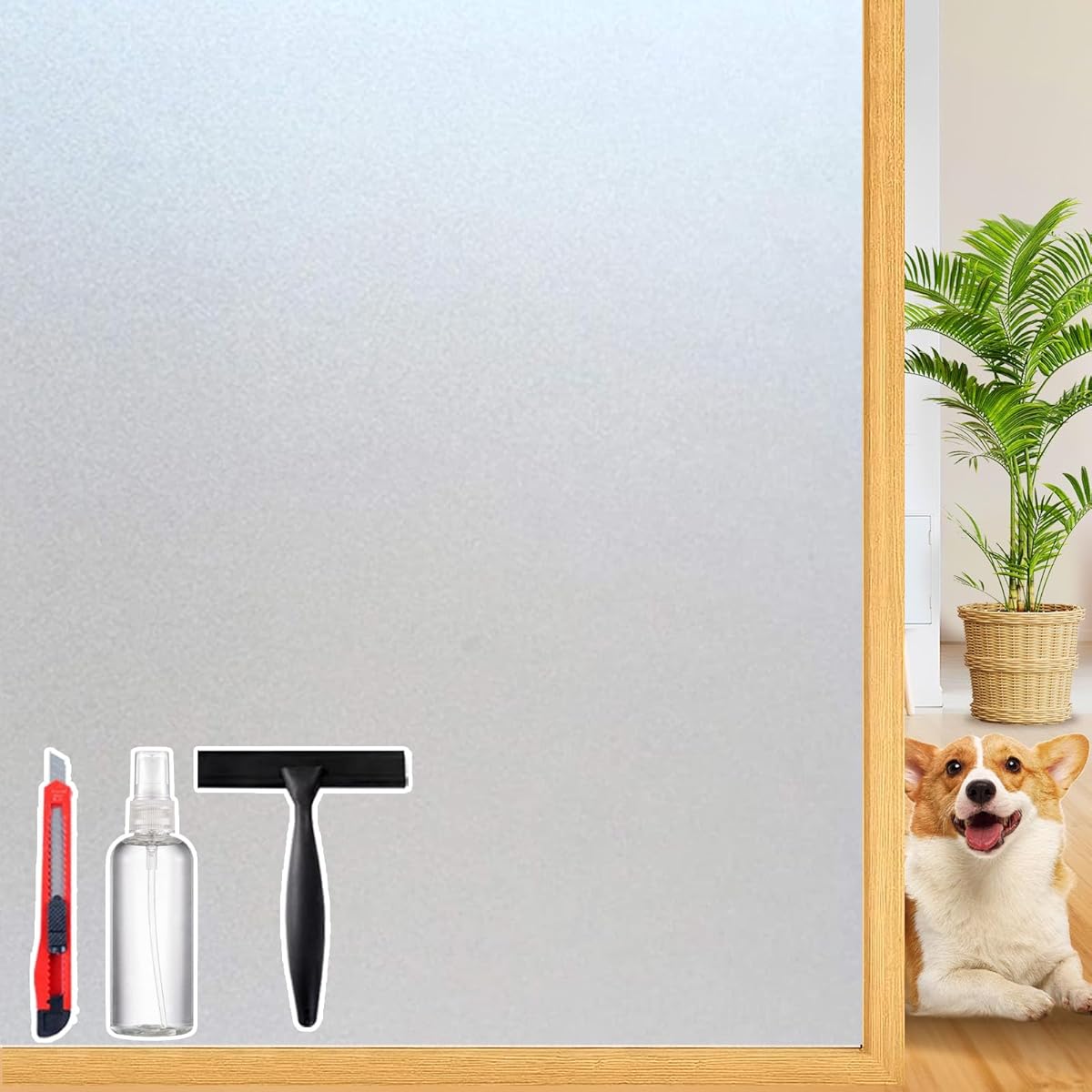
Dwersty Frosted Glass Window Privacy Film
4.3Editor score
All-day frosted privacy
Up to 99% UV blocking
Reusable static cling
Peel and stick window tint offers an approachable way to add privacy, reduce glare, soften daylight, and decorate clear glass without replacing windows. The best option depends on whether you need all-day obscurity, a daytime mirror effect, room-darkening performance, or a decorative finish that still admits natural light.
We compared all ten options by examining their stated privacy behavior, light transmission, UV and infrared rejection, installation method, included tools, dimensions, surface restrictions, and intended uses. The list covers frosted, blackout, one-way, and stained-glass designs, with special attention to clarity, renter suitability, and the conditions that limit one-way privacy.
Each pick highlights the characteristics that distinguish it from the alternatives, while the comparisons and buying guide explain the trade-offs. Product ratings and availability can change over time, so check the current listing and customer feedback before making your final selection.
4.3Editor score
4.5Editor score

4.1Editor score
As an Amazon Associate we earn from qualifying purchases.
The table below compares each film's core privacy style, light-control approach, installation method, and practical limitations. It is designed to make it easier to distinguish all-day frosted films, room-darkening blackout options, reflective daytime tints, and decorative stained-glass clings.


The Dwersty Frosted Glass Window Privacy Film is a versatile, all-purpose pick for bathrooms, offices, bedrooms, and other spaces where clear views need to disappear without turning the room into a dark enclosure. Its 4.3 rating reflects a strong balance of useful features: two-way privacy, soft light diffusion, UV filtering, reusable static cling, and installation tools included in the roll. The frosted appearance also gives ordinary glass a more finished decorative look.
We may earn a commission when you buy through this link, at no additional cost to you.
One of the strongest aspects is the privacy behavior. Unlike reflective one-way films that depend on a difference between outdoor and indoor brightness, this product is designed to obscure views from both sides throughout the day and night. The listed UV protection reaches up to 99%, while its heat-control design is intended to reduce heat transfer through the glass. That makes it especially useful for bathroom windows, where the priority is usually blocking silhouettes rather than preserving a clear outdoor view.
Installation should be straightforward for anyone comfortable with a basic DIY project. The backing includes one-inch grids for measurement and cutting, and the product can be repositioned with soapy water before it is fully set. A scraper, cutting knife, and watering can are included in the paper tube. Its wrinkle-resistance and reusable construction also make it practical for renters or seasonal privacy changes, although the manufacturer notes that it is intended for smooth, processed glass only.
This is the strongest general recommendation for buyers who want dependable all-day privacy, soft daylight, and uncomplicated removal. It is not suitable for frosted, cut, or other non-smooth surfaces, and careful trimming around edges and corners is still needed for a polished appearance. Even so, the combination of privacy, UV control, and renter-friendly removal makes it an excellent first option to consider.
Because the frosted surface diffuses light rather than relying on a mirror reaction, it continues blocking outside views when indoor lighting is brighter. That makes it a stronger choice than one-way film for bathrooms, night offices, and ground-floor rooms.
The one-inch backing grid supports more accurate cuts, while the included knife, scraper, and watering can reduce the need for separate supplies. Soapy water also allows the film to be shifted before final adhesion.
We may earn a commission when you buy through this link, at no additional cost to you.
The Dwersty Upgraded One Way Window Privacy Film is aimed at users who want a clearer view outdoors while keeping casual onlookers from seeing inside during bright daytime conditions. It has a 4.2 rating and pairs that mirror effect with stated UV and infrared blocking, glare reduction, and a static-cling installation that requires no adhesive. The one-inch backing grid makes the 17.5-by-78.7-inch roll easier to measure and cut for windows, doors, and other smooth glass panels.
We may earn a commission when you buy through this link, at no additional cost to you.
Its light-control specifications are the main attraction. The manufacturer states that the film blocks 93% of UV rays and 85% of infrared rays, allowing natural light to enter while rejecting substantial solar heat and reducing harsh glare. It may be particularly appealing for south- or west-facing windows, home offices, living rooms, and glass doors where daytime privacy is more important than a completely uniform frosted appearance.
The key limitation is fundamental to reflective one-way film. The exterior mirror effect is strongest when sunlight is brighter outside than inside. If interior lights are turned on after sunset, or if outdoor light is weak during heavy cloud cover, people outside may be able to see into the room. The manufacturer specifically recommends drawing curtains at night, so this is not a substitute for a true all-day privacy film.
Choose this option when your primary concern is daytime reflection, glare reduction, and heat control while retaining visible outdoor scenery. It is less appropriate for a bathroom where nighttime privacy is essential, or for anyone unwilling to add curtains after dark. For a smooth, adhesive-free installation with useful solar filtering, however, it is a focused and capable choice.
The reflective surface reduces glare and blocks a stated 85% of infrared rays, helping limit solar heat while preserving a relatively clear outward view. This balance suits rooms where daylight and scenery matter more than complete visual opacity.
One-way privacy depends on the contrast between indoor and outdoor brightness. Curtains or blinds remain important after dark, especially in rooms with bright interior lighting.
We may earn a commission when you buy through this link, at no additional cost to you.
rabbitgoo Blackout Window Film is designed for situations where the goal is darkness rather than merely softened light. Its 4.3 rating reflects a focused feature set: effective room darkening, 100% stated UV rejection, strong privacy, and glue-free static-cling application. It is a logical choice for shift workers, nurseries, bedrooms, media rooms, and any space where a bright window could interrupt sleep or expose the interior.
We may earn a commission when you buy through this link, at no additional cost to you.
The film is described as providing a high level of privacy with a blackout appearance, and it is intended to block outdoor light while rejecting all UV rays. Its dark finish also reduces the visibility of people looking toward the window. Heat and glare control are additional benefits, although the primary selling point is the transformation of a bright, transparent pane into a more enclosed-looking, darkened surface.
Correct coverage is critical. The manufacturer advises that the film should cover the glass completely, with minimal edge gaps, because uncovered margins can admit light. Soapy water should be applied generously to both the clean window and the film, and excess water and air should be worked toward the edges with a squeegee. Buyers should also heed the warning against applying it to double-panel windows, where the manufacturer says cracking may occur.
This is a strong recommendation for anyone who values sleep, nursery darkness, or complete visual screening above decorative softness or outward visibility. It is less suitable for rooms that need abundant natural light, and careful measurement is necessary to avoid revealing bright borders around the film. For deliberate blackout performance, it is one of the most capable options in this collection.
A dark bedroom, nursery, or meditation space can be much easier to use when streetlights and daylight are blocked. The high level of stated UV rejection also helps protect furniture and skin from direct sunlight.
Even an effective blackout material can allow light to enter through narrow gaps around the perimeter. Measure each pane carefully, overlap where needed, and remove bubbles and excess water before the film settles.
We may earn a commission when you buy through this link, at no additional cost to you.
Kromapolis Blackout Window Privacy Film combines strong room-darkening performance with one of the more complete accessory packages in this roundup. Its 4.3 rating reflects a product aimed at straightforward DIY installation on smooth, flat glass. The roll measures 17.5 by 78.7 inches and can be cut into different shapes, making it adaptable for standard windows, bathroom panels, bedroom glass, baby rooms, and offices.
We may earn a commission when you buy through this link, at no additional cost to you.
The manufacturer describes a total blackout effect, 100% UV blocking, privacy from both sides, and reductions in heat, glare, and heat loss. Those characteristics distinguish it from one-way films that preserve outward visibility and from frosted films that intentionally diffuse light. The result is a dark room, making it most appropriate for daytime sleep, nurseries, media spaces, or privacy-sensitive glass where daylight is not needed.
Installation support is a notable strength. A spray bottle, utility knife, scraper, and soft ruler are supplied inside the paper tube, reducing the need to gather separate tools. The film uses static cling rather than glue, and the instructions call for generous water on both the glass and film. It can be removed without sticky residue, which is useful for temporary use in rented rooms or for changing seasonal requirements.
This film is a practical pick when complete darkness and a well-equipped installation kit are priorities. The tradeoff is that it sacrifices natural light and outdoor visibility, and it will not conform to curved glass. Buyers should also ensure every edge is covered because small gaps may admit noticeable light. For smooth windows and straightforward blackout needs, it delivers a balanced, no-adhesive approach.
The included spray bottle, cutting knife, scraper, and ruler cover the basic steps of measuring, wet application, trimming, and smoothing. Check the paper tube before installation so no accessory is overlooked.
Beyond blackout and privacy, the film is designed to moderate glare and reduce heat movement through the glass. That can improve comfort in sun-exposed rooms while providing the darker interior appearance.
We may earn a commission when you buy through this link, at no additional cost to you.
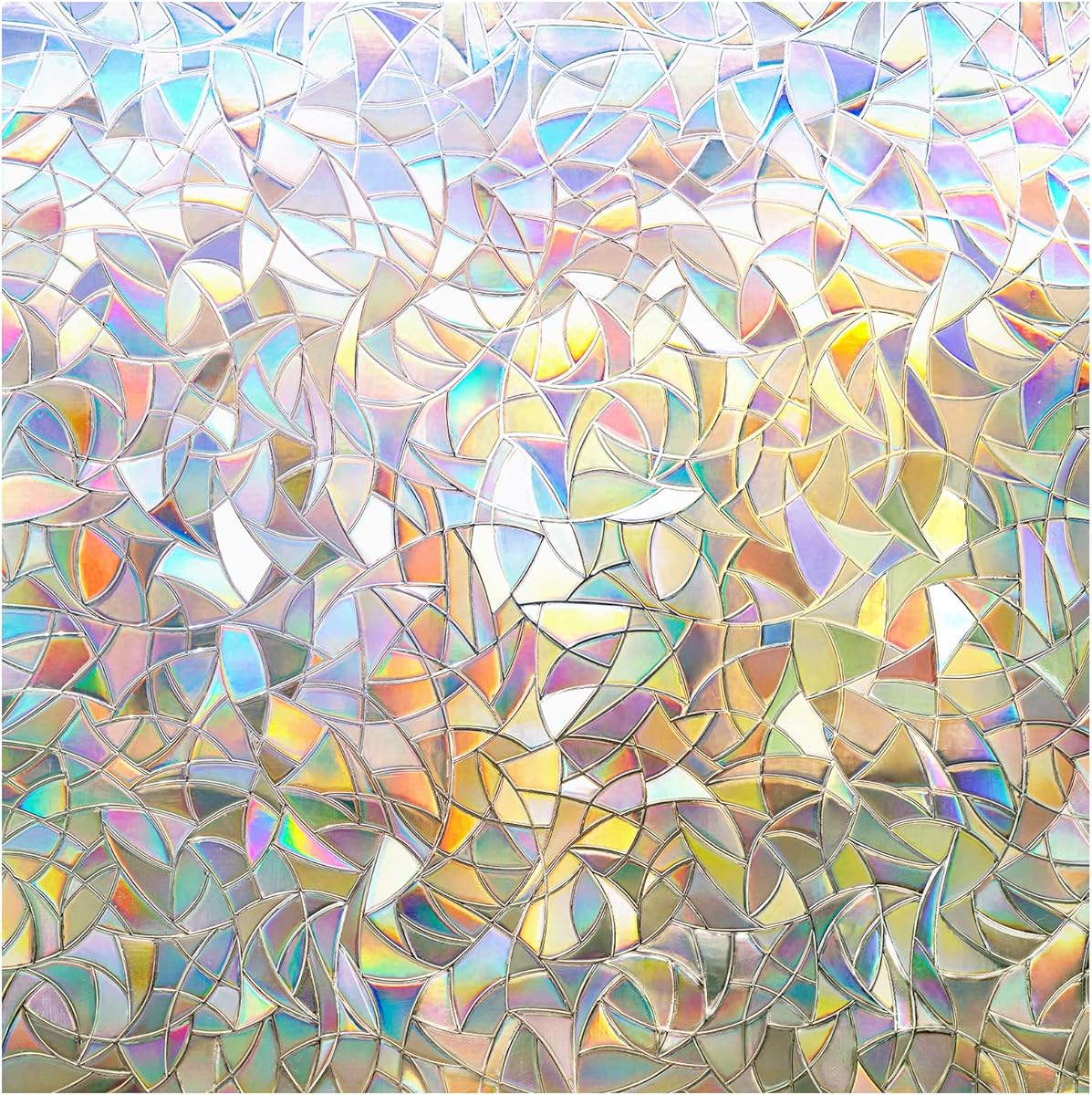
rabbitgoo Rainbow Window Privacy Film is the most distinctive decorative entry and the highest-rated product in the roundup, carrying a 4.5 rating. Rather than creating a uniform frosted or mirrored surface, it uses an irregular pattern and 3D laser design to cast colorful rainbow-like effects when sunlight passes through. That makes it especially attractive for a bathroom, entryway, studio, kitchen, or any window where visual character is as important as partial privacy.
We may earn a commission when you buy through this link, at no additional cost to you.
The vinyl film is described as reducing glare, blocking 96% of UV rays, and filtering natural light into a softer atmosphere. Its stated privacy protection is 60%, which is considerably less than a blackout or fully frosted design. Outside observers cannot see directly into the room with the same clarity they might through bare glass, but the pattern does not promise to make every view completely impossible. Buyers should choose it for decoration with added privacy rather than absolute concealment.
The material is a static cling without sticky chemical glue, and it can be removed and reused multiple times. That makes it an appropriate option for renters, dorms, and temporary seasonal decorating. Installation requires a flat, clean, smooth glass surface, with ample water applied to both the window and the back of the film. The larger roll can be measured and cut for partial-pane patterns or more extensive installations.
This film is an excellent choice for someone who wants privacy film that looks like a decorative accessory rather than a utilitarian layer. Its visual effect is dependent on sunlight, and it should not be selected for a room requiring complete nighttime privacy. Still, the combination of the highest rating, removable construction, UV filtering, and a distinctive stained-glass appearance makes it especially appealing for style-conscious buyers.
The irregular pattern and dimensional laser design introduce color and texture that a plain privacy film cannot. It works well for accent windows, glass doors, and spaces where a traditional curtain would feel visually heavy.
The stated 60% protection level is useful for obscuring direct views but does not equal blackout performance. Pair it with curtains when a fully private view is required at night.
We may earn a commission when you buy through this link, at no additional cost to you.
Gorilla Guard Window Privacy Film offers a balanced frosted design that combines two-way privacy, soft daylight, measured UV filtering, and a removable static-cling format. Its 4.3 rating places it among the stronger general-purpose choices. The stated 80% privacy protection makes it a practical middle ground: more private than a lightly tinted decorative film, but not as opaque or dark as the blackout options.
We may earn a commission when you buy through this link, at no additional cost to you.
The manufacturer cites third-party testing and reports blocking of 59% UVA and 89% UVB rays. The film also aims to reduce glare and help maintain a cooler room, while the frosted finish softens incoming light without fully blocking it. These characteristics make it suitable for bathrooms, offices, studies, meeting rooms, and front doors where the goal is to obscure details without making the room feel sealed off.
Installation is designed around convenience. A peel backing tab and one-inch grid template support measuring, cutting, and positioning, while water provides the bond needed for smooth application. The static-cling construction allows removal without residue and makes the film reusable, which is especially helpful in temporary living spaces. The roll measures 17.5 inches wide and 78.7 inches long and can be trimmed for a custom fit.
Gorilla Guard is a strong middle-of-the-road recommendation for buyers who want dependable two-way privacy, soft light, and easy reversibility. Its reported UVA and UVB figures are lower than those of several competing films, so shoppers prioritizing maximum UV rejection may prefer another option. For balanced everyday performance and renter-friendly installation, however, this is a well-rounded frosted pick.
The frosted surface prevents direct outside views while continuing to admit natural light. This makes it more comfortable for daytime spaces than a complete blackout and less visually restrictive than a one-way mirror film.
The one-inch grid makes custom cuts easier, while the peel tab can help position the film without stretching it. Both features are particularly useful when working over a sink, bathtub, or glass door.
We may earn a commission when you buy through this link, at no additional cost to you.
rabbitgoo Window Privacy Film One Way is built for rooms that need daytime privacy and meaningful solar control while retaining a view outward. Its 4.3 rating and stated 97% UV blocking, 91% infrared rejection, and 11% visible light transmission show that it prioritizes heat and glare management along with privacy. The black-silver finish is suited to living areas, offices, kitchens, bedrooms, and glass doors where harsh sunlight is a problem.
We may earn a commission when you buy through this link, at no additional cost to you.
The reflective layer creates a mirror-like appearance from outside when outdoor light is stronger than indoor light. This lets occupants enjoy a clearer outward view during the day while limiting direct views into the room. The relatively low visible light transmission also softens glare. Infrared rejection is a major strength for hot, sun-exposed windows, although actual room temperature still depends on the whole building and window system.
Installation uses a static-cling method with ample water or soapy water and a squeegee. Water makes the film easier to reposition during fitting and supports removal without adhesive residue. The manufacturer recommends a helper for large windows, which is sensible because a 17.5-by-78.7-inch sheet is much easier to align with two people. It also warns against use on double-pane windows exposed to prolonged sunlight.
This is a compelling choice for daytime use in a glare-prone room, particularly when the occupant values a visible outdoor scene. Curtains remain necessary at night because bright indoor lighting can reverse the privacy effect. It is also less suitable for certain double-pane installations. Within those limits, it combines strong solar figures, easy removal, and broad application options.
The stated 91% infrared rejection is among the stronger figures in the roundup. This can reduce solar heat gain during hot months, particularly in rooms receiving direct afternoon or western sunlight.
A one-way film is a daytime privacy tool, not an all-day one. If interior lighting is brighter than the outdoors, close the curtains or blinds to restore privacy and avoid visible silhouettes.
We may earn a commission when you buy through this link, at no additional cost to you.
KESPEN Window Privacy Film One Way is a reflective black static-cling tint for smooth glass surfaces. Its 4.1 rating is among the lower figures in this list, but the product offers a clear and understandable set of benefits: daytime mirror privacy, 90% stated UV blocking, 82% infrared rejection, and a 12% visible light transmission value. The 17.5-inch-wide, 6.5-foot-long roll provides a useful cutting area for several windows or one larger pane.
We may earn a commission when you buy through this link, at no additional cost to you.
The intended use is heat and glare control in rooms where the outside view should remain visible. The reflective surface directs some solar energy back away from the glass and softens harsh light, which can make living rooms, kitchens, and offices more comfortable during bright weather. As with other one-way films, the privacy effect depends on outdoor light being stronger than the light inside the room.
The no-glue static-cling design makes installation and eventual removal less concerning for renters. Both the glass and the adhesive side should be sprayed generously with water, and the surface, edges, and corners must be free of dust and debris. The film may be cut for different applications, but the manufacturer excludes double-paned, frosted, cut, and curved glass from the recommended uses.
KESPEN is a sensible option for a straightforward daytime reflective film, especially for users already comfortable with one-way limitations. It should not be considered for a bathroom or street-facing room that requires privacy at night. Its lower overall rating may also mean the visual finish and installation consistency receive less consensus than the leading options, so checking recent customer feedback is worthwhile.
The black reflective finish creates the familiar exterior mirror effect while allowing some visible light into the room. It is best suited to applications where maintaining a daytime view is a priority.
Do not apply this product to double-pane, frosted, cut, or curved glass according to its instructions. A smooth, clean surface is essential for a secure static bond and a smooth visual result.
We may earn a commission when you buy through this link, at no additional cost to you.
Haton Frosted Window Privacy Film is a practical all-day privacy option that includes the core tools needed for installation. Its 4.3 rating reflects a balanced set of features: two-way privacy, soft natural light, up to 96% stated UV blocking, infrared rejection, and reusable static-cling construction. It can give bathrooms, bedrooms, studies, meeting rooms, glass cabinets, and front doors a clean frosted appearance.
We may earn a commission when you buy through this link, at no additional cost to you.
The film is designed to obscure outside views from both sides while continuing to admit diffused daylight. That makes it a more dependable privacy solution than reflective one-way film, particularly at night or on cloudy days. Its heat and glare controls can also help limit uncomfortable brightness, while the frosted finish softens views of nearby plants, pets, or street activity without making the room entirely black.
A squeegee, utility knife, and empty spray bottle are included, and the manufacturer points buyers toward the included manual and video guide for a smooth finish. Because the film uses static cling, it can be repositioned and reused, removed without leaving adhesive residue, and adapted to temporary projects. This is especially useful in apartments, dormitories, rented rooms, and seasonal applications where permanent alteration is undesirable.
Haton is a strong recommendation for a user who wants frosted privacy, strong UV filtering, and a straightforward installation kit. The finish depends heavily on careful cleaning and water application, and the roll must be measured with a separate tool because a ruler is not included. Even with that small inconvenience, it is a versatile and renter-friendly product for smooth glass.
The reusable, adhesive-free design allows the film to be removed when a room is sold, a lease ends, or privacy needs change. It can also be moved to a different window when the dimensions allow.
The included utility knife supports custom cutting, while the squeegee helps push trapped water and air toward the edges. The empty spray bottle can be filled with the soapy solution recommended for wet installation.
We may earn a commission when you buy through this link, at no additional cost to you.
XIAWEI One Way Privacy Window Film is the premium construction choice in this roundup, with a 4.1 rating and a focus on PET material, heat resistance, and strong solar filtering. It blocks a stated 99% of UV rays and 80% of infrared rays while creating a daytime mirror effect. The clear-view objective makes it relevant for living rooms, kitchens, bedrooms, sliding doors, balconies, and office glass.
We may earn a commission when you buy through this link, at no additional cost to you.
The PET construction is the most product-specific feature. The manufacturer states that its impact resistance is more than five times that of PVC privacy film and attributes anti-shatter behavior to the material. It also says the film is designed to resist blistering and fading when exposed to high summer glass temperatures. These characteristics may be particularly valuable on strongly sunlit windows where lower-grade films can deteriorate.
Privacy remains conditional on lighting. During bright daytime conditions, the reflective surface obscures direct views from outside while preserving visibility from within. At night, under cloud cover, or when indoor lights are brighter, the mirror effect fades and curtains may be required. The installation tools are included inside the paper tube, and the product should be fitted to smooth, clean glass.
This is a compelling pick for buyers who prioritize UV protection, heat performance, and PET-based durability over the lowest cost. Its 4.1 rating is not the highest in the collection, so the advantage is feature-based rather than rating-based. For a high-exposure window where reduced glare, solar heat control, and a clearer view are priorities, it offers a specialized and potentially longer-lasting option.
The stated PET construction is intended to withstand high glass temperatures without the blistering associated with some conventional films. Its claimed impact resistance also adds a safety-oriented reason to prefer it over a basic PVC option.
With a stated 99% UV blocking figure, the film can help limit fading and aging of furniture, flooring, and other interior materials. It is most relevant in rooms with direct or prolonged sunlight exposure.
We may earn a commission when you buy through this link, at no additional cost to you.
The right peel and stick window tint depends on the privacy level, amount of daylight, surface type, and intended room. Start with the view you need to preserve, then evaluate heat control, installation tolerance, and whether you need a removable solution.
Privacy styles serve different purposes and should not be treated as interchangeable. Frosted films obscure views from both sides and soften incoming light, making them suitable for bathrooms and ground-floor rooms. Blackout films provide the greatest darkness and privacy but are ideal mainly where daylight is unnecessary. One-way films create a reflective exterior surface during bright daytime conditions, preserving outward visibility while limiting outside views. Decorative stained-glass films balance visual interest with partial privacy, generally without promising complete concealment.
Reflective one-way film depends on a specific relationship between brightness levels. It works best when strong outdoor light contrasts with a relatively dim interior. Once interior lamps become brighter than the outdoors, the exterior reflection weakens and silhouettes may become visible. Heavy cloud cover can create a similar effect during the day. If uninterrupted nighttime privacy is essential, select a frosted or blackout film or plan to use curtains after dark.
UV rejection helps reduce damage from solar exposure, while infrared rejection is more closely connected with heat transfer through glass. The listed products range from 59% to 100% stated UV blocking and from moderate infrared reduction to figures as high as 91%. Higher numbers do not guarantee a specific indoor temperature, since window area, orientation, insulation, climate, and heating or cooling systems also influence results. Choose a film with a balanced specification when both fading protection and glare reduction matter.
Most of these products require smooth, clean, flat glass. Several specifically exclude textured, frosted, cut, curved, or double-pane windows, and the rabbitgoo blackout product warns that applying it to double-panel windows may cause cracking. An existing frosted surface is not the same as adding frosted film to clear glass. Check the listing instructions before purchase, and avoid applying a film to a damaged, painted, or irregular surface that could prevent full contact.
A roll measuring 17.5 inches by roughly 6.5 feet can cover a large window, but unusual shapes may require multiple pieces or additional material. Measure both the glass and the visible frame area, then allow enough excess for trimming and repositioning. Blackout and frosted films are most effective when the pane is fully covered with minimal gaps. For one-way films, accurate sizing also helps preserve an even reflective appearance without exposed strips.
All ten choices use a peel-and-stick or static-cling approach rather than permanent adhesive. Most require generous soapy water on both the window and film, followed by careful squeegeeing to remove water and bubbles. Some rolls include a squeegee, knife, spray bottle, ruler, or watering can. A grid printed on the backing makes sizing easier, and a peel tab can help with positioning. Larger installations benefit from a second person because a broad wet sheet is difficult to control alone.
A privacy film changes the character of a room as well as the view through it. Frosted finishes create a soft, uniform surface, blackout films produce a dark appearance, and one-way films have a reflective silver or black-silver exterior effect. Decorative films introduce patterns and color that can become a focal point when illuminated by sunlight. Consider where the film is visible from both inside and outside, since its appearance may change as daylight and artificial lighting vary.
Static-cling film is especially attractive for renters, dorm residents, and anyone who may want to rearrange a space. These products are generally designed to peel away without adhesive residue and can often be repositioned before or after installation. Reuse quality can vary with the amount of grime, moisture, and handling, so clean the glass before storing a removed sheet. A removable design also makes seasonal privacy more practical, but it is not a permanent decorative treatment.
Begin by cleaning the glass thoroughly with a suitable glass cleaner, then dry away dust, grit, and oily residue from the surface, edges, and corners. Measure the target area and use the backing grid as a cutting guide. If the film must be fitted around a handle, vent, or unusual shape, make a paper template first and transfer that shape to the film. Cut with a clean utility knife while supporting the material so the cut does not score the glass.
Prepare the window and film with plenty of soapy water. A small amount of mild detergent in a spray bottle of water helps the film remain movable during placement. Remove the protective liner only after the film is positioned over the wet glass, then begin at one corner and lower the film gradually. Spray additional solution underneath if sections wrinkle or lift. A squeegee should be worked from the center toward the edges to push out trapped air and excess water without excessive pressure.
Allow the film to dry with the room well ventilated and avoid washing the glass for several days. For routine care, use a soft microfiber cloth and a nonabrasive glass cleaner, taking care not to catch the edge of the film. Do not use sharp tools against the surface or harsh solvents around the perimeter. To remove the film, peel from a corner at a shallow angle; cleaning the glass afterward helps remove any remaining residue and prepares it for another use.
It depends on the type. Frosted and blackout films are designed to obscure views regardless of whether outdoor or indoor light is brighter. One-way films create their mirror effect mainly during bright daytime conditions, and the effect can reverse after dark when interior lighting is stronger. Draw curtains or blinds at night when using a one-way film if complete privacy is important.
The products in this guide use static-cling or nonadhesive construction specifically to allow removal without sticky glue residue. Results are generally best when the glass is clean before application and the film is peeled away slowly at a shallow angle. Any marks on the glass can usually be cleaned with glass cleaner, and films designed for reuse should be stored flat and away from dust.
A suitable film can reduce solar heat transfer and glare through glass, especially when its infrared rejection is high. The result varies with window orientation, climate, glass type, frame area, and the size of the tinted surface. Window tint is only one part of a room's thermal performance, so it should complement rather than replace insulated curtains, efficient glazing, or appropriate heating and cooling controls.
Most products require smooth, clean, flat glass because static cling needs full surface contact. Several listings explicitly exclude frosted, cut, textured, or curved glass. Even if a product resembles one designed for an existing textured surface, read the installation instructions carefully and confirm compatibility before applying it.
That depends entirely on the manufacturer's instructions. Several one-way products in this guide warn against double-pane windows, and the rabbitgoo blackout product specifically warns that applying it to double-panel windows may cause cracking. Heat can become trapped between panes and stress the glass, so confirm the product guidance and window specification before installation.
Small bubbles commonly result from trapped water or air, especially when the film is laid down too quickly or without enough soapy water. Keep the installation wet, peel back a larger section if necessary, and use a squeegee to move the bubble toward an edge. Avoid pressing directly on a bubble, which can spread it or create a crease.
Yes, provided the surface is smooth, clean, and compatible with the product. Gorilla Guard specifically lists glass shower doors, while Haton identifies glass cabinets and other DIY surfaces among its possible uses. Decorative films can be cut to smaller shapes for cabinet panels, but allow time for the water to dry before loading the cabinet or operating the door frequently.
Choose blackout for a dark room and strong visual screening, frosted for all-day privacy with soft light, and one-way for a reflective exterior during daylight. Decorative designs are best when visual interest and partial privacy matter more than complete concealment. Also consider whether you can add curtains at night, since that determines whether a one-way film is sufficient.
The Dwersty Frosted Glass Window Privacy Film is the most versatile all-around option, offering two-way privacy, soft light, strong UV filtering, and removable installation. The rabbitgoo Rainbow Window Privacy Film stands out for decorative appeal and partial privacy, while the XIAWEI One Way Privacy Window Film is the premium pick for PET construction, high UV rejection, and solar performance.
Prioritize the lighting behavior that matches your room. Use frosted or blackout material when privacy must remain intact at night, and choose one-way film only when daytime reflection is enough and curtains can supplement it after dark. Confirm glass compatibility, measure carefully, and allow enough time for a careful water-assisted installation.
Ratings, product details, and prices can change over time, so review the current listing and recent customer feedback before purchasing. Checking the final dimensions, included tools, surface restrictions, and warranty information at that stage will help ensure that your chosen film fits both your window and your expectations.