
Mdbebbron 120 Inch Projector Screen
4.5Editor score
Large 120-inch viewing area
Double-sided projection support
Washable anti-crease polyester
Portable Projection Screens suit homes, backyards, offices, and camps; this guide compares ten models by size, setup, stability, image surface, and portability.
Portable Projection Screens make it possible to turn almost any space into an improvised theater, whether the goal is a bedroom movie night, a backyard showing, a classroom presentation, or an outdoor campsite. A good screen should balance image size with manageable weight, quick setup, a smooth viewing surface, and enough stability for its intended environment.
The ten products compared here include hanging fabric screens, tripod models, retractable tension-frame screens, and larger freestanding outdoor systems. We evaluated the supplied specifications and product details with attention to diagonal size, aspect ratio, viewing angle, frame or stand design, portability, projection support, installation method, and practical outdoor features.
Each pick demonstrates how portable screens differ across compact travel, standard family viewing, presentation, and large-format use. Ratings reflect the information available when this guide was prepared, while prices and product availability can change, so readers should verify current listing details before making a purchase.
4.5Editor score
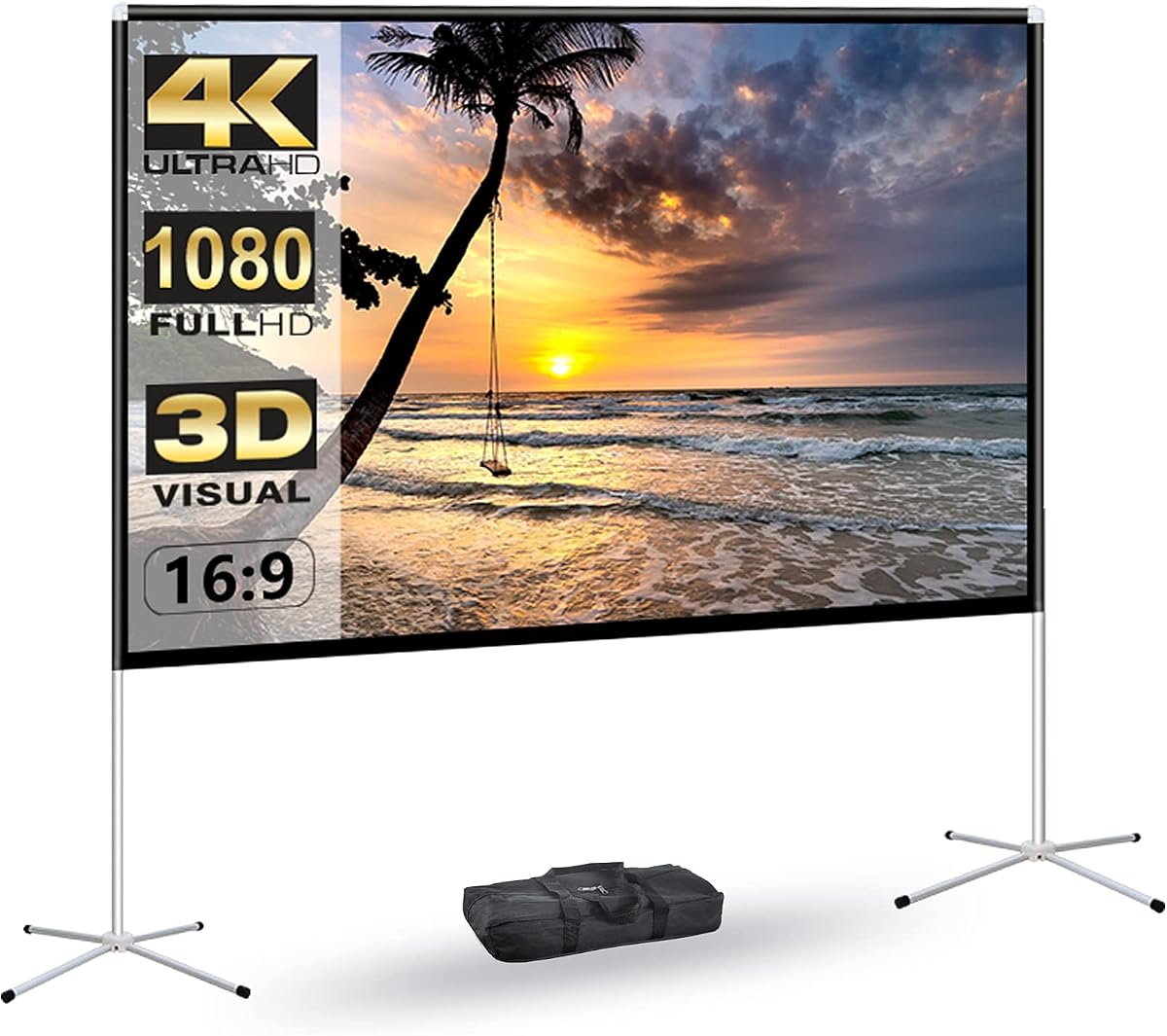
4.4Editor score

4.4Editor score
The comparison below places all ten portable projection screens side by side, emphasizing screen dimensions, projection format, support system, portability, and the features most likely to affect everyday viewing and setup.


The Mdbebbron 120 Inch Projector Screen offers an unusually generous image area in a lightweight, foldable format. Its 4.5 rating reflects a strong combination of useful size, straightforward storage, and installation flexibility. The 16:9 surface provides a 104-by-58-inch viewing area, making it suitable for modern widescreen movies, gaming, presentations, and backyard events.
We may earn a commission when you buy through this link, at no additional cost to you.
One of the screen's most useful traits is its lack of dependence on a conventional stand. It can be attached with hooks, ropes, brackets, nails, or double-sided tape, allowing users to choose an installation method that suits the location. The anti-crease polyester construction is described as thick and smooth, while the stated 160-degree viewing angle and support for front and rear projection provide useful placement flexibility.
The main trade-off is that this is a screen fabric rather than a complete freestanding theater system. Buyers must already own suitable anchors or prepare a wall, fence, frame, or other support. That reduces convenience for spontaneous outdoor use, but it also makes the screen exceptionally easy to pack, carry, and reuse in different temporary locations. Washing and spot-cleaning options also support repeated use.
This is the best budget choice for buyers who want a very large portable surface without paying for a full stand. Choose it if you already have a reliable mounting point or enjoy a straightforward wall-based setup. For instant backyard deployment, the included freestanding options in this guide may be more convenient.
At 120 inches diagonally, the screen can create a substantial theater-like presentation while remaining light enough to fold and place in luggage. The absence of a stand also reduces the number of components a traveler must manage.
Front and rear projection support gives the fabric more options around a room, while the wide viewing angle is useful when guests are spread across a seating area. Multiple attachment methods let users adapt the screen to walls and temporary structures.
We may earn a commission when you buy through this link, at no additional cost to you.
The 80 Inch Portable Projector Screen with Stand is a well-balanced middle ground between compact travel screens and imposing outdoor systems. Its 4.4 rating, 16:9 format, and 160-degree viewing angle make it appealing for family movies, camping, backyard gatherings, and casual presentations where both portability and image size matter.
We may earn a commission when you buy through this link, at no additional cost to you.
The stand is built from lightweight aluminum and is designed to assemble or disassemble without tools. At a listed weight of 5.62 pounds, the complete screen can be lifted with one hand and fits into the included soft padded carrying bag. The polyester projection surface is washable, and the package includes a rope, hanging hooks, and water bags to help keep the screen secure during outdoor use.
Buyers should not treat the included accessories as a guarantee of perfect stability in every outdoor condition. Wind, uneven ground, and a screen tensioned incorrectly can affect performance, so the ropes and water bags should be used as intended. The screen also occupies more space than a 50- or 60-inch option, making it less convenient for very small rooms.
Overall, this is the editor's choice because it combines a useful 80-inch image, a genuine freestanding design, quick assembly, and a padded bag without becoming unwieldy. It suits buyers who want one screen for several activities rather than a product dedicated only to tabletop or indoor use.
The collapsible aluminum structure offers a more self-contained alternative to a hanging fabric screen. Its tool-free construction and padded bag make repeated family trips, campsite visits, and backyard events considerably easier to organize.
An 80-inch 16:9 image provides enough room for shared viewing without approaching the space demands of a 150-inch system. The 160-degree viewing angle helps maintain a broad sightline when guests sit across a yard or living room.
We may earn a commission when you buy through this link, at no additional cost to you.
The 100 Inch Outdoor Projector Screen with Stand is the best premium pick for buyers who want a substantial freestanding image and a complete set of outdoor-oriented components. It carries a 4.4 rating and uses a 16:10 ratio, which may be especially useful for presentations, older standard-definition content, and mixed media that does not rely exclusively on widescreen video.
We may earn a commission when you buy through this link, at no additional cost to you.
Quick setup is one of its strongest selling points. The stand can be prepared in about five minutes without tools, while the package includes ropes, nails, and water bags for outdoor stabilization. Its high-quality natural polyester surface is described as wrinkle-free and curl-resistant, and the aluminum-alloy floor bracket adds a sturdier structural element than a simple folding tripod.
The 16:10 ratio deserves attention because it differs from the 16:9 format used by many modern projectors and streaming content. Images will be shown within that format, so users should confirm how their projector handles it. The 100-inch surface also requires adequate room and may overwhelm a small bedroom or compact presentation area.
Despite those considerations, the combination of double-sided projection, a durable bracket, easy assembly, and transport bag makes this a strong premium choice. It is best for families with a flexible living area, hosts who regularly show movies outdoors, and professionals who need a freestanding surface for educational or event displays.
The included carry bag, ropes, nails, and water bags reduce the need to assemble a separate support system. This makes the screen particularly convenient for trips, yard events, school activities, and temporary professional displays.
The 16:10 format can suit presentations and media designed around older projector ratios. Buyers should evaluate it against their content and room dimensions rather than assuming that a larger diagonal alone will produce the best result.
We may earn a commission when you buy through this link, at no additional cost to you.
The 50 Inch Portable Projector Screen with Stand is a compact retractable option built around a tensioned frame. Its 4.5 rating is among the strongest in the group, and the design is particularly useful for users who value quick setup and compact storage over a huge image. The frame opens quickly, locks into position, and folds for transport.
We may earn a commission when you buy through this link, at no additional cost to you.
The high-gain fiberglass surface is described as flat and designed to produce a clear HD picture. A 160-degree viewing angle supports off-center seating, while the tension mechanism helps keep the surface taut. Its listed dimensions fold down to approximately 34.25 by 3.46 by 3.15 inches, and the complete unit weighs 2.5 kilograms, making it easier to carry than large outdoor frames.
There is an important listing inconsistency. The product title identifies a 50-inch 4:3 screen, while the detailed product information describes a 16:9 projection ratio and gives an unfolded area of 102 by 76 centimeters. The stated area is close to 4:3 rather than widescreen, so buyers should confirm the final dimensions and compatible projector aspect ratio before purchasing.
This screen is a sensible recommendation for small rooms, compact presentations, and travelers who need a repeatable pull-and-lock setup. It is less appropriate for users expecting a large backyard theater. The tension frame earns its place by delivering a stable, neatly stowed alternative to loose hanging fabric.
Pulling the legs to 90 degrees and engaging the lock creates a repeatable setup without installation. The auto-lock design is particularly helpful for people who move between temporary presentation locations.
The folded package is narrow enough to resemble a long carrying case, and the supplied lifting handle supports easier transport. This makes the unit more practical than a large screen that must be disassembled into many separate pieces.
We may earn a commission when you buy through this link, at no additional cost to you.
The 150 Inch Projector Screen with Stand is designed for buyers who want the biggest possible image and have enough space to support it. Its 4.3 rating reflects a strong feature set: a 16:9 format, thick opaque polyester fabric, an iron frame, a carrying bag, and outdoor anchoring accessories. It can transform an open yard or spacious room into a large cinema.
We may earn a commission when you buy through this link, at no additional cost to you.
The anti-crease material is intended to resist permanent wrinkles after folding or compression, and the opaque construction can support clearer projected imagery. The iron frame is promoted as sturdy and capable of tool-free assembly in minutes. Ground nails and rigging ropes are included to improve outdoor stability, while the carry bag protects the components during travel and storage.
This is not a screen for compact rooms. A 150-inch diagonal creates a very large footprint, and the frame is correspondingly more cumbersome than a tripod or folding hanging screen. The stability accessories are also important outdoors; a large fabric surface can act as a sail, so anchoring should be treated as a core part of setup rather than an optional extra.
The screen is best recommended for spacious homes, event hosts, community gatherings, and outdoor cinema enthusiasts who prioritize scale. It may also suit temporary displays such as sports, gaming, weddings, church events, and presentations. Buyers with smaller spaces should favor one of the 50-, 60-, 80-, or 100-inch options.
The 150-inch diagonal can make a familiar yard feel like a public screening venue, particularly for movies, sports, and gaming. The wide 16:9 format aligns well with contemporary cinematic content.
The supplied iron frame, ground nails, and rigging ropes provide a stronger foundation than a simple tripod. Even so, large screens need calm conditions, careful tensioning, and secure anchoring to avoid movement.
We may earn a commission when you buy through this link, at no additional cost to you.
The 60 Inch Portable Projector Screen with Tripod Stand prioritizes mobility over maximum scale or heavy-duty construction. Its 3.6 rating is the lowest among the products reviewed, but its compact purpose is still clear: it targets RVs, dormitories, bedrooms, sleepovers, and casual outdoor viewing where a smaller footprint and low weight matter.
We may earn a commission when you buy through this link, at no additional cost to you.
The elastic screen weighs just 242 grams, and the aluminum tripod is designed to be folded into a compact bundle. A hook-based system replaces the older Velcro approach mentioned in some printed manuals, allowing the fabric to be stretched onto the frame without separate fastening tools. The package includes hooks, rubber caps, a drawstring pouch, and a sandbag for added support.
Buyers should expect some trade-offs. Initial fold marks can appear in the elastic material, although stretching it onto the frame or carefully using low heat may reduce them. The tripod is also intended for portability rather than permanent installation, and the supplied sandbag should be filled before outdoor use. It is better suited to indoor spaces or wind-free conditions than exposed campsites.
This is a practical entry-level choice for children’s sleepovers, travel, and very small living areas, but it is not the leading recommendation for regular backyard cinema use. Its strongest advantage is the combination of a compact package and a complete simple kit. Buyers who need greater durability, a larger image, or stronger outdoor support should look to the 80- and 100-inch stand systems.
The unusually light fabric and folding tripod make this easier to carry than most larger kits. It is well suited to people who want a screen that can move between a bedroom, dormitory, RV, or quiet campsite without taking up much storage space.
The hook system makes the surface quicker to fit than many hook-and-loop approaches, and the included sandbag adds a practical stability measure. Users should fill the bag and avoid exposed windy conditions because the lightweight tripod is not designed as a permanent installation.
We may earn a commission when you buy through this link, at no additional cost to you.
The Pyle 50 Inch Portable Projector Screen with Tripod Stand is a straightforward mobile screen for smaller spaces. Its 4.2 rating reflects a dependable combination of quick pull setup, white matte fabric, and flexible placement. The screen is intended for home viewing, outdoor movies, classrooms, offices, and presentations where a 50-inch diagonal is sufficient.
We may earn a commission when you buy through this link, at no additional cost to you.
The retractable design lets users raise and position the screen without assembling individual frame components. White matte material supports vivid image and video display, while a black masking border helps improve focus and alignment around the projected picture. Its listed viewing dimensions include a 25-inch minimum height and a 48-inch maximum height, giving buyers a better sense of the working range.
The trade-off is size. A 50-inch screen is convenient, but it will not create the same impact as an 80-, 100-, 120-, or 150-inch model. It also depends on a compact tripod rather than a broad ground-level frame, so outdoor use should be limited to reasonably calm conditions and an appropriately level surface.
The Pyle is a good choice for travelers, teachers, office presenters, and anyone who values fast setup over a large image. It can be placed on a flat floor or table, giving it more flexibility than some fixed outdoor systems. For larger family viewing, consider a freestanding 80-inch or 100-inch alternative.
The white matte fabric provides a familiar surface for general media and presentation content. The black masking border helps visually define the projected area and can make placement and image alignment feel more orderly.
The adjustable screen height gives users options for floor or table placement. That flexibility is useful for quick presentations, children’s viewing, and spaces where the projector and seating are not permanently arranged.
We may earn a commission when you buy through this link, at no additional cost to you.
The 120 Inch Outdoor Projector Screen with Stake-Down Base is built for buyers who place greater emphasis on outdoor anchoring than compact packing. Its 4.3 rating and 16:9 format make it relevant to backyard movies, sports viewing, events, and temporary professional displays where a large screen must remain stable.
We may earn a commission when you buy through this link, at no additional cost to you.
The widened and thickened base plate adds a larger bearing area and counterweight. Holes in the plate accept fluorescent ground stakes, while four stakes and two windproof ropes are supplied as part of the system. The all-iron bracket uses rust-resistant steel, creating a more substantial structure than a lightweight folding tripod. Modular tubing and Velcro screen straps support a claimed tool-free installation in about eight minutes.
This design also has limitations. Ground stakes are convenient in soil but not practical on a patio, indoor floor, or other hard surface unless another support method is used. The screen material is described as high-density woven milk silk, and the 120-inch surface will have a significant wind effect. Even a robust frame cannot replace sensible weather and placement decisions.
The screen is recommended for hosts with access to a yard, campsite, or soft-ground event area who want a stable large-format display. It offers front and rear projection, a 160-degree viewing angle, and a carry bag for transport. Indoor buyers without an anchoring solution should choose a tripod or tension-frame model instead.
The stake-down plate, broad bearing area, and counterweight system are designed to resist movement better than a standard tripod. This is a meaningful advantage when a large fabric screen is exposed to uneven ground and outdoor air.
Splicing tubes and hook-and-loop straps create a clear assembly path without separate tools. The included bag makes the frame portable, even though its individual pieces require more storage than a compact retractable model.
We may earn a commission when you buy through this link, at no additional cost to you.
The TOWOND 150 Inch Projector Screen and Stand is a large-format system intended for open indoor spaces, backyards, and outdoor cinema events. Its 4.3 rating, 16:9 format, 160-degree viewing angle, and support for both front and rear projection make it suitable for widescreen content and flexible projector placement.
We may earn a commission when you buy through this link, at no additional cost to you.
The natural polyester fiber surface is described as thick, anti-crease, and capable of sharp, bright images. The stand uses an elastic cord inside its structure to help the frame connect automatically, allowing the product to be assembled in about five minutes without tools. The package includes five crossbars, six ground nails, six ropes, two brackets, and a storage bag.
The primary limitation is scale. The complete system weighs 11.5 pounds, and the manufacturer specifically advises indoor users to have a room wider than 140 inches. That makes it a specialized choice for a dedicated theater or outdoor event area rather than a casual screen for a small apartment. Large fabric surfaces also demand careful anchoring and calm weather.
This is a strong recommendation for dedicated backyard cinema enthusiasts and event hosts who value a very large image and rear-projection flexibility. It is less suitable for travelers or compact living spaces. The included accessory set is helpful, but the room-size requirement should be checked before purchase to avoid an impractical setup.
Supporting both projection directions gives users more ways to arrange a large screen in a yard or room. Rear projection can be useful when the projector must be placed behind the audience or where room depth is limited.
The internal elastic connection helps the stand pull together quickly, reducing the number of separate steps compared with many frame kits. A carry bag keeps the disassembled components together for transport.
We may earn a commission when you buy through this link, at no additional cost to you.
The TOWOND 100 Inch Projector Screen with Stand combines a large, familiar 16:9 image with two tripod supports and a comprehensive set of outdoor accessories. Its 4.3 rating makes it a strong all-around option for home theaters, backyards, camping, schools, offices, weddings, and churches.
We may earn a commission when you buy through this link, at no additional cost to you.
The polyester milk silk surface is described as thicker and more wrinkle-resistant than ordinary fabric, with support for front and rear projection. A 160-degree viewing angle helps guests see the image from a broad area. The detachable crossbar assembles without tools, and the two-tripod structure provides a wider base than a single compact stand.
The supplied package includes a screen, two main stand sections, two tripods, a storage bag, a sandbag, six ground nails, and six windproof ropes. The instructions recommend fully extending and locking the tripod legs, aligning the two stands, attaching the screen evenly, filling the sandbags, and using the ropes and stakes outdoors. Those steps improve stability but add work compared with a retractable screen.
This model is recommended for buyers who want a substantial widescreen image without moving to a 150-inch format. The 100-inch size balances impact and manageability better than the largest models, while the complete accessory kit supports frequent outdoor use. It is less convenient for small rooms and requires more setup than the 50- or 60-inch tripods.
A 100-inch 16:9 surface provides ample room for movies and presentations while remaining less imposing than a 150-inch screen. It is a practical middle ground for medium-sized backyards and multipurpose rooms.
The sandbags, ground nails, and windproof ropes help address the weaknesses of a lightweight tripod design. Fully extending and locking every leg, attaching the screen evenly, and using all appropriate anchors is essential for a stable result.
We may earn a commission when you buy through this link, at no additional cost to you.
Choosing a portable projection screen requires balancing projected image size against room limits, transport weight, surface quality, setup method, and the amount of stability required at the intended location.
Diagonal size is the first visible difference among these screens, but it is not a complete measure of suitability. A 50- or 60-inch model can work well in a dorm, bedroom, RV, classroom corner, or compact living room, while 80- and 100-inch models are better suited to family rooms, decks, and yards. A 120- or 150-inch image can feel cinematic in a broad space but may overwhelm a normal room or require the projector to sit farther back. Consider where the audience will sit, how much wall or yard width is available, and whether the screen will be used by a few people or a larger gathering.
Aspect ratio determines how content fills the screen. The 16:9 format used by most modern movies, streaming services, and games is common across this guide, while the 100 Inch Outdoor Projector Screen with Stand uses 16:10 and the 50 Inch Tension Frame Screen includes conflicting ratio descriptions. A 4:3 surface can suit presentations, older media, and some educational content, but it may show bars with widescreen films. Confirm both the projector's native output and the screen's actual viewing area. A screen may also be physically capable of more than one format, but the listed diagonal alone does not always describe the usable image dimensions.
Portable screens differ substantially in how they collapse. The 60 Inch Tripod Screen offers a 242-gram fabric and a folding aluminum stand, while the Pyle and 50 Inch Tension Frame models use compact pull-up mechanisms. Larger 100-, 120-, and 150-inch systems rely on crossbars and multiple stand pieces that fit into carry bags but require more storage. Weight is only one part of portability; the number of components, length of the frame, and time needed to assemble also matter. Travelers should consider luggage limits and whether one person can carry the complete kit safely.
A basic tripod is convenient and light but best for calm conditions, smaller screens, and even surfaces. A tension frame produces a taut surface and can be compact when retracted. Large outdoor frames add wider supports, counterweights, or stake-down plates for more demanding setups. Stability depends on extending and locking every leg, keeping the stand level, attaching the screen with even tension, and using the included accessories. For outdoor use, wind ropes and ground stakes are important, but they cannot compensate for placing a broad screen in severe weather or on ground that cannot accept stakes.
Matte, polyester, woven milk silk, and high-gain fiberglass surfaces offer different compromises. Matte finishes are familiar and suitable for general use, while some specialized coatings improve brightness or resistance to ambient light. High gain can make projected images look stronger in controlled conditions but is not a substitute for proper projector calibration. Look for smooth, wrinkle-resistant materials and descriptions of front or rear projection support. For the cleanest image, project in a dark or low-light environment, tension the fabric evenly, and position the projector squarely in front of the viewing area.
Outdoor screens are most useful when their complete support system is included. Look for ropes, ground nails, sandbags, water bags, or weighted base plates rather than assuming a frame will remain stable by itself. The 80 Inch Outdoor Stand Screen includes ropes, hooks, and water bags, while the 100 Inch Outdoor Stand Screen adds nails and water bags for a more extensive kit. Larger systems often include more anchoring pieces because they create a greater surface area. Buyers should also consider local rules about staking into lawns, the possibility of buried utilities, and whether a soft-ground location is available.
Retractable and tripod screens generally provide the fastest setup, while a large frame with crossbars requires more steps. Advertised five- to eight-minute assembly usually refers to the frame rather than the full process of unpacking, choosing a location, leveling the supports, attaching the fabric, and anchoring the system. A screen that looks more complicated can still be appropriate for users who value a large image. The important question is how often the product will be installed and whether a few extra minutes of setup are acceptable.
Polyester screens in this group are described as washable or easy to clean, but care instructions should always be followed. Fold loosely when possible, avoid leaving the fabric under sustained pressure, and let it dry before packing if it has been damp. Remove dirt with the recommended cleaning method rather than abrasive products. The tension frame and 80-, 100-, 120-, and 150-inch stand systems use carry bags to organize their components, while the hanging Mdbebbron screen benefits from a completely dry fold to help prevent creases.
Choose a location before unpacking the screen. Check the available width, ceiling or wall clearance, projector placement, seating area, electrical access, and surface conditions. Indoors, remove furniture that could obstruct the image. Outdoors, select level ground away from branches, overhead cables, sprinklers, and direct sources of bright light. The screen should not be positioned where people are likely to trip over its stand, ropes, or stakes.
Assemble the support structure before attaching the projection fabric. Fully extend and lock tripod legs, open a tension frame to its specified position, or connect the crossbars of a larger outdoor stand. Keep the supports parallel and level. Attach the screen evenly from one side to the other to reduce folds and prevent it from leaning. For outdoor use, add the supplied sandbags or water bags, install wind ropes, and place ground stakes where appropriate.
After the event, disconnect the projector and allow the screen to cool and dry if needed. Remove loose dirt according to the manufacturer’s care guidance, spot-clean stains promptly, and let the fabric air-dry fully. Do not fold damp material into a carrying bag. Fold the screen along suitable lines without crushing it, disassemble the frame in reverse order, check that all parts are present, and store everything in a dry location.
An 80- or 100-inch screen is often a practical starting point for a backyard because it creates a large image without the space and wind resistance of a 120- or 150-inch model. The right choice also depends on how far the audience sits from the screen. Measure the available width, confirm the projector's native aspect ratio, and make sure the stand can be securely anchored.
A 50-inch screen can be ideal for a bedroom, dorm room, RV, or compact presentation area. It provides a clear shared viewing surface without requiring much room. For a large family room or group of outdoor guests, however, an 80- or 100-inch model will usually feel more cinematic and reduce the amount of blank wall or yard around the image.
Yes, but the support system matters. Even smaller tripod screens should be used in calm conditions, while large outdoor screens need properly tensioned fabric, level supports, sandbags, ropes, and ground stakes. A stake-down base is best used in soil, and a broad fabric surface should never be left exposed to strong wind. Always follow the product-specific setup instructions.
Front projection places the projector in front of the screen, with the audience facing the projector and viewing surface. Rear projection places the projector behind the screen so viewers see the image from the opposite side. Dual-sided or rear-compatible surfaces can be useful in rooms where a front projector would be inconvenient, although a separate translucent rear screen may produce different brightness characteristics.
Most light wrinkles disappear when the screen is stretched evenly across its frame. Many polyester screens can also be gently steamed or ironed on a low setting, but users should check the care instructions first. Avoid placing a hot iron directly against the fabric, and never fold a damp screen. A screen that remains visibly creased may need more tension rather than more heat.
Choose a tripod for portability and quick setup, a hanging fabric for the largest image with minimal frame weight, or a tension frame for a compact, taut, repeatable setup. Hanging fabrics require separate anchors, tripods need level surfaces and calm conditions, and tension frames balance portability with a consistent viewing area. The most convenient option depends more on your space and frequency of use than on image size alone.
No. A larger surface can feel more immersive, but image quality also depends on projector brightness, resolution, throw distance, ambient light, surface smoothness, and screen tension. A smaller screen positioned correctly in a dark room may look sharper than a very large screen stretched in a bright, windy location. Match the size to the room and project in controlled lighting whenever possible.
Let the fabric dry completely, clean visible marks according to the care instructions, and fold it without sharp creases. Disassemble the frame, confirm that every pole, fastener, rope, and anchor is present, and use the included carry bag when one is supplied. Keep the projector and screen equipment separated from sharp objects and avoid placing heavy items on the folded fabric.
The best budget pick is the Mdbebbron 120 Inch Projector Screen, which delivers a large 16:9 image and exceptional mounting flexibility in a foldable format. The editor's choice, the 80 Inch Portable Projector Screen with Stand, balances size, quick tool-free setup, and padded portability. The 100 Inch Outdoor Projector Screen with Stand earns the premium recommendation for its 16:10 viewing area, double-sided projection, complete carry system, and outdoor-oriented support hardware.
For most buyers, prioritize the intended setting before the largest diagonal. A tripod or retractable screen is easier to move, a tension frame provides a tidy taut surface, and a large anchored frame is better suited to open-air events. Measure the space, confirm the aspect ratio, and consider the effort required to transport, assemble, stabilize, and store the screen. Darkness and correct projector alignment can improve the image more than an incremental increase in screen size.
Product listings, ratings, availability, and prices can change, so check the current details before purchasing. In particular, verify the exact viewing dimensions, included accessories, care instructions, and any listing inconsistencies. With those details confirmed, the right portable screen can provide a convenient, large viewing experience for movies, gaming, presentations, sports, and shared outdoor entertainment.