
NICE-POWER 150W Encoder Supply
4.5Editor score
Compact 150W design
15V 10A or 30V 5A
Wide-range AC input
Encoder-based precise controls
Our Power Supply for Electrolysis guide compares voltage, current, precision, cooling, safety, and control features to help you choose a dependable model.
A power supply for electrolysis must deliver controlled DC power while handling the changing demands of an electrolytic cell. Useful models combine accurate voltage and current adjustment, visible readouts, overcurrent protection, dependable cooling, and flexible constant-voltage and constant-current behavior. Capacity, control quality, and safe operation matter far more than convenience features.
We compared ten adjustable bench power supplies using the specifications and feature descriptions supplied for each model. The comparison covers output range, maximum power, display resolution, adjustment controls, protection features, cooling, input compatibility, and suitability for electrolysis, electroplating, laboratory work, and related processes. The list includes compact, standard, and high-output options.
Each review shows which user needs the supply best serves, where its compromises matter, and which technical characteristics deserve attention before purchase. The first three picks are the strongest all-around options for different budgets and workloads. Product ratings and feature availability can change, and current prices should be checked on the linked listing before making a final decision.
4.5Editor score

4.6Editor score

5.0Editor score
The table below compares the ten supplies by their rated output, adjustment interface, display resolution, and practical electrolysis features. It provides a quick way to identify the appropriate capacity and control style before reading the full reviews.
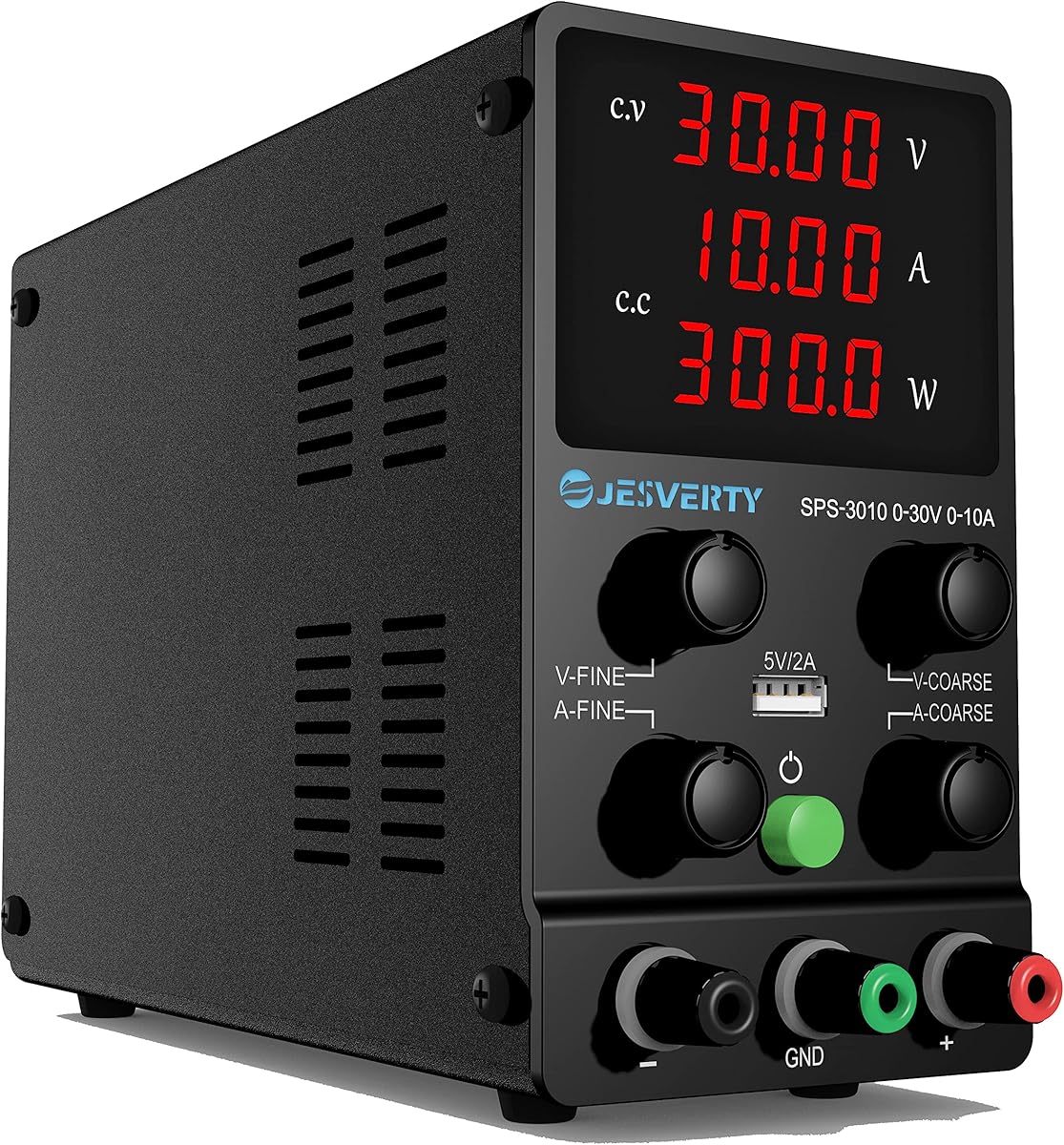


The Jesverty SPS-3010 is a 30V, 10A adjustable switching bench supply built around a bright four-digit LED display. Its stated resolution reaches 0.01V, 0.001A, and 0.1W, allowing voltage, current, and calculated power to be monitored at a glance. A 4.5 rating reflects a well-regarded feature set, although ratings alone cannot guarantee suitability for every electrolysis setup.
We may earn a commission when you buy through this link, at no additional cost to you.
Automatic constant-voltage and constant-current operation is the most important technical feature for electrolytic work. The unit changes its operating mode as the load changes, and the configured voltage and current values act as the transition points. That behavior gives the user more control over the cell than a fixed supply and makes it easier to recognize when the electrolyte or electrode load is drawing more current than intended.
The SPS-3010 measures approximately 7.1 by 3.35 by 6.1 inches and weighs about 2.5 pounds, making it reasonably compact for a crowded workbench. Its protections include short-circuit, overload, and temperature-related safeguards, with a temperature-regulated fan and grounding terminal. The main caveats are that the supplied test leads are described as general-purpose items and that the AC cord and input configuration depend on the destination.
This is a strong choice for electrolysis, plating, laboratory experiments, and electronics repair when a 30V, 10A range and precise readouts are desired. Buyers planning sustained high-current work should plan to obtain suitably rated test leads, while users outside the appropriate mains region should verify input compatibility before ordering. For its combination of resolution, mode handling, protection, and compactness, it remains a convincing all-purpose option.
Showing voltage, current, and power in real time makes it easier to identify changes in electrolytic behavior. The detailed display is particularly helpful when current draw rises as the electrodes react or when the operator needs to establish a repeatable working point.
Short-circuit and overload protection help contain unexpected conditions, while the temperature-regulated fan supports sustained operation. The compact enclosure reduces the amount of bench space consumed by a unit capable of serving multiple laboratory and repair tasks.
We may earn a commission when you buy through this link, at no additional cost to you.
The NANKADF 30V, 10A supply offers a four-digit display and an encoder control that can be pressed to select an individual digit before being rotated to change its value. This is useful when an electrolysis operator wants repeatable numeric settings rather than relying entirely on the feel of a conventional rotary control. It carries a 4.5 rating and supports both constant-voltage and constant-current operation.
We may earn a commission when you buy through this link, at no additional cost to you.
The automatic mode switching means the unit can respond to changes in load by changing the power-delivery behavior instead of maintaining one fixed operating condition without adjustment. Its display resolves voltage to 0.01V and current to 0.001A, and a status indicator reveals the active mode. Display brightness adjustment is also convenient when the supply is used in a dark laboratory or workshop.
The output enable and disable control is a standout feature. It allows the output to be switched off while settings are changed, reducing the need to disconnect a load and helping prevent accidental exposure of a connected cell to an unintended setting. Overcurrent protection can stop the output and sound a buzzer when a short circuit is detected. An 18W USB fast-charging port adds convenience for phones and smaller electronics, although it does not add electrolysis capacity.
This supply is well suited to users who value precise setpoint entry, easy output isolation, and audible fault feedback. It may be less compelling than four-digit alternatives that also calculate wattage, and its charging port is a convenience rather than a core laboratory function. Nevertheless, the combination of encoder adjustment, clear resolution, protection, and mode indicators makes it a practical choice for tabletop electrolysis and general bench work.
Selecting digits individually gives the user a direct method for entering exact voltage and current values. That precision is valuable when comparing different electrolytes, electrode materials, or cell configurations and documenting the settings used for each run.
The dedicated output button lets a user change setpoints without energizing the connected load. It is a simple feature, but one that improves workflow during repeated electrolysis experiments and repair sessions.
We may earn a commission when you buy through this link, at no additional cost to you.
The LONGWEI LW-K3010D is a 0-30V, 0-10A adjustable switching regulated supply designed for laboratory, repair, and testing work. Its backlit three-digit display reports voltage, current, and power with stated resolution of 0.1V and 0.01A. That remains usable for many electrolysis projects, although the four-digit models in this guide provide finer numeric detail.
We may earn a commission when you buy through this link, at no additional cost to you.
A major strength is the broad collection of workbench applications. The supplied information identifies laboratory use, school instruction, home electronics repair, and aging tests among its intended uses. It also includes a grounding wire, limited-current and over-power protection, over-temperature protection, and voltage-overload protection. Those safeguards make it relevant to users who want more than a simple adjustable output for a single experiment.
Thermal management relies on an intelligent temperature-controlled fan and side heat-radiation grooves. The description says this arrangement improves heat dissipation while reducing noise and prolonging product life. The unit weighs less than 2 kilograms and measures approximately 2.7 by 8.6 by 6.3 inches, making it portable enough for different workspaces. Complete test probes and an output cable with alligator clips are included.
The LW-K3010D is a good fit for electrolysis users who prioritize a familiar laboratory supply format, a full accessory package, and broad application support. It is less attractive when the finest possible setpoint resolution is the priority, since users must settle for 0.1V and 0.01A readouts. For general bench work, especially where multiple protection functions and replaceable accessories are useful, it remains a sensible and established option.
The unit's range of stated applications and included alligator connections make it practical for electrolysis alongside repair, education, and aging tests. A broad accessory package reduces the need to source basic output connections separately.
An intelligent fan and dedicated heat-radiation features help the supply manage heat as operating conditions change. This is important for electrolysis setups where the user may run an experiment for an extended period rather than briefly testing a circuit.
We may earn a commission when you buy through this link, at no additional cost to you.
This 30V, 10A adjustable supply combines a four-digit LED display with separate encoder controls for coarse and fine adjustment. The coarse knob handles the value before the decimal point, while the fine knob handles the digit after it. Its 4.6 rating and broad feature set make it a strong candidate for users who want fast setup without giving up numerical precision.
We may earn a commission when you buy through this link, at no additional cost to you.
The control scheme is particularly useful during electrolysis because voltage and current can be approached in two stages. A user can establish a broad operating range quickly and then make small changes without hunting through many rotations. Protection features include overcurrent and short-circuit alerts, grounding, leakage protection, overheating protection, and voltage- and power-overload protection. A buzzer provides audible notification when the load is short-circuited.
Charging conveniences include a 3.6A Type-C output and a USB port. They can be useful for powering or charging compatible devices during a workshop session, but they are separate from the main electrolysis output and should not be confused with additional cell capacity. Heat is handled by an intelligent temperature-controlled fan and heat sink, with the product positioned for laboratory, repair, production-line, research, and teaching work.
One notable feature is automatic input-voltage detection, which is described as adapting to 110V or 230V AC inputs within the stated tolerance without a manual rear toggle. That removes one potential installation concern, although users should still verify the unit and their local supply requirements. This model is a good fit for electrolysis projects that need accurate controls, useful charging ports, and comprehensive fault protection.
The separate coarse and fine encoders make it possible to move quickly through a wider range and then fine-tune a cell setting. This design reduces the number of repeated knob turns required when establishing a new operating point.
A buzzer accompanies the automatic shutdown behavior in the event of a short circuit. The alert helps a user recognize that the output has been interrupted instead of assuming the cell is simply operating normally.
We may earn a commission when you buy through this link, at no additional cost to you.
The Jesverty SPS-3010V is a compact 0-32V, 0-10A switching bench supply with a four-digit display and separate coarse and fine encoder knobs. Its stated setting resolution is 0.01V and 0.001A. The 4.6 rating places it among the stronger-rated products in the group, although suitability still depends on matching the supply to the cell's requirements.
We may earn a commission when you buy through this link, at no additional cost to you.
The main control improvement over conventional potentiometer supplies is the division of labor between the two encoders. One controls digits before the decimal and the other controls the digit after it, making fine adjustments more consistent. The output ON/OFF button lets users change voltage and current while the output is disabled, which is useful when reconfiguring an electrolysis cell or troubleshooting a connected load.
Two 20W charging outputs support USB-A and USB-C devices. The description also identifies use with Arduino UNO, Raspberry Pi, and other electronic modules, making the supply versatile for mixed electronics work. An OPN function can allow the unit to output voltage and current immediately after the main power switch is turned on, while a temperature-regulated cooling fan manages heat. Overcurrent protection adds an additional layer of control.
The unit measures approximately 7.1 by 3.6 by 6.2 inches and weighs about 2.5 pounds, making it portable without sacrificing a substantial output range. Buyers should note that AC input is selectable at 115V or 230V, that cord and input configuration vary by destination, and that the included test leads may be unsuitable for sustained high-current work. Overall, it is a versatile electrolysis and general-purpose bench option.
The two 20W charging ports are valuable when the same bench must support phones, controllers, or embedded modules alongside an electrolysis setup. These conveniences do not increase the main DC output, but they reduce the need for separate charging hardware.
Independent encoders and a four-digit display bring precise control without a large laboratory enclosure. The small dimensions and low weight also make the SPS-3010V easier to move between a workbench, classroom, and laboratory station.
We may earn a commission when you buy through this link, at no additional cost to you.
The NICE-POWER 30V, 10A switching supply is the most directly aligned model in this guide for electrolysis. Its feature description specifically names electrolysis, electroplating, brush plating, and related work, and it has a 4.6 rating. The unit provides a bright four-digit display with 0.01V and 0.001A resolution, including real-time voltage, current, and calculated power.
We may earn a commission when you buy through this link, at no additional cost to you.
Automatic constant-voltage and constant-current conversion allows the supply to respond as the load changes. This is especially useful in an electrolytic cell, where electrode reactions and electrolyte composition can affect current demand. A front OUTPUT key disables power while settings are adjusted, helping users change operating points without repeatedly disconnecting the cell. The current-voltage and power readouts provide useful context for those adjustments.
Protection is unusually comprehensive for the category. The stated functions include leakage, grounding-terminal, over-voltage, over-current, over-power, overload, over-temperature, and short-circuit protection. An intelligent temperature-controlled fan and heat sink activate when the working temperature exceeds the stated 50°C threshold. The vertical form uses shock-absorbing rubber feet, while dimensions of about 8.4 by 3.3 by 5.5 inches and a weight of 2.6 pounds keep it portable.
The decisive limitation is input voltage: this version is specified for standard US 110V AC only, with 220V explicitly unavailable. US buyers gain a capable, well-protected unit with an electrolysis-focused feature set, while users in 220V regions should not choose it without an appropriate alternative. For compatible locations, it offers the most complete balance of control, monitoring, protection, and application-specific suitability in this comparison.
Electrolysis is explicitly included among the listed applications, alongside electroplating and brush plating. That direct positioning is supported by automatic CV/CC behavior, a high-current 30V 10A range, and clear live power monitoring.
Short-circuit, over-current, over-temperature, over-power, and voltage-overload protections cover several failure modes that can occur around a powered cell. The output switch further helps separate setup adjustments from active operation.
We may earn a commission when you buy through this link, at no additional cost to you.
The NICE-POWER 150W model combines a compact enclosure with encoder-based control and a maximum output of 150W. It can operate in either a 15V, 10A range or a 30V, 5A range, with the two values constrained by the shared power ceiling. It carries a 4.5 rating and is listed for electroplating and related adjustable-supply applications.
We may earn a commission when you buy through this link, at no additional cost to you.
The compact design is its defining advantage. It measures only 10 by 18.5 by 8 centimeters and weighs less than one kilogram, making it useful where a full-size 30V 10A enclosure would be inconvenient. The voltage display resolves to 0.1V and current to 0.01A. Users select a digit by pressing the corresponding encoder and then rotate to set the value, replacing the less exact conventional potentiometer arrangement.
A cooling fan starts automatically to support heat dissipation, while the instructions emphasize stopping use if the unit becomes too hot. The input accepts 100-240V AC at 50-60Hz with a stated tolerance, making it suitable for a broad range of locations without a separate transformer. The package includes the supply, an output power cord, an input power cord, and a user manual.
This unit is a budget-conscious option for moderate electrolysis and electroplating work where space and portability matter. Its limitation is the 150W ceiling: setting 30V restricts current to 5A, while 10A is available only up to 15V. Users must choose which operating range fits their cell. Subject to that constraint, the small size, encoder control, and broad mains compatibility make it an attractive budget pick.
The enclosure is substantially smaller and lighter than most 300W-class supplies in the guide. It is especially appealing to students, hobbyists, and traveling technicians who need useful electrolysis capacity without a large permanent bench footprint.
Operators can use the unit at 15V and 10A or at 30V and 5A, depending on their cell. Understanding this relationship prevents a user from selecting high current and high voltage simultaneously beyond the fixed 150W capacity.
We may earn a commission when you buy through this link, at no additional cost to you.
The SKY TOPPOWER 30V, 10A adjustable bench supply provides a 0.01V and 0.001A display resolution, automatic conversion between constant-voltage and constant-current modes, and a backlit four-digit screen. Its 4.3 rating is the lowest among the ten listed models, but the supplied specification remains broad enough to support electrolysis, etching, load testing, and general electronics work.
We may earn a commission when you buy through this link, at no additional cost to you.
The operating behavior is well suited to a variable electrolytic load. When current reaches or exceeds the preset limit, the unit switches to constant-current mode and voltage drops; below that threshold, it functions as a constant-voltage source. The mode indicator below the knob makes the transition visible. Coarse and fine controls adjust smoothly, and the stated sensitivity supports repeatable selection across the 0-30V and 0-10A ranges.
The unit's protective features include leakage protection, thermal protection, voltage overload, current limiting, short-circuit protection, a temperature-controlled cooling fan, and a grounding terminal. Anti-reverse-connection protection is an especially useful addition because incorrect lead polarity is a common bench error. The screen uses bright red segmented digits and has a protective film intended to resist dirt and damage.
The enclosure measures approximately 8.70 by 5.43 by 4.09 inches and weighs under 1.5 kilograms. The package includes power cords, an alligator-clip lead set, and a manual. This is a practical choice for an electrolysis setup that values a small footprint, detailed readouts, and extensive protection. The lower rating and more limited stated feature narrative warrant checking the latest listing, but the core electrical functions are appropriate for the intended task.
The indicator shows when the supply moves from voltage regulation into current regulation. This visibility helps an operator understand whether the cell is drawing power normally or has reached the configured current limit.
Protecting against reversed connections helps reduce the consequences of a common lead-placement mistake. Combined with short-circuit, thermal, and overload safeguards, it makes the unit more appropriate for repeated experimental work.
We may earn a commission when you buy through this link, at no additional cost to you.
The NICE-POWER 200V, 5A supply is the high-output selection in this guide, offering up to 1000W and a 5.0 rating. It is designed for demanding applications that exceed the 0-30V range of most models, including electrolysis, LED and battery testing, aging runs, laboratory work, and other high-power maintenance tasks. A backlit four-digit display provides clear voltage and current readings.
We may earn a commission when you buy through this link, at no additional cost to you.
The encoder interface allows individual digits from 0 through 9 to be selected and adjusted, providing a controlled method for setting the required output. The unit automatically changes between constant-current and constant-voltage behavior as the load approaches or exceeds the preset current value. Internal over-voltage and over-current protection adds a second layer of control around those operating modes.
Cooling is handled by built-in cooling elements and an intelligent fan that activates when the described temperature reaches 50°C after sustained overload. The unit is stated to have CE and FCC certification, and the description highlights a maximum use case of 100 lamps in an aging test. Those features are relevant when the user needs sustained capacity rather than a lightweight supply for small experiments.
The enclosure measures 38 by 24 by 13 centimeters and weighs 3.3 kilograms, making it larger than the compact alternatives but still manageable on a laboratory bench. Both low-power and high-power output cables are included. This premium model makes the most sense for advanced electrolysis, high-voltage cell work, or multi-load testing where a 30V supply would be too restrictive. For small desktop projects, its capacity would be unnecessary.
The 200V upper limit opens the supply to cell configurations and aging tests that cannot be supported by a standard 30V model. It is a meaningful distinction for advanced users planning around higher-voltage electrolysis.
An intelligent fan responds to elevated temperature after heavy loading. Combined with the 1000W rating, this thermal approach makes the unit more relevant to extended laboratory and production-style testing.
We may earn a commission when you buy through this link, at no additional cost to you.
The NICE-POWER 30V, 5A supply is a compact option for small electrolysis, electroplating, LED testing, and general repair projects. It has a 4.6 rating, a backlit three-digit display, and dual encoder controls. Its stated output adjustment spans 0-30V and 0-5A, making it suitable for users who do not need the 10A current available from several larger models.
We may earn a commission when you buy through this link, at no additional cost to you.
The encoder design allows the voltage or current digit to be selected and then set numerically. The display resolves voltage to 0.1V and current to 0.01A. These values are less detailed than the four-digit alternatives, but they remain practical for many small cells and basic laboratory demonstrations where the working point does not require extremely fine display increments.
Protections include over-voltage, over-current, over-power, over-temperature, and short-circuit functions. The unit is described as FCC and CE certified, with a low-noise, low-ripple output and a fan that starts when powered to dissipate heat. Its 100-240V AC input makes it broadly usable at both 110V and 230V levels. The package includes the supply, power cord, output load cord, and manual.
At just 1.54 pounds and approximately 6.5 by 4.0 by 3.2 inches, it is one of the easiest models to carry between locations. The 5A ceiling and lower display resolution are the main constraints. It is a strong choice for hobby-scale electrolysis, plating, aging tests, and LED work where portability and simple encoder controls matter more than high-current output.
The small enclosure and low weight make the unit easy to place in a tool bag or move between work areas. Its broad mains input range also simplifies use across different compatible locations.
Digit-selecting encoders make the supply more repeatable than a basic knob while keeping the interface straightforward. This is useful for smaller electrolysis setups that need dependable settings without a large control panel.
We may earn a commission when you buy through this link, at no additional cost to you.
Choosing a power supply for electrolysis requires balancing the cell's voltage, current, operating duration, and control requirements. The most important factors are usable power, adjustment precision, mode behavior, protection, and cooling.
Begin with the voltage and current required by the electrolysis process rather than selecting on physical size or convenience features alone. Most compact selections cover up to 30V, while several offer 10A, and the premium model reaches 200V and 5A. A higher current rating does not automatically mean more total power: for example, the 150W unit permits 10A only at 15V and restricts 30V operation to 5A.
Choose a supply with usable headroom above the expected operating point, but avoid selecting an oversized unit when a smaller one meets the cell's needs. Match both dimensions of the rating and observe any shared wattage ceiling.
A useful electrolysis supply should be able to function in constant-voltage mode while acting as a constant-current source after the set current limit is reached. This behavior accommodates changes in the cell load, such as altered electrode reactions or electrolyte conditions. The transition should be visible on the display, allowing the operator to recognize when the cell is current-limited rather than operating at the selected voltage.
Prioritize automatic mode conversion and clear status indicators. This gives greater control than a fixed-voltage supply and makes experimental behavior easier to interpret.
Display resolution determines how precisely the operator can read voltage, current, and sometimes power. The strongest options in this guide provide four-digit displays with 0.01V and 0.001A resolution, while compact models use three digits at 0.1V and 0.01A. Real-time power calculation is also useful because it provides a more complete view of the energy reaching the cell.
Higher resolution is valuable for fine comparisons, small current changes, and documented experiments. If the application does not demand fine increments, a three-digit display may still be adequate.
Adjustment methods range from conventional coarse and fine potentiometers to encoder knobs. Encoders can be pressed to choose a digit and rotated to set a value, which is useful for establishing repeatable operating points. A dedicated coarse-and-fine encoder system can make large and small changes more efficient than turning a single conventional control repeatedly.
Look for controls that are easy to set precisely and do not require estimating a voltage from an analog scale. An output enable or disable button is a helpful addition when changing settings around a connected cell.
Short-circuit and overcurrent protection are essential because a damaged or incorrectly connected cell can present a very low resistance path. Additional protections for over-voltage, over-power, over-temperature, leakage, overload, and reverse connection add layers of control. Audible alarms can make a fault immediately noticeable, while automatic output shutdown can reduce the consequences of a sudden change in load.
Compare the supplied protection list rather than assuming every model offers the same safeguards. A grounding terminal and clearly identified protection behavior are useful additions for a bench near conductive liquids.
Electrolysis sessions may outlast short electronics tests, so cooling deserves careful attention. Temperature-controlled fans, heat sinks, heat-radiation grooves, and automatic fan activation help remove heat as load increases. The premium 1000W model includes intelligent cooling designed to activate at elevated temperatures, while several smaller units use automatic or temperature-sensing fans.
Allow the specified airflow around the enclosure and follow the manufacturer's warnings. A model that becomes excessively hot should not be continued in use, and ventilation should never be blocked by papers, containers, or other equipment.
Input compatibility is a decisive issue because the listed models differ significantly. The NICE-POWER 30V 10A selection is specified for 110V input only, while the auto-detecting model adapts to 110V and 230V, and the 150W unit accepts 100-240V. Other products use a selectable 115V/230V arrangement. Verify the intended version before ordering rather than assuming every global-looking listing is interchangeable.
Also inspect the supplied leads and their current capacity. Several descriptions explicitly recommend replacing general-purpose test leads for long-term high-current use. Electrolysis cells can involve corrosive solutions, so connections should also be appropriate for the chemistry and environment.
The most capable unit is not automatically the most convenient. A full-size 30V 10A supply offers more current than a 30V 5A model, while the 150W option saves substantial space but constrains its operating combinations. Charging ports and display brightness are convenient for mixed workshop work, yet they do not improve the core electrolysis output. The 200V unit is meaningful for advanced high-voltage work but excessive for a small classroom cell.
Prioritize capacity, regulation behavior, protection, and cooling first. Treat extra ports and compact dimensions as secondary benefits that should complement rather than determine the purchase.
Before connecting an electrolytic cell, confirm that the supply's input requirements match the local mains service and that its rated voltage and current exceed the planned operating values. Inspect the unit, cooling vents, output cable, and connector surfaces for damage. Set the desired voltage and current while the output is disabled, and confirm that the displayed mode and output status are understood before attaching the cell.
Connect the cell according to its required polarity and use leads with sufficient current capacity for the intended load. Increase the output gradually while watching the voltage, current, and power readouts. If the unit enters constant-current mode unexpectedly, investigate the cell, electrodes, electrolyte, and connections rather than increasing the limit automatically. Stop and disconnect the setup if you notice unusual heat, odor, discoloration, or a protection alarm.
Keep the enclosure dry, unobstructed, and on a stable surface. Electrolytes can splash, so the bench should be arranged to prevent fluid from entering the power supply. Allow the unit to cool if it becomes excessively hot, inspect cables periodically for corrosion or damage, and use only appropriately rated leads for sustained current. Always follow the cell chemistry's safety guidance and the power supply manufacturer's operating instructions.
The correct rating depends on the electrolyte, electrode materials, cell geometry, and process. Start with the manufacturer's recommended operating range and include enough headroom without exceeding the supply's wattage limit. A 30V unit may suit many small laboratory cells, while a 200V unit is intended for substantially higher-voltage applications.
Useful supplies support both behaviors and switch automatically as the load changes. Constant-voltage mode maintains the selected voltage until the current reaches its limit, after which constant-current mode reduces voltage as needed. This flexibility is valuable because electrochemical reactions can change current demand during a session.
A regulated adjustable bench supply can be used when its voltage, current, power, cooling, and protection are adequate for the cell. The model should also have suitable output connections and a clear method of limiting current. Avoid improvised wiring or an unregulated source because electrode reactions and accidental shorts can create unstable operating conditions.
It has reached the configured current limit, which means the connected cell is drawing more current than the selected threshold. Check the electrodes, electrolyte, wiring, and cell configuration, and consider whether the current limit is too low. Do not raise the limit beyond the rated output or use a damaged connection.
A four-digit display provides finer voltage and current resolution, which is useful for small adjustments and repeatable experiments. A three-digit display may be sufficient for coarse laboratory demonstrations or basic hobby setups. The more important consideration is whether the display is readable and the supply's adjustment controls allow accurate setpoint entry.
It can if the cell draws more power than the unit can sustain, if the output is shorted, or if electrolyte enters the enclosure. Use protection, suitable leads, adequate ventilation, and a stable bench. Stop operation if the unit overheats or repeatedly enters a protection state, and inspect the setup for excessive current demand.
Use leads rated for at least the maximum current expected from the cell and suitable for the surrounding chemistry. Several included lead sets are described as general-purpose or give-away accessories that may need replacement for sustained high-current work. Corrosive environments also warrant corrosion-resistant connectors and careful cable inspection.
No. A larger supply adds useful headroom but may be unnecessary, larger, and more demanding to operate. Match voltage, current, and total wattage to the cell while accounting for the power ceiling. Compact models with a shared limit can be ideal for modest projects, while advanced high-voltage work requires a larger-rated unit.
The NICE-POWER 30V 10A is the strongest all-around selection because it combines a detailed four-digit display, automatic CV/CC conversion, an output switch, broad protection, and explicit electrolysis suitability. The compact NICE-POWER 150W model is the budget pick for users who prioritize portability and a constrained operating range, while the 200V 5A NICE-POWER provides the premium capacity needed for advanced high-voltage applications.
For most users, the decisive priorities are usable voltage, adequate current, clear readouts, reliable mode switching, and effective protection. Match the supply to the cell rather than choosing only by physical size, charging ports, or display style. Check the input voltage carefully because some models support specific mains configurations, and use appropriately rated leads for sustained electrolysis work.
Ratings, availability, and prices can change, so confirm the current listing and its specifications before purchasing. The linked product pages contain the latest availability, configuration details, and current price information. Use those details to confirm compatibility with your planned cell, electrical environment, and safety requirements.