
Tapo Smart Water Leak Detector
4.6Editor score
One-second detection response
Adjustable 90 dB alarm
Three-plus-year battery life
Smart water leak detectors provide an early warning when water appears near appliances, plumbing fixtures, sump pumps, and other vulnerable areas. A useful model combines sensitive probes, a noticeable alarm, dependable app notifications, flexible placement, and straightforward setup, allowing you to monitor potential damage even while away from home.
We compared these ten detectors by examining their sensing methods, alarm output, wireless coverage, network requirements, app controls, environmental ratings, and ability to protect multiple areas. The list includes standalone sensors, hub-based systems, cable-based monitors, and a main-line shutoff device rather than treating every smart leak detector as the same type of product.
Each review explains the most useful capabilities and the trade-offs that may affect a particular household. Ratings and specifications reflect the supplied product information, while availability, bundles, app behavior, and prices can change. Always verify compatibility and current package contents before making a final purchase.
4.6Editor score
4.5Editor score

4.6Editor score
As an Amazon Associate we earn from qualifying purchases.
The comparison highlights the major differences in sensing style, alert coverage, connectivity, alarm capability, and intended role, from compact stand-alone sensors to an automatic whole-home shutoff system.


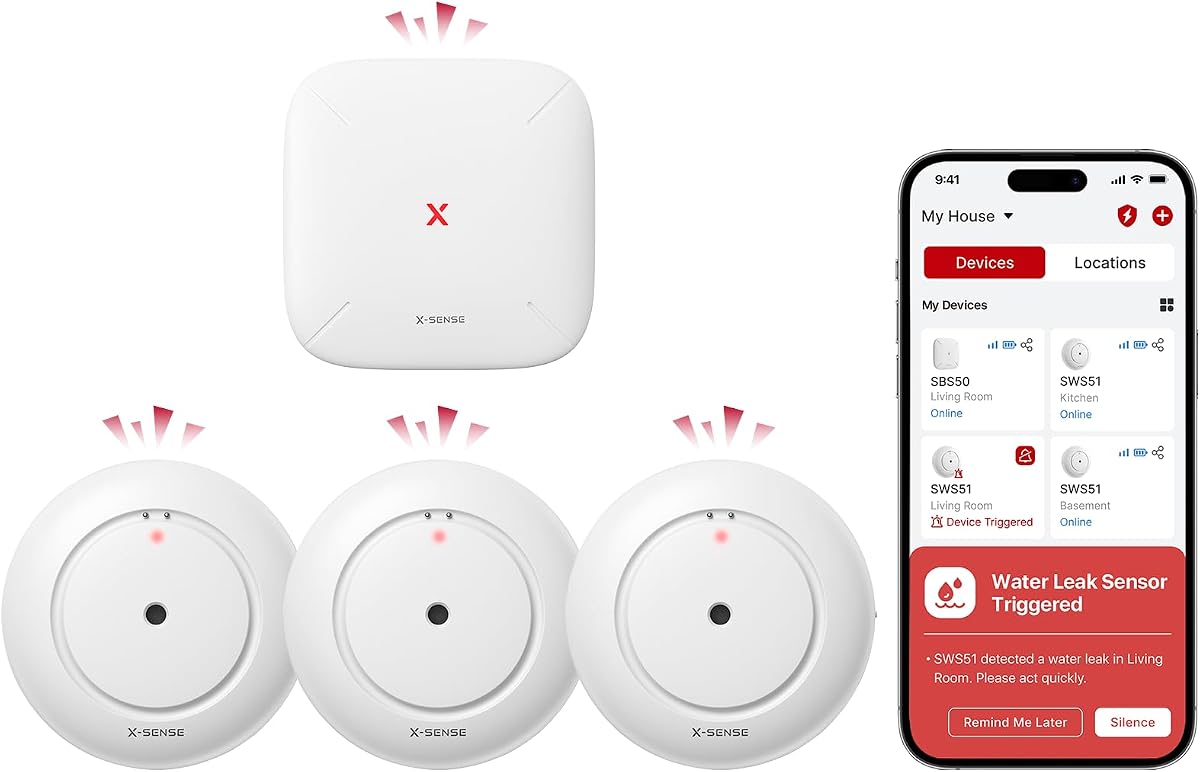
The X-Sense Wi-Fi Water Leak Detector Kit SWS54 earns a 4.5 rating and stands out for a balanced combination of detection capability, audible coverage, and wireless flexibility. It includes three sensors and a base station, giving a household several placement points without requiring separate products for every vulnerable appliance.
We may earn a commission when you buy through this link, at no additional cost to you.
Its sensors use two upper probes to detect dripping water and four lower probes to recognize pooled water as shallow as 0.4 mm. When a leak is found, both the sensor and base station sound 120 dB alarms, while the app provides a phone notification. A stated open-area range of up to 1,804 feet also makes the system practical for homes with basements, detached areas, garages, or utility rooms.
The main limitation is connectivity: setup requires a 2.4 GHz Wi-Fi network, and 5 GHz Wi-Fi is not supported. The package also relies on a base station rather than having every sensor operate as an independent Wi-Fi unit. These constraints are understandable for a multi-sensor system but deserve consideration before purchase.
This is a strong choice for users who want audible protection in several rooms and phone alerts when away. It is particularly appropriate for monitoring water heaters, washing machines, dishwashers, sinks, sump pumps, toilets, refrigerators, and plumbing lines, especially where a loud local alarm could be missed without the app.
The split probe arrangement makes the sensors more versatile than a basic puddle-only alarm. Upper probes can register drips from an appliance or pipe, while lower probes can identify water gathering beneath or around the device. That versatility makes the kit useful in varied locations rather than only beside floor-level plumbing.
The synchronized sensor and base alarms improve the chance that someone nearby notices a problem. The app adds a remote layer, supports shared access for as many as 12 users, and offers reminder intervals of 10 minutes, 30 minutes, 2 hours, 6 hours, or 12 hours.
We may earn a commission when you buy through this link, at no additional cost to you.
The Moen Flo Detector 920-005 has a 3.6 rating and takes a different approach by including a remote sensing disc attached to an extension cable. That design lets a detector reach narrow, confined, or inconvenient areas where a compact sensor body might be difficult to position correctly.
We may earn a commission when you buy through this link, at no additional cost to you.
This three-pack can monitor locations such as a flooding basement, washing machine, or hot water tank. Detected moisture produces real-time notifications through the Moen Smart Water Network app. The detectors can operate as standalone monitoring devices or connect with the separately sold Flo Smart Water Monitor and Shutoff for a broader whole-home installation.
Its lower rating than the other products warrants attention, although the supplied information does not identify a specific defect. Buyers may also need to account for the separate cost and installation of a Flo Shutoff if they want automatic water shutoff rather than notifications alone.
The Moen package is most attractive to existing Flo ecosystem users or households that need the remote disc. It is less compelling for buyers seeking a broad set of modern app controls, especially since its central value is flexible physical placement and compatibility with Moen's water-management system.
The included extension cable with remote sensing disc extends detection up to 48 inches. This is particularly useful behind appliances, beside pipes, under fixtures, and inside tight areas where the main detector housing cannot sit directly next to the potential leak source.
You can begin with the three detectors and receive moisture notifications through the Moen app. The system also supports connection to the Flo Smart Water Monitor and Shutoff when broader monitoring and automatic shutoff are desired.
We may earn a commission when you buy through this link, at no additional cost to you.
The X-Sense Ultra-Slim SWS0A41 carries a 4.5 rating and focuses on a problem many conventional sensors can create: finding enough room to place the device. At only 0.7 inches thick and 3 inches in diameter, it is designed for narrow cabinets, tight appliance gaps, and other awkward locations.
We may earn a commission when you buy through this link, at no additional cost to you.
Detection is handled by two top probes and four bottom probes. The sensors can identify water as shallow as 0.4 mm and detect drips from above. A leak triggers a flashing red light, an app alert, and a base-station alarm rated at up to 100 dB. The app also supports alarm history, volume adjustment, muting, device testing, low-battery notices, and temporary reminders.
The base alarm is slightly less powerful than the dual 120 dB setup offered by the SWS54, and the supplied specifications do not list an IP rating for this model. Those points deserve attention in very damp locations, even though its slim design makes placement easier.
This detector is ideal for users who need a low-profile sensor more than maximum alarm volume. The four-sensor bundle, detailed app controls, and long stated open-area range make it well suited to apartments, basements, kitchens, bathrooms, and other areas where discreet installation matters.
The low-profile enclosure is the model's defining feature. It can be positioned where a thicker alarm would obstruct a fixture, interfere with an appliance, or look out of place, while still providing probes on both the top and bottom surfaces.
Users can inspect alarm history, adjust volume, mute an active alert, test the device, and receive low-battery notifications. Temporary reminder periods can also help keep a genuine leak visible without requiring immediate repeated attention.
We may earn a commission when you buy through this link, at no additional cost to you.
The Tapo T300 has a 4.6 rating and offers a strong balance of rapid detection, app notifications, and maintenance convenience. Its most eye-catching specification is the ability to trigger the built-in siren in as little as one second when water is detected.
We may earn a commission when you buy through this link, at no additional cost to you.
Six sensitive probes cover both top and bottom surfaces, allowing the sensor to react to drips and leaks from different directions. The local alarm is adjustable up to 90 dB and can be silenced with one press. A Tapo hub can also be triggered for additional audible coverage, while the app provides immediate notifications for leaks and low batteries.
The most important practical requirement is the Tapo hub, which must be purchased separately if you do not already own one. Battery life is stated at up to three years with two replaceable AAA batteries, although actual duration can vary with use and environmental conditions.
This is a compelling choice for a household already using the Tapo smart-home ecosystem or willing to add a hub. Fast triggering, a simple one-button silence control, and a strong battery claim make it a practical pick for leak-prone rooms.
The one-second trigger helps reduce the period between the first contact with water and an audible or app alert. That speed is valuable near water heaters, washing machines, dishwashers, and other equipment where a small leak can grow quickly.
The T300 carries an IP67 rating against water and dust, making it suitable for humid and dusty environments. Its replaceable AAA batteries also remove the need for a proprietary power connection in many installations.
We may earn a commission when you buy through this link, at no additional cost to you.
The TECKNET WiFi Water Leak Detector has a 4.2 rating and removes one common installation hurdle by connecting directly to a 2.4 GHz Wi-Fi network without a hub. Each package includes two sensors and four AAA batteries, creating a straightforward starting point for monitoring two locations.
We may earn a commission when you buy through this link, at no additional cost to you.
Both sensors use two upper probes and four lower probes for multi-directional detection. An adjustable 120 dB siren provides local warning, while the Tuya Smart app sends immediate push notifications. The IP67 housing is designed for humid locations such as basements, laundry rooms, kitchens, and areas near water heaters.
Only 2.4 GHz Wi-Fi is supported, and the product will not connect to 5 GHz networks. Push notifications are available without a separate subscription, but optional SMS and phone-call alerts require a third-party service. The app also provides low-battery reminders, which helps make maintenance predictable.
TECKNET is a good match for users who want direct Wi-Fi connectivity, a strong local alarm, and a two-sensor bundle without another hub. It is less suitable for homes limited to 5 GHz Wi-Fi or for users who assume every form of remote messaging is included at no additional cost.
Direct 2.4 GHz Wi-Fi connectivity removes the gateway from the installation. With two sensors, four batteries, and app-based setup, the package can cover two strategic areas and expand coverage through additional compatible purchases.
The adjustable 120 dB alarm should be noticeable in a laundry room, basement, or utility space, while push notifications provide remote awareness. Users can also rely on low-battery reminders to avoid a silent loss of protection.
We may earn a commission when you buy through this link, at no additional cost to you.
The Smart Water Leak Detector 3 Pack has a 4.5 rating and combines three WD71 sensors with a Tuya-connected gateway. The gateway is the central hub for alerts, while the compact sensors are approximately 1.1 inches thick and 2.8 inches in diameter, allowing placement in corners and narrow spaces.
We may earn a commission when you buy through this link, at no additional cost to you.
Each sensor has two upper probes for dripping and four lower probes for pooled water. The specification notes that at least two bottom probes must be activated to limit false alarms. Sensors communicate with the gateway over as much as 328 feet in open areas, commonly reaching around 150 feet indoors.
The app supports push notifications, device sharing, adjustable sensor and gateway volumes, alarm muting, and history. It also allows automatic arming or disarming schedules, which can be useful for reducing unnecessary nighttime alerts or briefly changing monitoring behavior in certain conditions. The gateway supports up to 24 WD71 sensors.
This three-pack is a good option for buyers who want gateway-based scalability and flexible app scheduling. Its main limitations are dependence on 2.4 GHz Wi-Fi and the need to understand the sensor's multi-probe activation behavior before installation.
The included gateway can support up to 24 WD71 sensors, making this a practical foundation for a larger home. A three-sensor starting package allows immediate coverage while leaving room to add monitored locations later.
Automatic arming and disarming options let users control when alerts are active. The app also provides separate volume controls for the sensor and gateway, helping balance a loud local warning with a less disruptive remote notification routine.
We may earn a commission when you buy through this link, at no additional cost to you.
The Moen Flo Shutoff 900-001 has a 3.9 rating and offers a fundamentally different form of protection. Installed on the main water line, it monitors flow, pressure, and temperature around the clock rather than waiting for water to reach a probe placed near a suspected fixture.
We may earn a commission when you buy through this link, at no additional cost to you.
Daily MicroLeak tests look for abnormal behavior and can send alerts through the Moen Flo app. If a qualifying issue is detected, the device can automatically shut off the water before a leak becomes substantial damage. The app also allows remote monitoring, management, and water shutoff from anywhere.
This is not a small sensor that can be placed under a sink in minutes. It requires suitable main-line installation and compatible hardware, so households without access or confidence for that work may need a plumber. It also addresses whole-home flow patterns rather than pinpointing the exact source of moisture.
The Flo Shutoff is best for owners seeking automatic shutoff and broad main-line monitoring. It complements local sensors rather than replacing them, since a point sensor can identify a specific appliance problem while the shutoff device can limit the consequences of a larger event.
The major advantage is the ability to stop the water automatically when the system identifies a leak condition. That can limit damage when nobody is present to respond immediately to a notification.
FloSense technology adapts to a home's typical water use, helping distinguish normal activity from anomalies such as running water or small leaks. The device combines ongoing monitoring with periodic microleak testing to look for problems before they become obvious.
We may earn a commission when you buy through this link, at no additional cost to you.
The WiFi Water Leak Detector for Home includes a 2.4 GHz gateway and six sensors, giving it one of the broadest starter bundles in this comparison. It has a 4.2 rating and is designed for households that want to cover many leak-prone points without assembling the network one sensor at a time.
We may earn a commission when you buy through this link, at no additional cost to you.
The sensors combine a top drip sensor with four lower flood probes. They are suitable for faucets, roof leaks, sinks, bathtubs, and washing machines. The W13 gateway supports up to 24 WD61 sensors and has a maximum stated transmission range of 328 feet.
App controls are extensive. Sensor volume can be adjusted across four levels up to 120 dB, while the gateway offers five levels up to 100 dB and 32 selectable ringtones. Users can also rename devices, manage on and off functions, and receive real-time alerts through the Tuya Smart app.
Compatibility requires attention. The gateway supports 2.4 GHz Wi-Fi but not 5 GHz, and it expands only with WD61 sensors rather than the WD60 models identified in the supplied notice. Push alerts are free, while optional SMS and call alerts involve a third-party Tuya service.
A six-sensor package can cover appliances and plumbing fixtures throughout a larger home. Because each unit includes both drip and flood sensing, it can be positioned where water may arrive from above or collect around the sensor body.
Separate volume settings and 32 gateway ringtones make it possible to tune alerts for different spaces. The app also supports naming and remote controls, providing centralized management for an expanded sensor network.
We may earn a commission when you buy through this link, at no additional cost to you.
The Kidde Wi-Fi Water Leak Detector and Freeze Alarm has a 3.9 rating and adds temperature monitoring to the standard leak-detection role. It can identify water leaks and freezing conditions, including temperatures reaching 37 degrees Fahrenheit or a rapid temperature drop.
We may earn a commission when you buy through this link, at no additional cost to you.
The compact, battery-powered unit includes two AA batteries and is intended for placement beside dishwashers, refrigerators, water heaters, toilets, under sinks, or in basements and garages. Setup involves downloading the Kidde app, scanning the device's QR code, and following the provided steps.
Notifications can be sent to a smartphone as well as to friends and family. Compatibility with Amazon Alexa, Google Home, iPhone, and Android smart devices makes it approachable for users with an established smart-home setup.
This detector is most useful in locations exposed to both moisture and cold, such as a basement, garage, or unheated utility area. The 37-degree trigger may not be the only temperature concern in every climate, so users should evaluate whether the freeze function fits their environment.
Combining leak and freeze detection makes the device especially relevant to seasonal properties, garages, basements, and utility rooms. It can report a low-temperature condition before a pipe freezes, adding protection beyond water detection alone.
Compatibility with Amazon Alexa, Google Home, iPhone, and Android devices allows alerts to fit into an existing connected-home routine. Shared notifications also let additional household members remain informed about a potential hazard.
We may earn a commission when you buy through this link, at no additional cost to you.
The Eve Water Guard earns a 4.6 rating and stands apart with a 6.5-foot sensing cable, a 100 dB siren, and a privacy-focused local smart-home design. Instead of relying on a small puddle probe alone, the cable can be arranged across a room or around a larger vulnerable area.
We may earn a commission when you buy through this link, at no additional cost to you.
A leak is announced through a loud siren, a red flashing light, and notifications sent to an iPhone, iPad, or Apple Watch. The cable is extendable up to 490 feet, offering considerable flexibility for bathrooms, utility rooms, basements, beneath sinks, and areas near water pipes.
The device supports Bluetooth and Thread and can join a Thread network automatically. It works with Apple HomeKit and does not require a separate bridge or gateway. It also uses local intelligence and direct communication without an Eve cloud, registration, or tracking dependency.
This is a premium choice for Apple-centered households that value privacy, Thread, and flexible cable placement. The trade-offs are platform dependence and the need to position the cable carefully, since coverage depends on laying it where water is likely to travel.
The full-length cable acts as a sensor that can be placed along a floor, near a pipe run, or beneath a sink. Its extendability makes it possible to monitor an irregular area without forcing moisture to reach a single compact probe.
Eve emphasizes local intelligence and direct device communication without cloud dependency. The system requires an iPhone or iPad with the latest iOS or iPadOS, so it is best suited to users already invested in Apple's smart-home platform.
We may earn a commission when you buy through this link, at no additional cost to you.
The right smart water leak detector depends on where you need coverage, how you want to be alerted, the size of your home, and the smart-home ecosystem already in use. These factors help separate a local point sensor from a gateway system, cable monitor, or automatic shutoff device.
Compact probe sensors are designed to detect drips from above and pooled water around their base. Models with upper and lower probes provide more placement flexibility than a simple single-surface sensor. Cable-based detectors can trace a wider floor area or reach awkward spaces, while main-line monitors identify abnormal flow and pressure patterns rather than confirming moisture at one exact location.
Match the detection method to the risk. Probe sensors suit appliance-adjacent locations, cables work well beneath sinks and around pipe runs, and main-line systems provide broad preventive control.
A useful system should notify you quickly when the household is empty, while also making a loud enough sound to wake someone or alert a person nearby. Look for adjustable alarm volume, phone push notifications, shared access, alarm history, low-battery warnings, and temporary mute or reminder controls. Some services also offer SMS or phone calls, but those may require third-party subscriptions.
Prioritize dependable app and local-alarm support. Do not assume optional calling features are included without checking the service terms.
Many of the listed products connect to a 2.4 GHz Wi-Fi network, while some require a separate hub or gateway. The Tapo T300 requires a Tapo hub, the Moen detector can work with the Flo ecosystem, and the Eve Water Guard supports Bluetooth, Thread, and HomeKit. Check your router bands, smart-home platform, hub availability, and account requirements before ordering.
Choose a product whose stated network requirements match your home. A compatible hub is part of the installation, not an optional accessory.
Stated wireless ranges generally apply to open areas, while walls, floors, appliances, and concrete can reduce actual distance. The X-Sense systems state ranges around 1,700 feet in open areas, whereas gateway-based systems list up to 328 feet. Place the base or gateway centrally and test the app from intended remote locations. For larger homes, pay attention to sensor expansion limits.
Do not rely on a headline range alone. Confirm that the base can communicate with sensors in the intended rooms.
The number of sensors in the initial package is only part of the equation. Some gateways support as many as 24 compatible sensors, making them better suited to whole-home monitoring. Expansion may require matching a specific model, such as WD61 sensors for the W13 gateway. Other products are naturally used as a fixed small set rather than a large expandable network.
Check both included sensor count and supported expansion models before planning a property-wide installation.
Basements, laundry rooms, kitchens, garages, and utility areas may expose a sensor to splashes, humidity, dust, or occasional immersion. The Tapo T300 has an IP67 rating, while several other products use IP66-rated housings. These ratings indicate stronger environmental protection than an unspecified enclosure, though careful placement remains important.
Choose an appropriately rated model for damp locations and keep the sensing surfaces unobstructed for easier detection and testing.
Some products are ready to place as soon as they are configured, while the Moen Flo Shutoff requires installation on the main water line. Battery-powered sensors are easier to reposition and usually include replaceable batteries. Low-battery notifications help, but you should still establish a routine for checking alerts, cleaning probes, and testing each unit.
Choose a product that fits your comfort with installation and the maintenance schedule you are genuinely willing to perform.
Remote notifications are most useful when they reach more than one person. Look for device sharing, family access, and the ability to adjust alert timing. Some apps offer arming schedules, temporary reminders, adjustable ringtone selection, and mute controls. These features are helpful during maintenance, nighttime, or periods when water may legitimately be present.
Configure notifications before leaving home, then test them from both near and remote locations to confirm the full alert path works.
Begin by mapping the most likely leak sources. Prioritize washing machines, dishwashers, water heaters, refrigerators, toilets, sinks, sump pumps, utility areas, and any visible pipe connections. Place each sensor where its top probes can catch drips and its lower probes can detect pooling, while keeping the housing away from direct heat, chemicals, and obstructions.
Install the required app, create the appropriate account, connect to the specified network, and complete pairing before relying on the detector. For hub or gateway systems, position the central unit where it can communicate reliably with all sensors. Test each unit manually and confirm that phone notifications, shared-user alerts, local sirens, and any hub alarm all operate as expected.
Care for the system by checking the app for low-battery warnings, replacing batteries on a consistent schedule, and gently cleaning the probes after a wet event. A sensor that has detected water may be reusable after it has dried, but it should be tested again before returning it to service. Never ignore an active leak notification until you have found and addressed the source.
Install it near appliances, plumbing fixtures, and equipment that can fail or overflow. Common locations include beside washing machines and dishwashers, under sinks, near water heaters, next to toilets, in utility rooms, and near sump pumps. Keep the sensing probes unobstructed and follow the manufacturer's placement instructions.
It depends on the model and the type of alert you need. Most listed products are intended to connect to a 2.4 GHz network or a compatible hub for remote notifications, while local siren behavior may vary. Check whether the product retains alarm functions when network access is unavailable before relying on it as a standalone warning.
A single point sensor normally monitors only the area around its probes, although a sensing cable can cover a broader footprint. To monitor several appliances, choose a kit with multiple sensors or a gateway that supports additional compatible units. Expansion limits and supported sensor models differ substantially between brands.
An automatic shutoff is valuable when nobody can respond to an alert quickly. The Moen Flo Shutoff monitors the main line and can stop water when it identifies a qualifying anomaly, while point sensors can identify moisture near a specific appliance. Using both approaches provides location awareness plus whole-home damage limitation.
Many smart-home devices use the 2.4 GHz band because it generally offers broader range through walls and is widely supported by routers and hubs. If your network combines 2.4 and 5 GHz under one name, the device may still work, but separate bands or a compatible hub may be required. Confirm compatibility before installation.
The supplied information for one reusable system says its IP66-rated sensors can operate after drying. That does not mean every model is washable or designed for repeated submersion. After any wet event, follow the product instructions, allow the device to dry fully, and test it before relying on it again.
Test the alarm and app alert path after installation, whenever you change a sensor's location, and on a regular schedule thereafter. Replace batteries when the device or app warns you, and clean the probes so dust or residue does not interfere with detection. A brief monthly functional test and periodic battery check is a practical baseline.
Leak sensors detect moisture at a particular location and usually identify the area that needs attention. Whole-home monitors analyze flow, pressure, or temperature patterns at the main line and may automatically shut off the water. The two categories solve different problems, so a whole-home monitor can complement several local sensors rather than replace them.
The X-Sense Wi-Fi Kit is the most balanced choice in this guide, offering three sensors, dual 120 dB alarms, six-probe detection, and generous open-area range. Tapo T300 is the best budget-oriented ecosystem option when a hub is already available, while the Eve Water Guard is the premium choice for Apple HomeKit households that prioritize extended cable sensing, Thread, and local operation.
Prioritize compatibility before features. Confirm whether you need a hub, whether your router supports the required Wi-Fi band, how many sensors the system can expand to, and where the gateway can be placed. Then match detection style to the risk: use local probes around appliances, cable sensing beneath fixtures, and main-line monitoring when automatic shutoff is the priority.
Package contents, app behavior, optional messaging services, and prices can change over time. Check the current listing and manufacturer requirements before buying, and configure and test every alert before treating the detector as active protection.