
SNAP CIRCUITS Jr. SC-100
4.8Editor score
100+ approachable projects
29 snap-together components
Designed for ages eight
Explore the best Snap Circuits Kits for Kids, comparing project counts, age ranges, component sets, difficulty, and learning value to help you choose well.
Snap Circuits Kits for Kids turn basic electronics into a hands-on activity that feels more like play than homework. A strong kit should offer approachable instructions, safe snap-together components, varied projects, and enough challenge to sustain repeat play rather than ending after one successful build.
This guide compares ten kits based on their stated age ranges, project counts, component sets, learning focus, and practical trade-offs. It includes general electronics kits, game-oriented sets, a home-focused option, a flight-themed activity kit, and specialized choices for lighting and more advanced experimentation.
Each pick highlights a different reason to choose Snap Circuits, from an accessible starting point to extensive project libraries and advanced interfaces. Ratings reflect the supplied customer feedback, while availability and prices can change, so readers should confirm current listing details before purchasing.
4.8Editor score
4.8Editor score

4.8Editor score
The table below compares every kit by age range, project scale, core building experience, and special features, making it easier to identify the option that best matches a child's interests and experience level.



The SNAP CIRCUITS Jr. SC-100 is an approachable introduction to electronics for children age eight and up. With a 4.8 customer rating, 100 or more projects, and 29 included parts, it delivers enough variety to establish a productive learning habit without overwhelming a new builder.
We may earn a commission when you buy through this link, at no additional cost to you.
Its strongest quality is the balance between accessibility and meaningful construction. Numbered, color-coded components snap onto a plastic grid, so children can concentrate on how a circuit works instead of struggling with tiny wires or soldering iron. Suggested builds include a flying saucer with an alarm, giving kids a visible and audible result to connect with the underlying circuitry.
The main limitation is scale. A larger kit offers more component types, specialized modules, and a deeper project library, while the Jr. set concentrates on foundational builds. Some children who quickly master the instructions may eventually want more advanced components, but that progression can also make a larger kit a logical next step.
Choose the SC-100 for a first Snap Circuits experience, a manageable birthday gift, or a child who prefers clear guided projects. It offers a strong balance of educational value, approachable mechanics, and play appeal, making it an excellent entry point into the product family.
Young builders can work directly from the colorful instruction book, following visual steps while learning how switches, power flow, sound, and light interact. The kit's straightforward structure makes it easier to identify a misplaced connection and try again.
More than 100 projects create substantially more replay value than a single-activity electronics set. As children master familiar circuits, they can move on to different combinations and begin inventing their own layouts.
We may earn a commission when you buy through this link, at no additional cost to you.
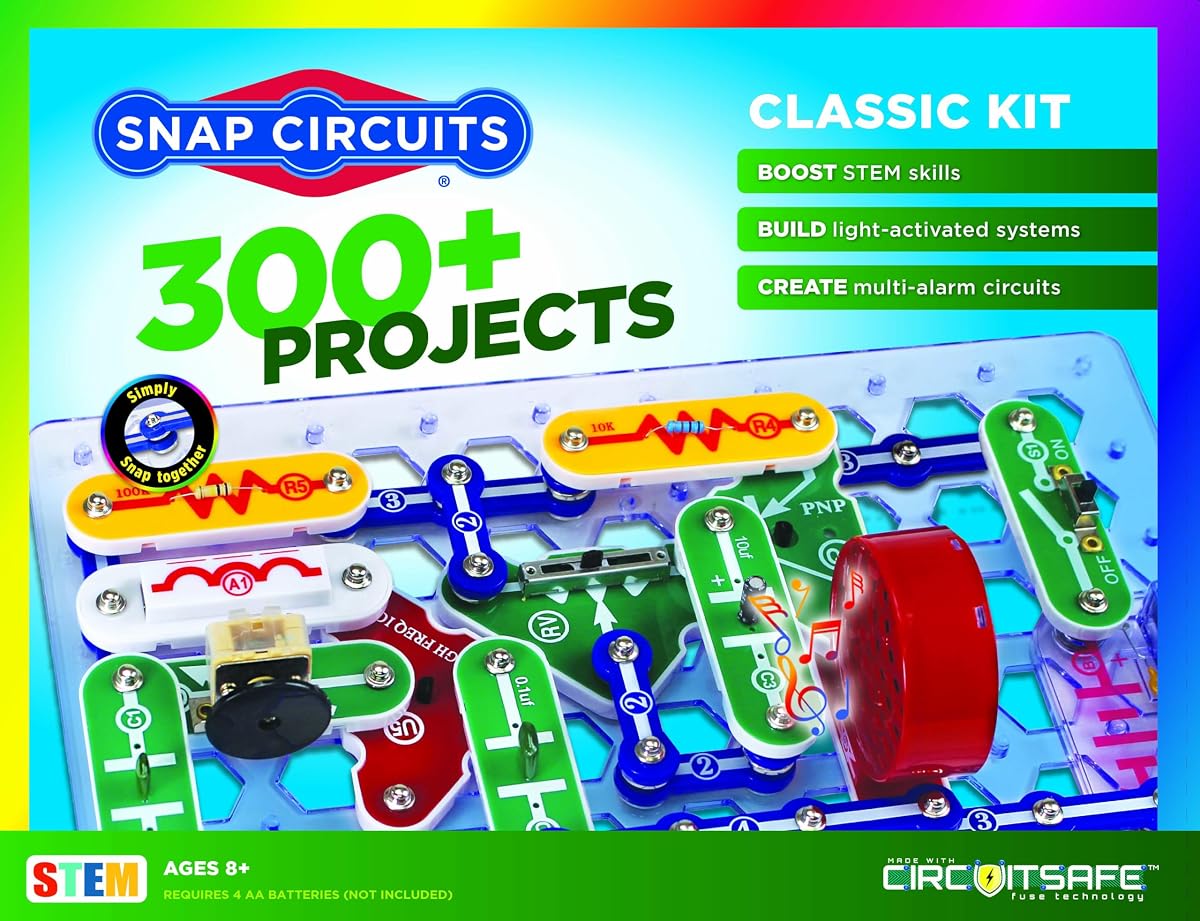
The SNAP CIRCUITS Classic SC-300 is the most balanced general-purpose kit in this guide. It carries a 4.8 rating, supports more than 300 projects, and includes over 60 pieces for children age eight and up. The broad library makes it a strong choice for families wanting one versatile electronics set rather than several narrowly focused toys.
We may earn a commission when you buy through this link, at no additional cost to you.
Its project range is notably practical and entertaining. Builders can construct AM radios, burglar alarms, doorbells, and electronic games, creating different kinds of feedback through sound, motion, and light. The included 60-plus components provide more opportunities for experimentation than the Jr. kit while remaining simpler to use than the Pro and Extreme systems.
Trade-offs include a manual that is less streamlined than the dedicated Beginner kit, and the need for batteries. Children under eight may find some concepts or densely illustrated instructions challenging. However, for the stated age group, the visual building method remains intuitive, and the reward of working through hundreds of ideas offsets those limitations.
The SC-300 suits families seeking the strongest all-around balance, schools that want repeatable STEM activities, and children who enjoy building recognizable gadgets. It is also a natural choice when a child has outgrown a smaller starter kit but does not need a computer interface or advanced measurement tools.
A collection exceeding 300 projects allows children to revisit core concepts in different forms. The same foundational components can be rearranged into sound, light, alarm, radio, and game projects, which helps maintain interest over time.
Radios, doorbells, and burglar alarms provide clear goals and immediate feedback. A child can connect the finished mechanism to a practical idea, making the STEM activity feel more tangible than an abstract exercise.
We may earn a commission when you buy through this link, at no additional cost to you.
The SNAP CIRCUITS Extreme SC-750 is built for children who want to move beyond introductory circuit construction. It has a 4.8 rating, more than 750 experiments, and 80 parts, making it the most extensive kit here in terms of stated activity volume and advanced component access.
We may earn a commission when you buy through this link, at no additional cost to you.
Its appeal comes from both variety and technical depth. Listed parts include a photo resistor, power amplifier, variable capacitor, analog meter, solar cell, and computer interface. The supplied software and PC interface cable allow children to view waveforms and frequencies, connecting physical construction with digital observation in a way the smaller sets do not.
That sophistication creates a meaningful trade-off. A younger or first-time builder may find 750 experiment choices overwhelming, while computer-based activities require compatible hardware and some setup. Children also need more guidance when experimenting with advanced modules. These are not drawbacks for the intended older audience, but they make the kit less streamlined for immediate independent use.
The SC-750 is ideal for an enthusiastic child age eight or older, a learner ready for intermediate electronics, or a classroom seeking advanced STEM and STEAM material. For a premium kit with computer-assisted observation and a broad advanced component set, it is the strongest option in this comparison.
The inclusion of a variable capacitor, analog meter, power amplifier, and other specialized parts gives children more ways to study cause and effect. These parts support deeper experimentation than the switches, lamps, and basic modules found in introductory kits.
The included PC interface and software add a valuable visualization element. Children can view waveforms and frequencies, helping them connect physical behavior with the invisible signals operating inside a working circuit.
We may earn a commission when you buy through this link, at no additional cost to you.
The SNAP CIRCUITSPro SC-500 offers a middle path between the Classic and Extreme kits. With a 4.8 rating, 500-plus projects, and 75 parts, it is a substantial electronics system for children eight and up who want considerable variety without the computer interface found in the Extreme set.
We may earn a commission when you buy through this link, at no additional cost to you.
Its component selection supports recognizable and creative outcomes. Stated project examples include a child-built radio, a voice recorder, and an LED display. These builds provide different sensory rewards and encourage children to move beyond simply lighting a component or activating a switch.
The main drawback is the potential intimidation of a very large project library. Beginners can focus on the instruction book, but they may need adult help understanding which projects best match the available pieces. As with most kits in this range, batteries are also required, and the learning curve is steeper than with the Jr. or Beginner model.
The SC-500 is a good choice for a child who quickly works through basic Snap Circuits sets. Its broad combination of parts, 500-plus project ideas, and engaging output devices makes it especially suitable for sustained weekend building, homeschool activities, and creative electronics play.
A voice recorder and LED display show how different modules can create distinct outcomes. These projects can be especially rewarding because children can record a message or design a display and then understand the circuit responsible for it.
With 75 components, children have more construction options than in the Classic set. The broader collection is useful for experimenting with combinations rather than treating every project as a fixed one-time exercise.
We may earn a commission when you buy through this link, at no additional cost to you.
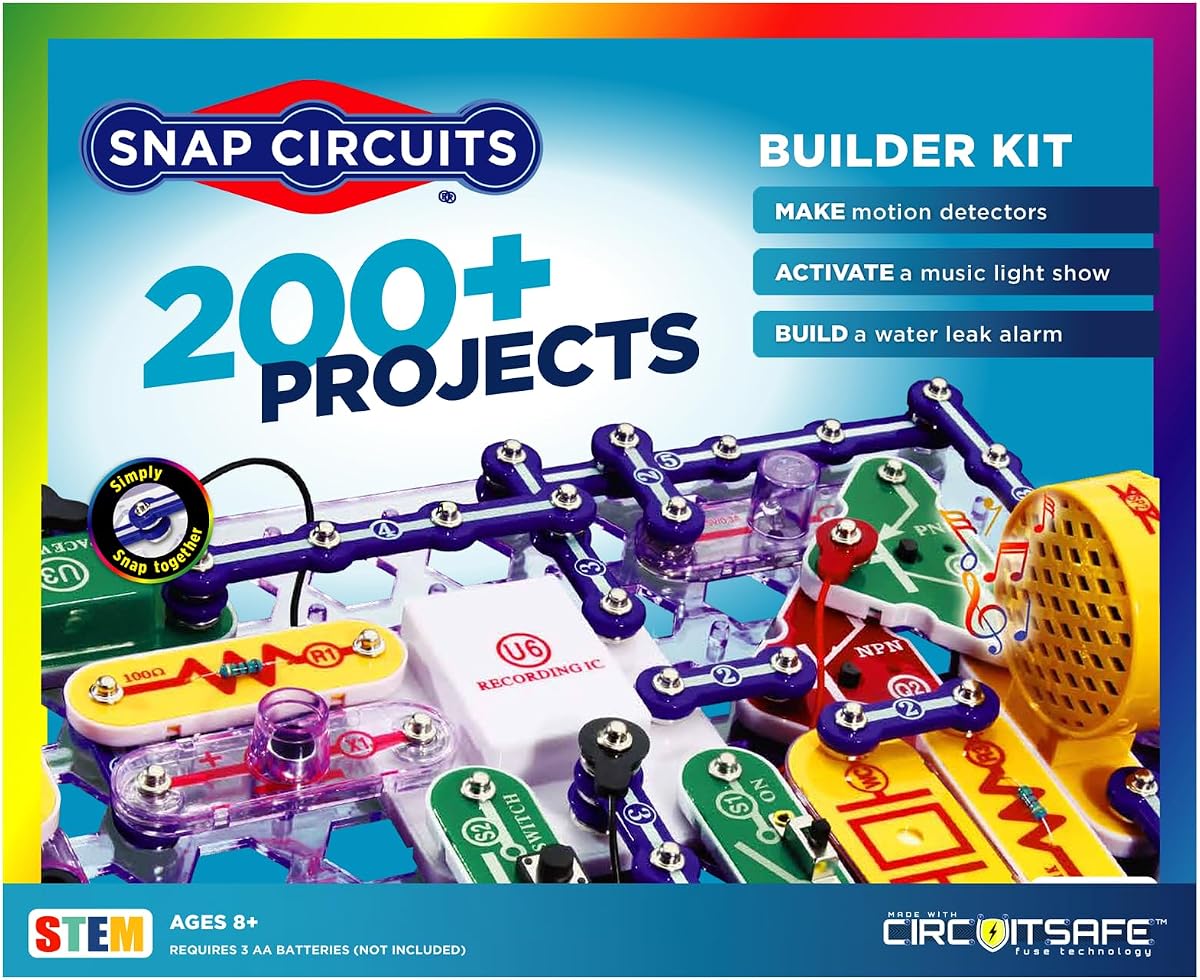
The SNAP CIRCUITS 203 is a compact midrange option for children age eight and up. Its 4.7 rating, 200-plus projects, and 40-plus pieces make it a practical option when the Classic kit's library feels excessive or a younger builder needs fewer components to manage.
We may earn a commission when you buy through this link, at no additional cost to you.
The kit retains the familiar Snap Circuits method, using numbered and color-coded pieces on a plastic grid. Suggested projects include burglar alarms, doorbells, and electronic games, so it covers familiar themes that children can understand while providing enough repetition to remain engaging.
Its most noticeable limitation is depth. With fewer parts and a smaller project count than the Pro, Classic, and Extreme kits, it may not hold the attention of a child who wants advanced measurement, recording, or computer-assisted projects. Conversely, that more contained format can also make it easier for a developing builder to concentrate and finish.
Choose the 203 for a child ready for a meaningful collection of projects but still benefiting from a simpler system than the largest kits. It works especially well for supervised family electronics time, birthday gifts, and children who naturally enjoy alarms, bells, lights, and simple games.
The combination of more than 200 projects and 40-plus components provides a meaningful step up from a beginner set. It is large enough to feel expansive while remaining more approachable than systems with specialized advanced modules.
Alarms, doorbells, and games introduce concepts through sounds that children can immediately recognize. These feedback mechanisms make circuit behavior easier to understand and offer a change of pace from light-based builds.
We may earn a commission when you buy through this link, at no additional cost to you.
The SNAP CIRCUITS Arcade SCA-200 specializes in making circuit building feel like an entertainment system. It has a 4.8 rating, 36 pieces, more than 20 featured games with sounds and lights, and a stated total of over 200 projects for children age eight and up.
We may earn a commission when you buy through this link, at no additional cost to you.
One distinctive activity lets children write a spinning LED message using a circuit they engineer. That feature combines creativity with engineering, while the game-oriented format gives the set a clear identity beyond general electronics instruction. It may be especially attractive to children who naturally connect STEM play with competition, challenges, and interactive entertainment.
The drawback is thematic concentration. A child primarily interested in home automation, radio, or scientific measurement may prefer a general-purpose kit. The listing also notes that batteries are required, adding a small ongoing consideration when deciding whether the kit will be used regularly.
The SCA-200 is a strong fit for kids who want their circuit kit to function like an arcade. It also works well for playing with friends because its game orientation naturally creates shared challenges. For families prioritizing entertainment, lights, sounds, and friendly competition over advanced lab-style experimentation, it is a particularly compelling choice.
The focus on more than 20 games gives children a reason to repeat core concepts in competitive or interactive formats. That structure can make electronics practice feel less like completing a worksheet and more like creating a playable system.
A spinning LED message offers a particularly personal project. Children can combine text, motion, and circuitry, then share the result with family or friends as a visible demonstration of what they built.
We may earn a commission when you buy through this link, at no additional cost to you.
The SNAP CIRCUITS Beginner SCB-20 fills an important gap for younger children. Intended for ages five to nine, it has a 4.7 rating and focuses on simpler projects, child-friendly components, and instructions that use age-appropriate diagrams and language.
We may earn a commission when you buy through this link, at no additional cost to you.
Safety and accessibility are central to the design. The kit includes extra childproofing features alongside its larger components, while the included instruction material uses clear diagrams. Children can complete 21 unique projects that teach how switches and circuits work while practicing problem-solving, troubleshooting, and planning.
Compared with the other sets, 21 projects is a smaller library. The kit also has less thematic and component variety than general-purpose options for older children. That limitation is reasonable for the age group because a focused set can reduce confusion and keep early builders engaged with achievable goals.
The SCB-20 is the most appropriate pick for a child between five and nine who is new to electronics. It also works well for siblings at different stages because the youngest can begin with the Beginner system before moving to age-eight kits. Its emphasis on safe, guided learning makes it an excellent first educational electronics toy.
The colorful manual uses simplified language and diagrams designed for children as young as five. Clear visual steps help young builders follow the sequence and understand the relationship between the pictured arrangement and the working circuit.
Extra childproofing features are a meaningful advantage in a set designed for younger users. Children can explore real working circuits with less concern about small or easily separated component details.
We may earn a commission when you buy through this link, at no additional cost to you.
The SNAP CIRCUITS Light is a specialized kit for children age eight and up who are fascinated by illumination, color, and visual effects. Its 4.8 rating, 175-plus projects, and 55 parts focus on a clear theme instead of offering the broad electronics mix found in general kits.
We may earn a commission when you buy through this link, at no additional cost to you.
Fiber optics stand out as the kit's most distinctive feature. Children can create a light show and connect a smartphone to watch the illumination change with music. Other suggested projects include a strobe light and a color organ controlled by an MP3 player, voice, or finger, creating several ways to interact with sound and light.
The trade-off is that the project library is smaller and narrower than that of the Classic, Pro, or Extreme kits. A child with broad interests may eventually want radios, measurement tools, or more conventional circuit components. The smartphone-related functionality also depends on having a suitable device, although not every listed project requires it.
This kit is a superb fit for a child who loves lights, music, visual art, and dramatic effects. It also works well as a specialized supplement to a general Snap Circuits set. For a focused illumination experience with fiber optics, strobe effects, and interactive projects, it delivers an unusually distinct combination.
Fiber optics produce visually distinctive effects that basic lamps cannot replicate in the same way. A child can explore how light travels through the project and experiment with arrangements that create a personal show.
Connecting a smartphone allows a light project to respond to music, turning the circuit into an interactive experience. The color-organ and strobe ideas also teach how different inputs can change a visible output.
We may earn a commission when you buy through this link, at no additional cost to you.
The SNAP CIRCUITS My Home kit translates basic electronics into practical household themes. Rated 4.8, it is intended for children age eight and up and offers 34 STEM-based projects centered on electric circuits, home security, overhead lights, and an infrared-controlled lighting system.
We may earn a commission when you buy through this link, at no additional cost to you.
Its component list is broad for a themed kit. The package includes a base grid, slide and press switches, vertical, snap, and jumper wires, a battery holder, resistors, capacitor, LEDs, lamp, sound module, transistors, meter, and motor. Detailed instructions help children understand how these different elements work together in a home-like context.
Thirty-four projects is a smaller library than the large general kits, so children seeking hundreds of possible builds may want another Snap Circuits set as well. The kit also requires three AA alkaline batteries, which are sold separately. These are minor practical considerations when compared with its concentrated, practical learning format.
The My Home kit is a strong choice for children who like systems, buildings, lights, and security concepts. It works particularly well for a child interested in how everyday household devices operate. Rather than offering an enormous catalog, it provides a coherent theme with enough components to explore several related forms of home circuitry.
Security systems, door-related circuits, and overhead lighting give the projects an understandable real-world context. Children can relate each build to familiar household mechanisms and then examine the components controlling them.
Resistors, a capacitor, transistors, a meter, motor, sound module, and multiple switch types offer more than basic lights and wires. These components introduce a richer set of relationships between input, control, and output.
We may earn a commission when you buy through this link, at no additional cost to you.
The SNAP CIRCUITS Flight Deck is a compact STEM activity kit centered on flight, launching, motion, and air pressure. It has a 4.5 rating and is intended for children age eight and up, with five unique projects that include paper airplane and flying saucer launchers, ball launching, a spinning wheel, and a levitating-ball demonstration.
We may earn a commission when you buy through this link, at no additional cost to you.
Its five-project structure creates a tightly guided experience. The easy-to-follow directions allow children to work independently and build confidence as they work through each activity. Each project also connects circuitry to a broader scientific idea, such as how electricity operates, why paper airplanes fly, or how air pressure affects aerodynamics.
The limited selection is the clearest drawback. Five projects offer much less variety than the SC-100, the 203, or the larger kits, making this more of a focused activity set than a comprehensive electronics system. Batteries are not included, and the overall rating is also the lowest in this guide, though it remains solidly positive.
The Flight Deck is best for a child who loves aircraft, launchers, motion experiments, or physics demonstrations. It can also serve as a compact introduction to Snap Circuits before moving to a larger collection. For a focused, guided activity with a satisfying visual payoff, it offers a clear and engaging purpose.
Launching a paper airplane, flying saucer, or ball gives children an immediate result to observe. Seeing the mechanism operate helps connect circuit construction with forces, motion, and air pressure in a memorable way.
The directions are designed to be accessible enough for a child to follow without constant intervention. Success with each focused project can build the confidence required for more complicated electronics sets later.
We may earn a commission when you buy through this link, at no additional cost to you.
The right Snap Circuits kit depends on age, interests, and the amount of repeat activity a household wants. These factors help narrow a broad catalog of construction options into a set that is engaging rather than merely impressive on paper.
Most kits in this guide are labeled for ages eight and up, while the Beginner SCB-20 is designed for ages five through nine. Younger children benefit from a larger number of illustrated steps, childproof component features, and simpler language. A child who reads fluently and follows numbered diagrams can usually work with an age-eight set, but adult encouragement remains helpful.
Choose a kit that matches the youngest intended user rather than the oldest child in the household. Age-appropriate instructions reduce frustration and help children complete projects independently.
Project count is an important measure of longevity. The SC-100 offers more than 100 projects, the Classic SC-300 exceeds 300, the Pro SC-500 exceeds 500, and the Extreme SC-750 exceeds 750. Themed sets generally provide fewer: 21 for the Beginner, 175 for Light, 34 for My Home, and five for Flight Deck.
A larger number of projects does not automatically mean a better experience, because some children prefer depth and a clear theme. Prioritize enough ideas to prevent boredom while considering the child’s attention span and interests.
The number and type of components determine the range of experiments a child can perform. Basic kits emphasize switches, lamps, sounds, and motors, while advanced sets add meters, capacitors, transistors, amplifiers, photo resistors, and computer interfaces. The My Home kit also provides a varied technical collection despite its smaller project library.
Look for modules that create distinct outputs and new learning opportunities. More parts can support creativity, but the best components are those a child can understand, combine, and use in projects that remain meaningful.
A child attracted to sound may prefer projects involving alarms, doorbells, radios, or a voice recorder. A future pilot or physics enthusiast may respond better to Flight Deck, while a child fascinated by illumination may enjoy Light. My Home is well suited to young engineers interested in household systems and security.
Themed kits can be more engaging than a larger general collection when the subject matches a strong interest. They may also be less satisfying if the child quickly wants unrelated builds, so consider how long the theme is likely to hold attention.
Snap Circuits uses numbered, color-coded components that connect to a plastic grid. The listed kits require no soldering, and most also require no tools, glue, or separate wire stripping. This reduces setup barriers and makes the kits much easier to use as gifts, classroom activities, or independent play.
Check whether the kit is a complete standalone set. Some advanced combinations may be possible only by adding other Snap Circuits kits, so treating a single purchase as a complete library can lead to disappointment.
The Extreme SC-750 includes software and a PC interface cable that can display waveforms and frequencies. This feature gives older children a closer look at electrical signals and can support a more analytical electronics experience. It also adds setup requirements and makes the kit less convenient for use away from a computer.
Choose a connected set when the child is ready to visualize invisible electrical behavior or when a parent can provide guidance with software. For simple portable building, a non-computer kit is usually simpler.
Batteries are required for many of the full electronics kits, while the Flight Deck explicitly does not include them. The My Home kit requires three AA alkaline batteries, sold separately. The presence of a battery holder does not necessarily mean batteries arrive in the box, so checking the listing and product description can prevent a disappointing first setup.
For regular use, rechargeable batteries may offer a practical alternative when compatible with the holder. Always follow the kit's stated battery guidance and remove batteries during long periods of storage.
The Beginner kit emphasizes age-appropriate diagrams, Flight Deck uses easy-to-follow directions, and most other sets include a colorful instruction book. Instruction design matters because a kit intended for children should make the sequence understandable without requiring constant adult translation. Visual layouts also help children troubleshoot a build when a connection is in the wrong place.
For younger users, begin with one guided project and demonstrate how parts attach to the grid. Once the basic method is clear, children can gradually work through more instructions and create their own variations.
Begin by sorting the components, identifying the base grid, and reading the complete project before placing any pieces. A large instruction image is easier to follow when it is spread across a table. Lay out only the parts needed for the first build, connect them according to the diagram, and confirm that every piece is fully snapped into place before adding power.
Build alongside children without taking over every decision. Ask the child to predict which component will light, sound, or move, then discuss what happened after power is applied. If a project does not work, disconnect the batteries and check connections one at a time. This turns troubleshooting into a useful part of the learning process rather than simply an error to correct.
Store the kit with components organized in the original case or labeled compartments, and keep the instruction book together with the base grid. Remove batteries when a kit will not be used for an extended period. Clean the plastic grid and reusable modules with a lightly damp cloth, avoid liquid near electrical contacts, and replace any damaged or loose component before the next session.
Most of the kits in this guide are intended for children age eight and up, while the Beginner SCB-20 is designed for ages five to nine. Readiness matters as much as the printed age range because children need to follow visual steps and understand basic directions. A younger child can begin with the Beginner kit and graduate to an age-eight set when comfortable.
No. The listed kits use numbered, color-coded components that snap onto a plastic grid without soldering. Most also require no tools, cutting, or glue. This makes them easier for children to use independently and eliminates many of the barriers associated with traditional electronics construction sets.
Batteries are required for many of the kits, but they are not always included. Flight Deck explicitly notes that batteries are not included, while My Home requires three AA alkaline batteries sold separately. Review the current product listing before buying so you know which power supplies to have ready for the first build.
The Extreme SC-750 has the largest stated library in this comparison, with more than 750 experiments. The Pro SC-500 follows with more than 500 projects, while the Classic SC-300 offers more than 300. More projects do not necessarily make every kit preferable, because age fit, component quality, and thematic interest also matter.
The product descriptions for several kits state that they can be combined with other Snap Circuits kits for even more projects. Compatibility should still be confirmed in the current listing, especially when mixing kits with specialized computer-interface components. A broad general-purpose set is often the easiest foundation for future expansion.
The Beginner SCB-20 is specifically designed for children ages five to nine. It uses child-friendly pieces, extra childproofing features, simplified instructions, and 21 unique projects. It is a better fit than a kit with hundreds of denser instructions for a child just beginning to explore circuits.
The Arcade SCA-200 is designed specifically around games, with 20-plus featured games using lights and sounds and a stated total of more than 200 projects. It also includes a spinning LED message activity, making it a strong choice for children who prefer interactive, entertainment-focused circuit building.
The Extreme kit includes software and a PC interface cable for viewing waveforms and frequencies. The computer-related activities are optional parts of the broader experiment library, but they add valuable visualization for children ready to explore electronic signals. A compatible computer and some setup are required for those specific activities.
The SNAP CIRCUITS Jr. SC-100 is the clearest starting point for a child eight or older, offering 100-plus projects without an intimidating component range. The Classic SC-300 stands out as the most versatile all-around option, while the Extreme SC-750 provides the deepest experimentation with advanced modules and PC-based signal viewing.
Prioritize age fit, genuine interest, and the number of children sharing the kit when making a decision. A themed option may be more motivating than a huge general set, while a larger project library can keep an enthusiastic builder engaged for longer. Look for clear instructions, secure snap-together components, and projects that produce feedback the child finds exciting.
Current product details, availability, and prices can change over time, so confirm the listing before purchasing. Check the included components, battery requirements, age guidance, and any computer compatibility details to ensure the chosen kit fits the child's age, interests, and learning environment.