
InnoGear Boom Arm Floor Stand
4.4Editor score
Adjustable 28.1-inch to 89.8-inch height
Rotating 16-inch to 30-inch boom
Detachable straight-stand configuration
A dependable microphone stand keeps your microphone consistently positioned while leaving your hands free to perform, record, stream, or mix. In a home studio, useful features include a stable base, smooth height controls, flexible reach, clean cable routing, and compatibility with the microphone and mounting hardware you already own.
This guide compares ten microphone stands across floor, tripod, desktop, boom-arm, and isolation-shield designs. We evaluated the supplied specifications for height range, adjustment options, construction, stability, portability, cable management, and microphone compatibility, covering options suitable for first-time creators as well as demanding broadcast-style setups.
Each review identifies the product's most useful features, practical limitations, and ideal recording environment. The Top 3 selections represent the strongest combinations of value, professional adjustability, and premium desktop performance, while ratings and specifications reflect the information available in October 2026 and product pricing can change.
4.4Editor score

4.6Editor score

4.7Editor score
As an Amazon Associate we earn from qualifying purchases.
This side-by-side comparison shows how the ten stands differ in format, height range, stability features, adjustability, portability, and acoustic support, helping you identify the right design for your room and recording workflow.




The InnoGear B0C61MKJK5 is a versatile floor stand rated 4.4 out of 5. It combines a tripod base, telescoping vertical pole, and adjustable boom arm, allowing it to serve voice, podcast, streaming, instrument, and performance setups without forcing a narrow room into one fixed microphone position.
We may earn a commission when you buy through this link, at no additional cost to you.
Its strongest quality is the unusually broad height range of 28.1 to 89.8 inches. The 16- to 30-inch boom adds horizontal reach and rotates 360 degrees horizontally and up to 180 degrees vertically. A 4.0-pound tripod and thickened steel poles provide a reassuringly substantial foundation, while the included carrying bag makes the disassembled stand practical to transport.
The detachable boom converts the product into a straight mic stand, which makes it useful for close vocal positioning or users who prefer less visual clutter. Two clip styles and a 3/8-to-5/8-inch adapter cover many common microphones, including dynamic, USB, and side-address models. The trade-offs are its sizable footprint and adjustment system that is focused on function rather than refined studio styling.
This is the strongest budget recommendation for a home studio because it combines unusually versatile adjustment with conversion capability and transportability. Choose it when you want one floor stand that can move between seated, standing, and instrumental recordings. It is especially useful for creators who record in different parts of a room and do not want to maintain separate stands.
The vertical and boom controls let you move the microphone from low seated positions to full standing height. The 360-degree horizontal rotation also helps keep the microphone close to a keyboard, desk edge, or performer without pushing the entire tripod into an awkward place.
Removing the boom and attaching the supplied clip converts the unit into a conventional straight stand. That versatility makes it more useful for untreated rooms where precise proximity may matter more than the reach provided by a boom.
We may earn a commission when you buy through this link, at no additional cost to you.
The InnoGear B08QZD9B5P is a straightforward floor microphone stand rated 4.3 out of 5. Its defining feature is a 4.5-pound weighted round base with a 9.8-inch diameter, providing stable support for singers, presenters, podcasters, and performers who value a modest footprint over an extended boom.
We may earn a commission when you buy through this link, at no additional cost to you.
A clutch adjusts the height from 34 to 60 inches, while the microphone clip rotates 180 degrees for easier angle placement. The thickened 1.5mm steel arm is designed to resist deformation, and non-slip pads under the base improve floor grip. A metal gasket between the base and upright helps reduce unwanted movement.
Its limitation is the lack of an articulated horizontal boom, so positioning depends primarily on moving the entire stand. It also has a more compact height range than some floor models. In exchange, it offers a sturdy vertical format that can be easier to manage around performers and in relatively tight home spaces.
Choose this model when stable upright support and a weighted base matter most. It is a strong fit for vocalists who know their ideal stand height, streamers recording from a fixed area, and users who prefer fewer articulated parts. It also disassembles into three pieces for easier transport between a home studio and another recording location.
The 4.5-pound base provides useful inertia without requiring an extended boom. Non-slip pads help limit sliding, making the stand suitable for users who reposition the microphone frequently while recording or rehearsing.
The user-friendly clutch supports quick height changes across the 34- to 60-inch range. This makes it easy to alternate between seated narration and standing performances without repeatedly dismantling the stand.
We may earn a commission when you buy through this link, at no additional cost to you.
The Hola! Music B00Z9WU2ES earns a 4.7 rating, the highest among the floor stands in this guide. It is a conventional clutch-operated tripod with a telescopic boom, making it a natural choice for singers, presenters, musicians, and home studios that want separate control over standing height and microphone reach.
We may earn a commission when you buy through this link, at no additional cost to you.
The ergonomic center clutch adjusts the upright from 40 to 63 inches. A separate metal telescopic boom extends 4 to 27 inches and has its own clutch for length and angle. Patented leg housing locks the tripod legs when opened without requiring a separate screw, making setup and repositioning less cumbersome.
Cable management is unusually practical for a simple stand. It includes standard US 5/8-27 threading and two clip-on cable holders that keep XLR or other cables from crossing the floor. The lack of a stated maximum microphone weight should be considered for heavy broadcast microphones, although its boom positioning is versatile for ordinary studio and stage equipment.
This stand is worth shortlisting when independent boom adjustment, organized cabling, and straightforward operation are priorities. It also sits within a broader family of stand configurations, including low-profile and one-hand-clutch options, so the design language can suit different performance styles. For a versatile home studio, it offers a balanced mix of reach and convenience.
Separate clutches for the upright and boom let you fine-tune vertical height and horizontal reach independently. That control is useful when the microphone needs to sit close to a performer but far from the base of the stand.
The included holders keep cables elevated and organized around the stand. This reduces tangles and makes a recording area look cleaner, although permanent cable routing still depends on the length and connector requirements of your microphone.
We may earn a commission when you buy through this link, at no additional cost to you.
The BILIONE B0FMF2248P is a weighted floor stand rated 4.4 out of 5. Its compact square base and broad height range make it appealing for home studios where a standard round base could occupy too much space or where the microphone must sit low during seated narration.
We may earn a commission when you buy through this link, at no additional cost to you.
Height adjusts from 22 to 70 inches through a clutch knob, and the microphone clip swivels 180 degrees. A 1.5mm steel arm and 25mm reinforced rod are intended to minimize wobble. The 5.2-pound base uses EVA pads for grip and floor protection, while its square shape is designed to reduce trip hazards around a workstation.
Its dual-thread clips and included 3/8-to-5/8-inch adapter work with many popular USB, dynamic, and side-address microphones. The stand also breaks down into portable parts in under 20 seconds. A storage tray is included for small accessories, though that feature adds visual complexity and may not be necessary for every minimalist studio.
This is a good recommendation for creators who want a low-profile, space-conscious floor stand with a substantial base. It should appeal especially to podcasters and streamers working in compact rooms, while the quick breakdown makes it practical for mobile recording sessions or temporary studio setups.
The compact square base is designed to preserve usable floor area around a desk. Its weighted construction and padded underside provide a stable platform without requiring the broad footprint of a large round stand.
The quick-detach construction is valuable for creators who record in more than one location. Separating the major components makes storage and transport less cumbersome while preserving the broad height adjustment of a floor stand.
We may earn a commission when you buy through this link, at no additional cost to you.
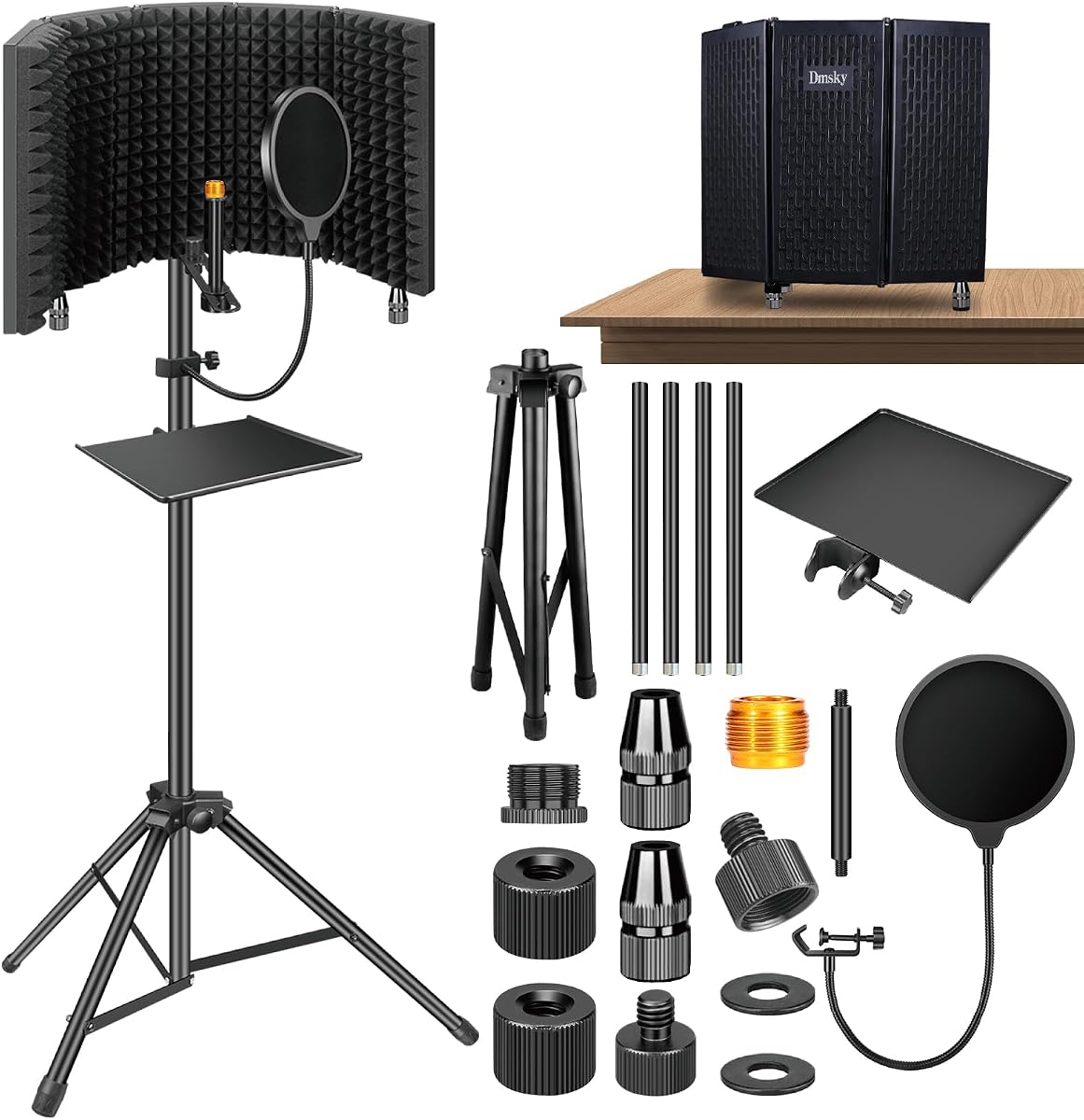
The Dmsky B0BDRLM83F is a microphone isolation shield with a tripod stand, rated 4.6 out of 5. It is designed for creators who need more control over reflections, ambient interference, and vocal plosives than a conventional microphone stand alone can provide.
We may earn a commission when you buy through this link, at no additional cost to you.
Five folding panels use a reflective layer, filter layer, and absorbing layer to help reduce sound-wave bounce and external interference. The panels adjust through 180 degrees, allowing the shield to open for access and close around the microphone as needed. The steel structure includes a 78.7-inch adjustable tube, while the shield itself adjusts from 42 to 71.5 inches.
Installation supports both tabletop use and attachment to a boom arm through the included adjuster. A pop filter and 3/8-to-5/8-inch adapter are included, along with a storage tray for an external sound card or mobile phone. The product ships with upgraded stand tubes, so its appearance may differ from the listing image, although both tube versions are described as steel.
Choose this product if your recording space has noticeable reflections or variable background noise and you want a single setup to address both acoustic control and mic positioning. Its size and folding shield require more room than a plain stand, but the result is a more purpose-built vocal environment for podcasting, streaming, broadcasting, and singing.
The five independently adjustable panels let you shape the reflective and absorptive areas around the microphone. Opening a section gives easy access, while folding it inward can improve isolation during a take.
The included pop filter, mounting adapter, and small storage tray reduce the need for separate accessories. This is convenient for new creators building a compact voice-over, podcast, or live-streaming station.
We may earn a commission when you buy through this link, at no additional cost to you.
The B0DYZCZNRT isolation shield stand is rated 4.4 out of 5 and combines a foldable acoustic screen with a 72.8-inch microphone stand. It targets home studios where reflections, computer fan noise, or nearby household movement can affect a close-miked voice recording.
We may earn a commission when you buy through this link, at no additional cost to you.
The shield uses a sandwich design combining a sound-reflective layer, precision filter layer, and absorption layer. Its front panel pairs high-density foam with lightweight ABS plastic, and the listing specifies 26dB of noise reduction and a dual noise-blocking design that reduces ambient noise by 87 percent. Those figures describe the supplied product claims rather than a universal result for every room.
A weighted triple-leg base helps limit tipping, while the industrial-strength clamp and quick-release adapters support positioning. The package includes a foldable 17.1-inch shield, two universal adapters for 3/8- and 5/8-inch mounts, and an illustrated setup guide. It can serve as a desktop screen or attach to a boom, but a microphone is not included.
This option makes sense for streamers and podcasters who want a focused vocal station without building a full acoustic enclosure. The weighted base and compact desktop use are especially useful in busy rooms. Be sure to confirm the available desk space and account for the separate microphone, shock mount, and any needed desk clamp before purchasing.
The combination of reflective, filtering, and absorptive layers gives the shield more complexity than a single foam panel. Its effectiveness still depends on microphone technique, room construction, and how completely the screen surrounds the sound source.
The weighted triple-leg base reduces movement during long recording sessions. Quick-release adapters also make it easier to shift the microphone or change the shield orientation without repeatedly searching for separate hardware.
We may earn a commission when you buy through this link, at no additional cost to you.
The Amazon Basics B019NY2PKG is a portable boom-arm floor stand rated 4.5 out of 5. It offers a useful balance of reach, folding storage, and adjustable height for home studios, rehearsal spaces, and mobile recording, although its microphone clip must be purchased separately.
We may earn a commission when you buy through this link, at no additional cost to you.
The vertical stand reaches up to 85.75 inches, and the boom can be positioned at standing height for speech and singing or lowered for instrument recording. A molded-plastic counterweight helps balance the extended arm, while a 21-inch tripod base provides the foundation. The steel structure is designed to remain portable rather than permanently installed in a studio.
The main constraints are the two-pound maximum microphone weight and the missing clip. More specialized studio microphones may exceed that limit or come with their own mounting hardware, so compatibility should be checked before purchase. A clip-on cable holder helps route the cord, but it does not replace full cable management.
Choose this model if you want a folding stand that can alternate between boom and straight-stand formats and move easily between locations. It is particularly useful for lighter microphones, karaoke, voice work, and casual podcasting. Buyers with heavier broadcast microphones should first confirm that their microphone and shock mount remain within the stated load limit.
Folding the boom away creates a straight stand for more compact positioning. This makes the product adaptable to different performers and recording angles without requiring a second piece of hardware.
The counterweighted boom helps control the arm while keeping the overall structure light enough to transport. It is a practical format for creators who alternate between a permanent desk area and temporary recording locations.
We may earn a commission when you buy through this link, at no additional cost to you.
The InnoGear B07F82BPLV is a desktop microphone stand rated 4.6 out of 5. It is designed for home offices, streaming desks, compact recording rooms, and temporary voice-over stations where a floor stand would occupy too much space.
We may earn a commission when you buy through this link, at no additional cost to you.
A 5.12-inch metal base weighing 1.85 pounds provides a stable foundation, while four non-slip rubber pads help prevent movement and protect the desk surface. Height adjusts from 8.0 to 12.8 inches through a screw-in knob that is intended to resist loosening. The stand supports microphones and accessories up to 3.3 pounds.
Compatibility is broad for such a compact model. A 3/8-to-5/8-inch adapter supports Blue Yeti, Blue Yeti Pro, Blue Snowball, HyperX QuadCast, SoloCast, Fifine, AT2020, and Razer Seiren X. A second clip with a 1.26-inch maximum diameter supports dynamic models such as the Shure SM58, Shure SM48, Samson Q2U, and Shure PGA48.
This desktop stand is an excellent pick when your microphone is used at a seated desk and needs reliable vertical positioning without a large floor base. The limited height range and absence of a boom limit its use for standing performers, but its portability, stable base, and included adapters make it especially practical for everyday creators.
The weighted round base keeps the microphone planted while remaining small enough for a typical work desk. Rubber pads add grip and reduce the chance of scratching the surface during frequent repositioning.
The screw-in adjustment knob offers more resistance to loosening than a lightweight snap mechanism. Once positioned, the microphone is more likely to remain at the same height through a lengthy recording or streaming session.
We may earn a commission when you buy through this link, at no additional cost to you.
The K&M König & Meyer 21090.500.55 is a professional tripod microphone stand rated 4.6 out of 5. It is made in Germany and is a compelling option for home studio owners who want a conventional, durable floor stand with a telescoping pole and boom arm.
We may earn a commission when you buy through this link, at no additional cost to you.
The supplied information emphasizes world-class construction, a five-year product warranty, and ten-year replacement-parts availability. Its adjustable telescoping upright and two-piece boom offer familiar positioning for vocals, instruments, and general room recording, while the folding tripod base supports transport and storage.
The listing does not provide specific height, weight, or microphone-capacity figures, so buyers seeking exact dimensional limits should verify those details before purchase. That limited published specification also makes it harder to compare this model numerically with the more fully documented InnoGear and BILIONE options. Its clear advantages are build quality, warranty support, and professional orientation.
This stand earns a top-three recommendation for creators who value longevity and professional hardware over a feature-heavy bundled package. It is suitable for a home studio that will use a floor stand regularly, from podcast production and instrument recording to livestream performance. The folding base helps if you also need to take the setup between rooms or locations.
The five-year warranty and long-term replacement-parts availability make this a reassuring choice for a frequently used studio stand. Owning spare components and service options can extend the practical life of the setup.
The folding legs reduce the space needed when the stand is not in use. That makes the tripod easier to store in a home studio and more practical for creators who occasionally record away from their main workspace.
We may earn a commission when you buy through this link, at no additional cost to you.
The RØDE PSA1+ is a professional desktop boom arm rated 4.7 out of 5. It is the premium choice in this guide for podcasters, streamers, voice actors, and home studio owners who want silent microphone movement and precise positioning without a floor stand taking up the room.
We may earn a commission when you buy through this link, at no additional cost to you.
The desk clamp accommodates surfaces up to 70 millimeters thick and supports microphones from 0.25 to 1.2 kilograms, including those installed in shock mounts. Internal spring damping lets the arm move without the creaks or handling noise associated with many conventional articulated arms, a meaningful advantage during live recording.
The arm rotates through 360 degrees for broad reach, while integrated cable management keeps XLR runs hidden along its structure. Both 3/8-inch and 5/8-inch adapters are included. Its limitations are practical but clear: it requires a suitable desk edge, and no floor base is included, making it less useful for standing performers.
Choose the PSA1+ when silent handling, refined cable routing, and repeatable professional positioning matter most. It is especially suitable for seated podcast, streaming, and voice-over work, as well as creators placing a heavier microphone in a shock mount. The premium construction and damping system make it a strong long-term studio investment.
Internal spring damping reduces creaks and contact noise when the arm is moved. This is particularly valuable during live takes, where a conventional hinge might transmit sound directly into the microphone.
The integrated channel helps conceal XLR cabling along the arm, reducing loose loops around the desk. A cleaner cable path also lowers the chance of snagging a cable during an adjustment.
We may earn a commission when you buy through this link, at no additional cost to you.
The right microphone stand depends on your room, microphone, performance style, and need for mobility. Evaluate mounting compatibility, stability, adjustment range, cable handling, and acoustic support before choosing a design.
Begin with the way your microphone is supported. A 3/8-inch thread is common on many compact and USB microphones, while 5/8-inch threading is frequently used for broadcast-style models and shock mounts. Some stands include a removable adapter, but it is safer to confirm both the microphone connection and whether its shock mount has a separate mounting point.
Height determines whether the microphone can serve seated narration, standing vocals, or low instrumental work. Boom reach adds horizontal positioning without moving the base, which helps when the microphone must sit close to a performer but the stand cannot sit directly in front of them. Consider both the maximum and minimum useful positions.
A heavy base, broad leg spread, and non-slip feet help prevent movement and accidental tipping. Stability becomes especially important with heavy broadcast microphones, shock mounts, long booms, and active performers who may brush against the stand. Compact rooms may benefit from a square base that uses less floor space than a wide round base.
Useful controls should move smoothly, provide clear tension, and resist loosening once positioned. A clutch is convenient for frequent height changes, while a screw lock may be more stable for a permanent setup. Articulated booms should move smoothly without bouncing, and vertical microphones should remain fixed without unwanted drift.
Floor stands require enough space for the legs and an unobstructed boom path. Desktop arms save floor area but need a sturdy, accessible edge and a suitable clamp range. Isolation shields create a larger visual and physical footprint, so measure the desk, wall clearance, and cable path before committing to one.
A microphone stand supports the microphone; it does not automatically create a controlled recording environment. Isolation shields can reduce reflections and some ambient interference, but their performance depends on construction, placement, and the room itself. Heavy acoustic treatment, quiet equipment, and good microphone technique may matter more than a bundled screen.
Integrated cable holders, internal channels, and a storage tray can keep a station organized. For XLR microphones, plan a route that avoids the boom arm's moving joints and keeps cables away from foot traffic. USB microphones may need access to their cable connection without putting strain on the stand or adapter.
Permanent studio use can favor a heavier stand, while mobile creators may prioritize quick disassembly, folding legs, and a compact packed size. Check whether the microphone clip, adapters, and boom sections are included in the stated setup. A supplied carrying case or rapid breakdown can be particularly useful for podcasters who record in different rooms.
Assemble the stand on a level surface, tighten each height and boom clutch gradually, and confirm that the microphone or shock mount is securely seated. Position the base before extending the arm, then attach the appropriate 3/8- or 5/8-inch adapter. Check that the microphone points toward the intended sound source and that cables have enough slack to move without pulling.
After setup, test the stand by gently adjusting the arm and observing whether the microphone drifts, dips, or rotates. Mark a satisfactory height and angle once each recording position is established. On desktop models, verify that the clamp contacts a solid desk edge, and on floor models, check that all legs rest fully and the base is not near a walkway.
For maintenance, wipe metal surfaces with a soft, lightly dampened cloth and avoid harsh chemicals that could damage finishes or padding. Retighten loose adjustment knobs gradually, and do not force a control that does not move easily. Store the stand with the boom folded where applicable, protect cables from sharp edges, and consult the product manual for model-specific care instructions.
A compact desktop stand is often the most space-efficient choice for a small room, especially when recording at a seated desk. A low-profile floor stand offers more height flexibility if you alternate between seated and standing sources. Choose based on your available surface area, microphone weight, and need for boom reach rather than room size alone.
No. Compatibility depends on the stand's mounting thread, included adapters, and whether your microphone uses a built-in mount or a separate shock mount. Check the microphone's required thread and compare it with the 3/8-inch or 5/8-inch hardware supplied with the stand before purchasing.
A boom arm is useful when you want to move the microphone close to your mouth, keep it out of the frame, or route cables more neatly. It is not essential to every recording. A stable straight stand can provide consistent positioning if the microphone sits at the correct distance and angle.
Choose a stand with a high enough stated load capacity, a stable base, and a rigid boom or upright. Shock mounts also need to be included in the weight check. The RØDE PSA1+ supports microphones from 0.25 to 1.2 kilograms including shock mounts, while the InnoGear B0C61MKJK5 describes upgraded load-bearing structures without providing a numeric limit.
No. An isolation shield can reduce reflections and some ambient sound around a microphone, but it cannot control every reflection throughout a room. Broadband room treatment, quiet computer fans, sensible microphone placement, and good recording technique remain important for a clean final recording.
Place all tripod legs fully on a level surface, extend them as designed, and avoid positioning the base where it can be bumped. For boom-heavy setups, balance the microphone and shock mount close to the arm's pivot, use a sufficiently weighted base, and keep cables from pulling the microphone off-center.
Choose a straight stand when you need simplicity, a smaller number of moving parts, or a low-profile setup. Choose an articulated boom when you require horizontal reach, frequent angle changes, cable concealment, or easier placement beside a desk. The Amazon Basics model adds further versatility by folding into a straight stand.
Fold or collapse the stand before storage where the design allows it, loosen no more than necessary, and protect the adjustment knobs from impacts. Keep the microphone removed if the manufacturer recommends it, coil cables without sharp bends, and store the stand in a dry place where its legs or clamp cannot be deformed.
The InnoGear B0C61MKJK5 is the most versatile budget choice, combining a wide height range, rotating boom, straight-stand conversion, and carrying bag. The K&M 21090.500.55 stands out for professional construction, German manufacturing, and long-term warranty support, while the RØDE PSA1+ provides premium desktop positioning with silent spring damping and integrated cable management.
Prioritize the details that match your actual recording space: thread compatibility for your microphone, enough stability for its weight, useful height and reach, and room for the base or clamp. Smaller studios may favor a desktop model or compact square base, while untreated rooms may benefit more from isolation features than from additional articulation.
Finally, compare the complete configuration rather than focusing on one headline feature. Confirm whether the microphone clip, adapters, cable accessories, and acoustic shield are included, then check the current product listing for dimensions, load limits, warranty details, and price. Availability, ratings, and prices can change, so review the latest information before making a final purchase.