
DEWALT DCE180B
4.5Editor score
Cordless 20V MAX platform
Automatic and manual modes
Integrated automatic LED
A PVC pipe cutter should make clean, dependable cuts without requiring excessive hand strength or leaving a rough edge inside the pipe. The right tool combines appropriate capacity, a sharp blade, secure pipe positioning, a dependable ratchet mechanism, and a comfortable grip for repeated plumbing or repair work.
This guide compares ten PVC pipe cutters selected for practical differences in cutting capacity, construction, blade accessibility, safety features, and material compatibility. It includes compact ratcheting cutters for smaller pipe, heavy-duty models for larger diameters, and a cordless option for jobs requiring powered cutting.
Each review explains where the cutter is strongest, where its limitations matter, and which user it best suits. Ratings reflect the supplied customer feedback, while specifications and compatibility come from the listed product information. Product availability and pricing can change, so verify current details before purchasing.
4.5Editor score

4.5Editor score
4.4Editor score
As an Amazon Associate we earn from qualifying purchases.
The comparison below places all ten cutters side by side, focusing on capacity, compatible materials, cutting mechanism, portability, and notable safety or convenience features.




The LIBRATON PVC Pipe Cutter is a ratcheting cutter designed to handle pipe and tubing with an outside diameter of up to 2-1/2 inches, or 63 millimeters. Its 4.2 rating reflects generally positive customer feedback, while its defining feature is the quick-change blade system that allows a worn blade to be replaced without additional tools.
We may earn a commission when you buy through this link, at no additional cost to you.
Its body combines a durable aluminum-alloy-steel construction with a thick SK5 blade coated in Teflon. The ratcheting drive, arched cutting geometry, and spring-loaded handle are designed to build force progressively, reducing the amount of hand pressure needed for a cut. Compatible materials include PVC, CPVC, PP-R, PEX, PE, and rubber hose, giving it useful reach beyond ordinary household PVC work.
The trade-off is that the replacement blade is not supplied with the cutter, and blade life varies according to pipe material and job frequency. The product also recommends rotating thin PVC during the cut so the pipe is less likely to fracture. Users must position the pipe perpendicular to the blade and make sure the V-shaped section holds it securely before applying the ratcheting handles.
This is a good choice for plumbers, electricians, vehicle mechanics, and serious home repairers who cut multiple pipe types and value fast blade changes. It is especially attractive when a dedicated, easy-to-service blade system is more useful than carrying a small cutter for only occasional light-duty work.
The tool-free quick-change system is particularly valuable when a blade begins to drag, tear the pipe wall, or produce an uneven edge. Replacing the consumable blade at the first sign of deterioration can help preserve the cutter's ratcheting action and reduce the chance of damaging more expensive pipe.
Compatibility with PVC, CPVC, PP-R, PEX, PE, and rubber hose makes this a broader tool than a PVC-only model. That versatility is useful for repair work that mixes tubing systems, although metal pipe and unsupported diameters remain outside the stated cutting range.
We may earn a commission when you buy through this link, at no additional cost to you.
The Klein Tools 50080 combines a 4.5 rating with the capacity to cut up to 2-inch ID and 2-3/8-inch OD pipe. That places it above many compact ratcheting cutters while keeping the design focused on the PVC, CPVC, and PEX sizes most frequently encountered by homeowners, handymen, plumbers, and electricians.
We may earn a commission when you buy through this link, at no additional cost to you.
The optimized jaw design is intended to hold different pipe sizes securely, while pulling the handles apart retracts the durable ratcheting blade. Soft-molded handles provide a secure, comfortable grip, and the one-handed release improves positioning when the cutter is not in use. Compatibility with Schedule 40 and 80 PVC adds practical flexibility for repair and installation tasks.
The principal limitation is capacity. Although it cuts 2-inch ID pipe and reaches 2-3/8 inches outside diameter, it does not cover the full 2-1/2-inch range offered by several heavier ratcheting models. Replaceable blades are another consideration: having the mechanism is useful, but owners should confirm the availability and correct fit of a replacement before a blade becomes dull.
The 50080 is the strongest all-around recommendation in this guide for users who want established tool-brand familiarity, straightforward one-handed handling, and enough capacity for substantial plastic pipe. It is a particularly good fit for routine service work where 2-1/2-inch capability is unnecessary.
A 2-inch ID and 2-3/8-inch OD rating gives the 50080 more reach than compact 1-1/4-inch and 1-5/8-inch cutters without making it oversized for common residential work. This makes it a versatile middle ground for both individual fittings and longer runs of supported plastic pipe.
One-handed blade retraction makes it easier to open the cutter, position it around the pipe, and begin the cut without repeatedly using both hands. The soft-molded handles also support stable control as the ratchet mechanism builds cutting force.
We may earn a commission when you buy through this link, at no additional cost to you.
The Bates 1-5/8-inch Ratchet Pipe Cutter is built for PVC, CPVC, PP, PEX, PE, rubber hose, and multilayer tubing. Its 4.4 rating indicates strong customer reception, while the smaller stated capacity makes it a practical option for repairs involving narrower pipe rather than large-diameter plumbing lines.
We may earn a commission when you buy through this link, at no additional cost to you.
A manganese-steel body supports durability, and the ratchet mechanism is designed to cut with a series of short, controlled handle squeezes. The triangle-shaped blade edge improves access around the pipe, while the fish-shaped, rubber-textured handle offers a stable grip. A stainless-steel buckle lets the handles collapse and lock together for compact storage.
Capacity is the defining limitation. The product is explicitly not suitable for 2-inch PVC or metal pipes, so it should not be chosen for a project involving larger plumbing stock. Although compatible with many plastic types, users still need to confirm wall thickness and dimensions against their specific installation.
This cutter suits homeowners, handymen, plumbers, electricians, and vehicle mechanics who primarily cut smaller plastic pipe or tubing. It is a sensible pick when portability, compact storage, and straightforward ratcheting operation matter more than the ability to cut the largest pipe in this comparison.
The collapsing handles and security buckle make the cutter easier to organize in a crowded toolbox, van, or maintenance drawer. This portability is especially helpful for technicians who move between jobs and need a cutter that does not remain open or protrude unnecessarily.
Short ratcheting strokes gradually increase the bite on the pipe instead of demanding a single hard squeeze. The pointed blade geometry helps the tool engage the material, which can make repeated cuts more consistent for users who are new to ratcheting cutters.
We may earn a commission when you buy through this link, at no additional cost to you.
The Klein Tools 50063 has a 4.5 rating and is designed for pipe up to 1-1/4 inches. It is one of the more compact options here, making it well suited to repair kits, apartment maintenance boxes, and tool bags where larger cutters would consume unnecessary space.
We may earn a commission when you buy through this link, at no additional cost to you.
The tool cuts Schedule 40 and 80 PVC, CPVC, and PEX. Pulling the handles apart retracts the durable ratcheting blade, and the soft-molded handles offer both comfort and a secure grip. A latch keeps the cutter closed during storage, helping reduce accidental blade exposure and allowing it to sit more neatly among other tools.
Its principal disadvantage is capacity. It cannot handle pipe larger than its stated 1-1/4-inch limit, so users working with 1-1/2-inch, 2-inch, or larger pipe need a different model. The listing also does not mention an included deburring tool, leaving edge-finishing as a separate task.
The 50063 is best for homeowners and maintenance professionals whose work centers on smaller PVC, CPVC, and PEX lines. Its favorable rating, light handling, and secure closure make it a simple choice for frequent access-light repairs where compact storage matters.
A 1-1/4-inch capacity covers many supply-branch and smaller distribution-pipe tasks, while the compact frame keeps the cutter manageable in confined work areas. It is a better fit for precision-oriented repair work than a large, high-capacity model.
The closure latch secures the handles after use. That is a helpful feature for shared toolboxes because it reduces the chance that the blade is open when someone reaches into the bag or handles the cutter without intending to cut.
We may earn a commission when you buy through this link, at no additional cost to you.
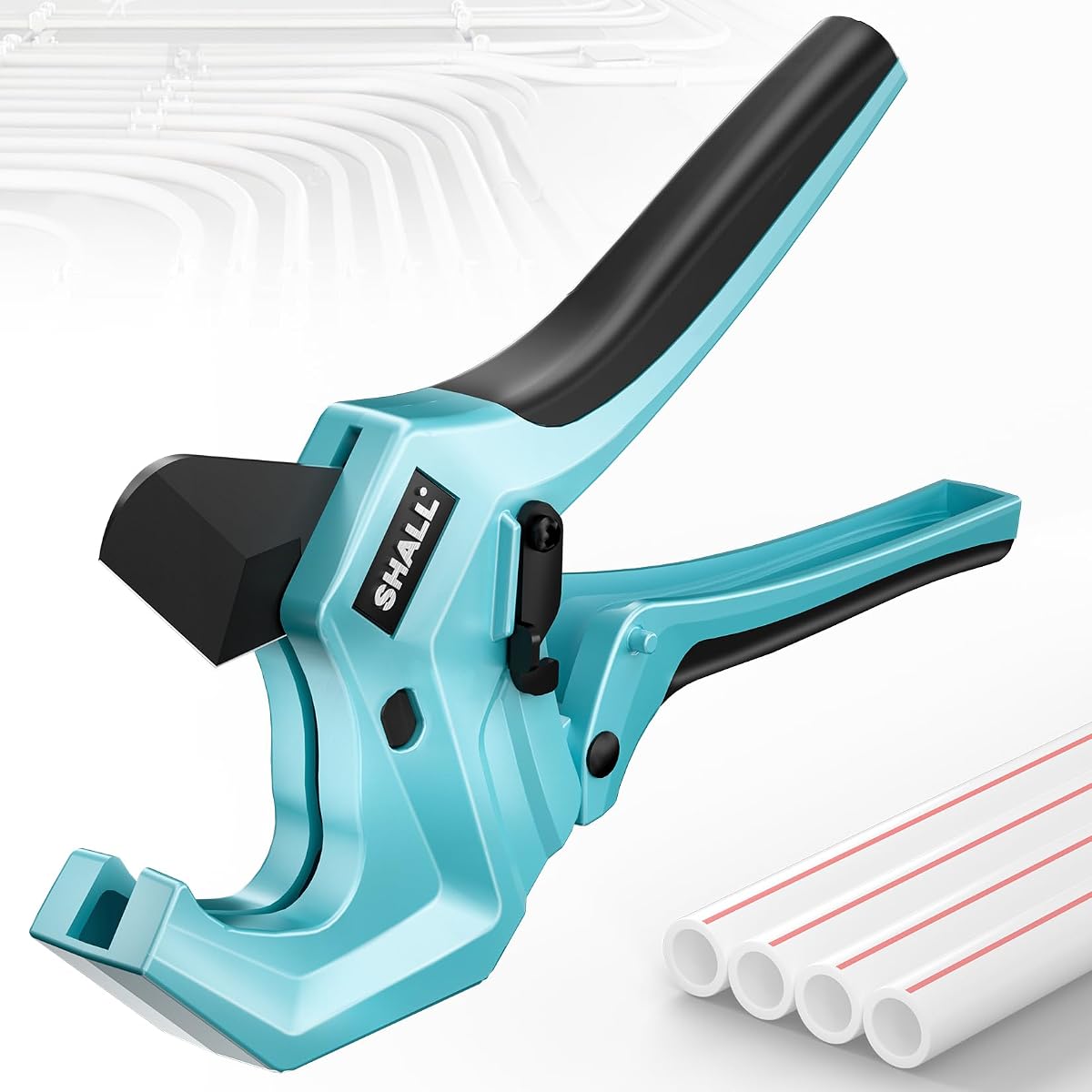
The SHALL PVC Pipe Cutter combines a 4.4 rating with a maximum cutting capacity of 2-1/2 inches. Its strongest selling point is the balance it offers between broad capacity, ratcheting operation, durable construction, and a relatively accessible approach to plastic pipe cutting.
We may earn a commission when you buy through this link, at no additional cost to you.
The body is made from die-cast aluminum, while the wear-resistant SK5 blade has a Teflon coating intended to reduce friction and support smooth penetration. A V-shaped blade edge helps the cutter enter the pipe with less damage. Compatible materials include PVC, PPR, PEX, PE, CPVC, rubber pipes, and plastic hoses.
The ratcheting drive is designed to let the user cut with one hand and reduce the effort needed on hard pipe. Its bi-material ABS-coated handles provide a non-slip grip for longer sessions, and a side safety lock can be engaged with one hand to prevent accidental operation while saving storage space.
This model is a good recommendation for budget-conscious plumbers, electricians, handymen, and homeowners who want more capacity than a small plastic cutter but do not need a powered system. Buyers should verify blade replacement arrangements and confirm that the actual pipe dimensions fall within the stated range before starting a large project.
The ability to handle PVC, PPR, PEX, PE, CPVC, rubber, and plastic hose means one cutter can serve several kinds of repair work. This material flexibility is a major advantage over a tool intended only for standard PVC pipe.
The Teflon-coated SK5 blade and V-shaped cutting edge are designed to enter the pipe efficiently while preserving a neat edge. Paired with the ratchet mechanism, they reduce the amount of force needed compared with many conventional fixed-blade cutters.
We may earn a commission when you buy through this link, at no additional cost to you.
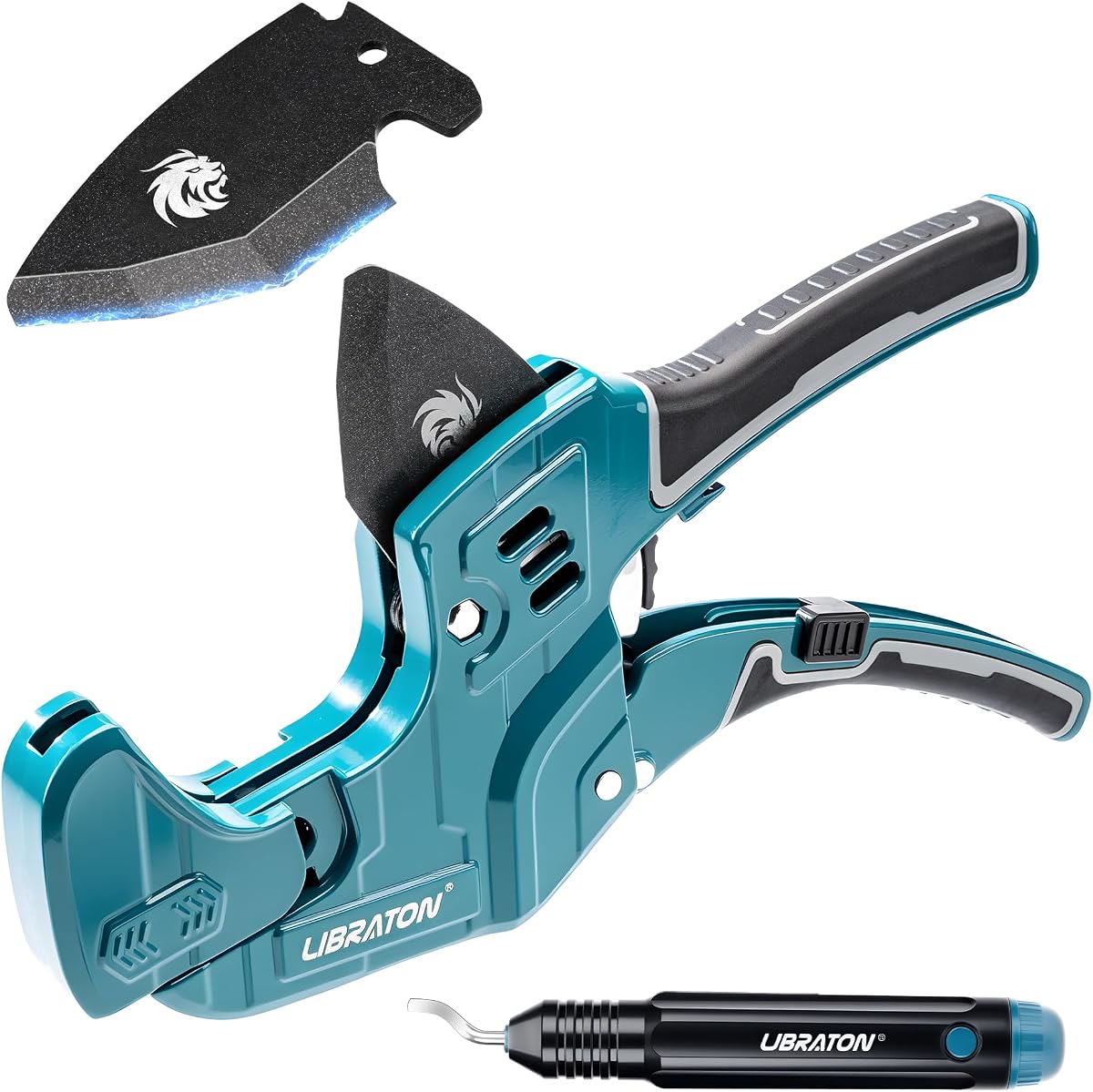
The LIBRATON 2-1/2-inch Ratchet PVC Pipe Cutter stands apart through an adjustable telescoping cutting head with two size ranges. Its 4.4 rating and broad material compatibility make it a versatile selection for users who work with different diameters and want more control than a fixed-position cutter provides.
We may earn a commission when you buy through this link, at no additional cost to you.
The cutting head can be adjusted to match pipe diameter, which is intended to improve stability and support faster, more precise cutting. Its replaceable 3CR13 blade has a protective surface coating intended to improve impact and corrosion resistance. The ratchet mechanism supports one-handed operation, while the V-shaped blade tip promotes faster penetration.
Unlike most cutters in the group, this model includes a deburring tool for smoothing the cut edge. That is a meaningful workflow advantage because a square cut can still leave a small burr that affects fitting insertion or flow. On the other hand, the adjustable mechanism adds more complexity, and users must position and secure the head correctly for each diameter.
The cutter is appropriate for plumbing, drainage, HVAC, and general repair work involving PVC, CPVC, PP-R, PEX, PE, and other plastic pipe. It is especially attractive to users who value a clean edge and frequently alternate between pipe sizes.
The included deburring tool helps remove the rough edge left after cutting. This is useful when preparing a pipe for a fitting because a burr can resist insertion even when the cut itself appears square and complete.
The two adjustable ranges allow the head to accommodate different pipe sizes more closely. Proper adjustment can reduce unwanted movement around the blade and help keep the cutting plane square to the pipe.
We may earn a commission when you buy through this link, at no additional cost to you.
The AIRAJ Ratchet PVC Pipe Cutter is a 2-1/2-inch-capacity model built from manganese steel and aluminum alloy. Its 4.3 rating reflects solid customer feedback, and its combination of broad capacity, one-handed operation, and a locking mechanism makes it practical for technicians who need to carry a capable cutter between jobs.
We may earn a commission when you buy through this link, at no additional cost to you.
The ratchet-driven design locks automatically during cutting, and the blade rebounds after pressure is released to help protect the user. The rubber handle is designed to resist slipping, while the stainless-steel buckle holds the handles firmly together when the cutter is closed. Compatible applications include PVC, CPVC, PPR, PEX, PE, rubber hoses, and multilayer pipe.
Compared with smaller 1-1/4-inch and 1-5/8-inch cutters, this model offers substantially greater reach and requires no interchangeable cutter head. Its construction may also feel bulkier for users who prioritize minimal tool-bag space. The listing does not provide detailed guidance about replacement blade availability or expected blade life.
The AIRAJ is a sensible choice for plumbers, electricians, vehicle mechanics, and home repairers who cut mixed plastic systems. Its automatic locking action and protected rebound add convenience, while the 2-1/2-inch range covers pipe that would be beyond the reach of many compact ratcheting cutters.
The ratchet mechanism is designed to lock as the handles move and maintain consistent engagement through the cut. This supports steady pressure without requiring the user to hold the cutting element manually in position.
Blade rebound and a bottom locking buckle give the tool two ways to remain protected when not in use. The closed configuration is compact enough for a van, workshop drawer, or technician's tool bag.
We may earn a commission when you buy through this link, at no additional cost to you.
The DOMINOX PVC Pipe Cutter has a 4.4 rating and cuts pipe and tubing with an outside diameter of up to 2-1/2 inches. Its SK5 blade, aluminum-alloy construction, and ratchet mechanism are designed to produce smooth cuts across PVC, PEX, PE, PPR, and rubber pipe applications.
We may earn a commission when you buy through this link, at no additional cost to you.
The blade is described as resistant to rusting, bending, and breaking, while the die-cast aluminum handle is enclosed in ABS to remain sturdy and relatively light. Its pointed blade angle helps hold the pipe in place, and the ratchet mechanism applies pressure progressively, reducing the strain associated with conventional manual cutters.
Its most important user-facing detail is the suggested cutting technique. The blade should be tight, the pipe should sit at least 1.5 inches from its end, and the blade should meet the pipe perpendicular to its center. Rotating the pipe slightly during the cut helps produce an even kerf, but getting this sequence right requires more attention than simply squeezing the handles.
The DOMINOX is a good choice for users who cut many pipe sizes and want a lightweight 2-1/2-inch ratcheting tool. Those who expect the tool to correct an angled or poorly positioned pipe automatically should not expect the blade geometry to do that without proper setup.
The pointed blade angle is intended to contact the center of the pipe and help hold it against the cutter. Correct centering improves the likelihood that the cutting plane remains perpendicular to the pipe's axis.
The aluminum and ABS combination provides a sturdier feel than an all-plastic body without making the tool as bulky as many fixed metal pipe cutters. That balance is useful during repair jobs requiring repeated positioning and cutting.
We may earn a commission when you buy through this link, at no additional cost to you.
The DEWALT DCE180B is the only powered entry in this guide and stands apart from the manual ratcheting models. It carries a 4.5 rating and belongs to the 20V MAX cordless platform, making it a premium option for users who value powered cutting, quick repositioning, and reduced physical effort.
We may earn a commission when you buy through this link, at no additional cost to you.
Automatic and manual cutting modes give the operator different ways to approach a cut. Automatic mode is intended to optimize control during demanding work, while manual mode provides a direct option when the user wants to guide the operation manually. An integrated automatic LED illuminates the cutting area, which is particularly useful in cabinets, crawl spaces, and other low-light work environments.
The main purchasing consideration is that this is a bare tool. A battery and charger are not included, so buyers who do not already own a compatible 20V MAX battery need to account for those separate components. The supplied information does not state a maximum pipe diameter, so its capacity should be verified against the manufacturer's current specifications before use.
This cutter is best for frequent users, professional service technicians, or serious home renovators who already use DEWALT's cordless platform. It is less compelling for occasional PVC repairs where a manual cutter would be sufficient, but it offers the most specialized approach among the ten options reviewed.
Automatic operation can reduce the repeated squeezing involved in a manual ratcheting cut. For users cutting many sections during a renovation or service call, the ability to choose between automatic and manual modes offers flexibility for both routine and carefully controlled cuts.
The integrated automatic LED adds useful visibility exactly where pipe installation work often becomes awkward. Users working inside cabinets, utility rooms, or unfinished walls can inspect the blade and pipe position more easily in dim conditions.
We may earn a commission when you buy through this link, at no additional cost to you.
The Klein Tools 50044 has a 4.5 rating and is designed around a clearly stated 1-1/4-inch ID and 1-5/8-inch OD cutting range. That makes it a useful compact option for small-diameter PVC, CPVC, and PEX work where a broader cutter would be unnecessarily large.
We may earn a commission when you buy through this link, at no additional cost to you.
Its spring-loaded button provides faster blade positioning and one-handed retraction, helping the user open the tool, place it around the pipe, and begin work without using both hands. Soft-molded handles offer comfort and a secure grip, while the optimized jaw design is intended to hold various pipe sizes within its supported range.
The trade-off is straightforward: it cannot serve larger plumbing installations. Schedule 40 and 80 compatibility adds versatility, but neither schedule designation expands the cutter beyond its dimensional limits. Users should compare actual ID and OD measurements rather than relying only on nominal pipe names.
The 50044 is a strong pick for homeowners, handymen, plumbers, and electricians who need a lightweight, precise cutter for smaller lines. It is especially useful when easy one-handed positioning is more valuable than extended cutting capacity.
The listing states both 1-1/4-inch ID and 1-5/8-inch OD capacity, giving buyers two useful dimensions to compare against their pipe. Checking both measurements helps avoid the common mistake of assuming that a nominal size always corresponds to the outside diameter printed on the pipe.
The spring-loaded button releases the blade with one hand, allowing the cutter to be opened around a fixed pipe position. This is convenient when the pipe is already supported and difficult to turn or hold with the other hand.
We may earn a commission when you buy through this link, at no additional cost to you.
The right PVC pipe cutter depends on pipe dimensions, material, cutting frequency, portability, and the amount of control needed. Comparing these factors before purchasing helps prevent an undersized or unnecessarily complicated choice.
Choose a cutter comfortably above the largest pipe in your project rather than relying on an exact limit.
Measure both pipe ID and OD before buying.
Confirm every pipe material in the project before choosing a cutter.
Match the tool's approved materials and do not assume metal compatibility.
Choose ratcheting operation for portable, low-maintenance cutting.
Consider a powered model for frequent high-volume work.
Prioritize a sharp, replaceable, or quickly changed blade.
Treat the blade as a consumable part of the tool.
Look for blade geometry that promotes a clean, square cut.
Check whether a deburring accessory is included or needed.
Choose a grip that feels secure in wet or sweaty conditions.
Favor textured or soft-molded handles for extended work.
Prefer a cutter that locks securely when stored.
Check the blade position before placing it in a tool bag.
Weigh special features against how often you will use them.
For occasional work, simplicity may be more valuable than automation.
Measure the pipe and confirm that its material, inside diameter, and outside diameter fall within the cutter's approved range. Support the pipe securely on a stable surface, allowing enough room on both sides of the cut. A pipe that rolls or flexes while under the blade can produce a crushed, angled, or incomplete cut.
Open and position the cutter according to its instructions, then make sure the cutting blade is square to the pipe. Several models recommend keeping the pipe perpendicular to the blade and rotating it slightly as the cut progresses. This technique helps distribute the force around the circumference and can prevent thin PVC from breaking. Advance the ratchet steadily or select the appropriate powered mode rather than forcing the handles.
After cutting, inspect the end for a square opening and remove any burr with a suitable deburring tool. Lock or retract the blade before storage. Clean away plastic residue with the tool maker's recommended method, keep the blade dry, and replace it when it begins to drag, chip, or leave a torn edge.
Choose a cutter whose maximum capacity comfortably exceeds the outside diameter of the largest pipe in the project. Compact models often handle smaller lines, while cutters reaching 2 inches or 2-1/2 inches cover more residential supply, drain, and DWV applications. Check both inside and outside dimensions because nominal pipe sizes do not always match the dimensions stated by a cutter.
Many of the listed ratcheting cutters are designed for PVC, CPVC, and PEX, and several also support PP-R, PE, rubber hose, or multilayer tubing. Compatibility depends on the individual model, so confirm the product description before cutting. Also consider wall thickness, pipe condition, and whether the cutter's capacity covers the actual diameter.
An uneven cut often results from a loose pipe, an incorrectly positioned cutter, a dull blade, or excess force applied in one direction. Support the pipe firmly and keep it perpendicular to the blade. Rotate the pipe slightly as the cut advances, and replace a damaged blade rather than forcing the cutter through the remaining wall.
The ratchet mechanism is designed to build cutting force through repeated handle squeezes rather than one very hard pull. That generally reduces wrist and hand strain compared with conventional manual cutters. Force still varies with pipe material, wall thickness, blade sharpness, and tool alignment, so proper setup remains important.
No. The listed products are intended for plastic pipe, plastic tubing, and, in some cases, rubber hose. The Bates model explicitly states that it is not suitable for metal pipe, and the other listings do not claim metal-cutting capability. A separate metal pipe cutter is required for copper, steel, or other rigid metallic pipe.
Replace the blade when it no longer cuts cleanly, pulls the pipe toward one side, leaves a heavily torn edge, or requires noticeably more force. Blades are consumable components that wear with use and may deteriorate faster when cutting hard or abrasive material. Always use a compatible replacement and follow the manufacturer's installation instructions.
For occasional repair work, a manual ratcheting cutter is usually simpler and avoids the need for separate battery and charger components. A powered cutter becomes more attractive for frequent service, renovation, or production work where automatic operation and rapid repositioning can save time. The DEWALT DCE180B is also most practical for users already invested in the 20V MAX platform.
Retract or close the blade, engage the safety lock or handle latch if the tool has one, and store it in a dry toolbox or drawer. Do not leave an open cutter beneath loose tools. Inspect the blade before use because a damaged blade can tear pipe and create sharp fragments.
The Klein Tools 50080 is the strongest general recommendation because its 4.5 rating, 2-inch ID capacity, one-handed blade retraction, and compatibility with common PVC, CPVC, and PEX pipe combine versatility with straightforward handling. For the broadest manual capacity, the SHALL and LIBRATON 2-1/2-inch models offer additional reach, while the dual-range LIBRATON adds adjustability and a deburring accessory.
Prioritize capacity that fits the actual pipe, compatibility with every material involved, and a cutting mechanism that suits the frequency of the job. Compact Klein tools are useful for smaller lines, ratcheting models are dependable general choices, and the DEWALT DCE180B makes sense for frequent users who want powered operation and already use compatible 20V MAX batteries.
Before purchasing, verify the current manufacturer specifications, replacement-blade availability, and included accessories. Product specifications, ratings, availability, and pricing can change, so checking the current listing helps ensure that the selected cutter still matches the dimensions and materials of the project.